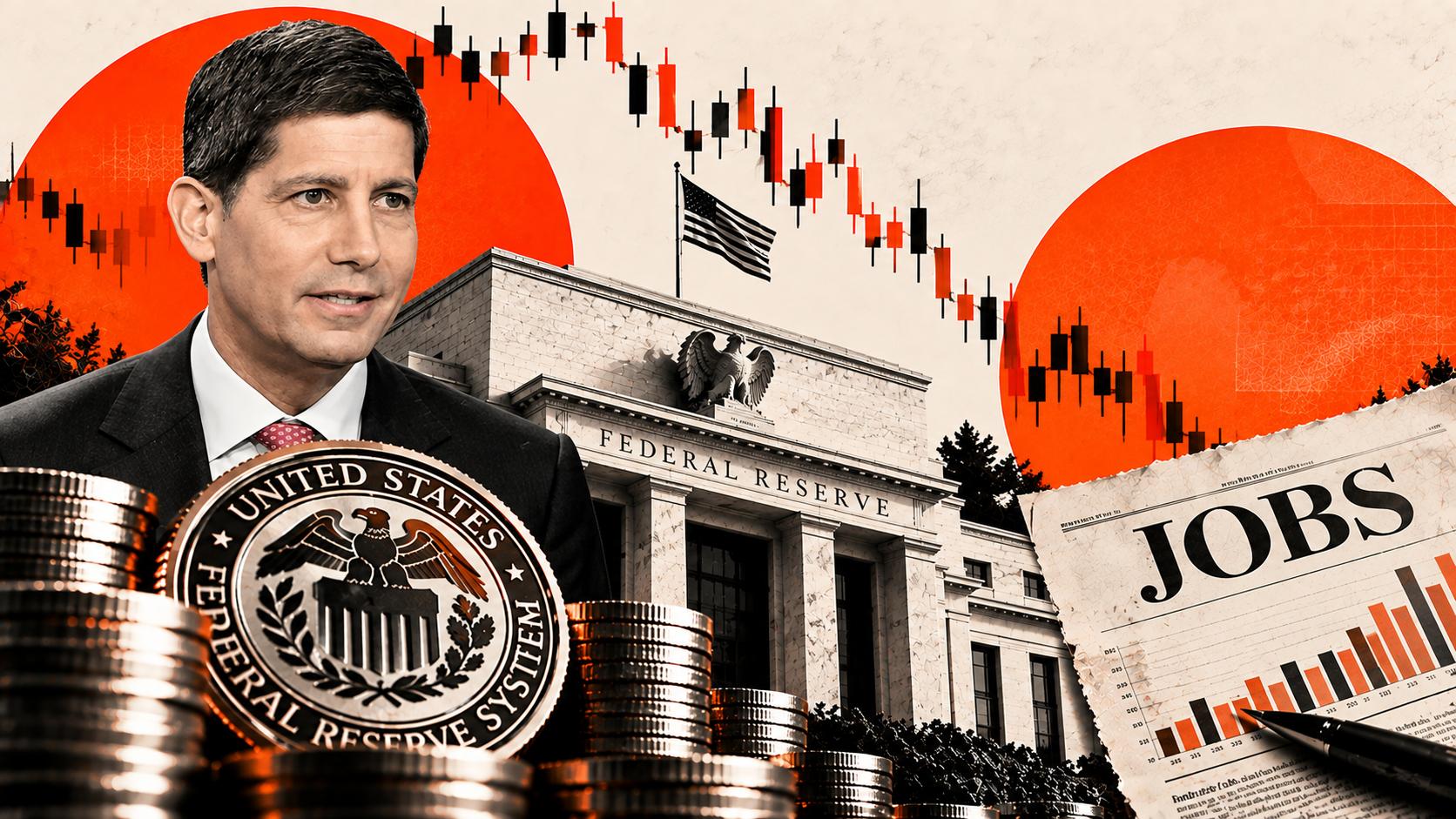
Dow Jones futures climb as cooling economic data lower Fed rate hike odds
- Dow Jones futures rise as CME Fed Watch tool shows September odds dropping to 53% following weak US labor data.
- Wall Street ended mixed Thursday as tech stock volatility ahead of the holiday countered fading interest rate anxieties.
- Traders question if excessive optimism surrounding artificial intelligence has overinflated current stock market valuations.

The Dow Jones futures gain 0.24% to trade above 53,300, while S&P 500 futures rise 0.46%, trading near 7,560. Meanwhile, Nasdaq 100 futures advance 1.0% to trade near 29,850 during European trading hours on Friday.
Wall Street delivered a mixed performance on Thursday as pre-holiday tech volatility overshadowed easing interest rate worries. While the Dow Jones surged 1.03%, the S&P 500 finished flat, and the Nasdaq 100 slid 0.8%. The tech decline was led by chipmakers, which dropped for a second consecutive session as investors questioned whether artificial intelligence optimism had overinflated market valuations.
US index futures gain as a disappointing set of domestic labor data was released on Thursday, easing Fed rate hike bets. CME FedWatch tool indicates that financial markets are now pricing in a 53% chance of a September interest rate hike, down sharply from the 66% priced in right before the release.
US labor market forces Wall Street to aggressively rethink its interest rate outlook. The primary catalyst for this shift was the June Nonfarm Payrolls (NFP) report released on Thursday. The US economy added just 57,000 jobs last month, completely missing the market consensus of 110,000. While the headline unemployment rate managed an unexpected tick downward to 4.2% from May's 4.3%, the severe hiring slowdown heavily signals a cooling broader economy.
Warsh rejects forward guidance as Fed refocuses on price stability in AI era
Fed Chair Warsh delivered a moderately hawkish message, with a 5.6/10 FXS SpeechTracker score indicating a cautious but not extreme stance relative to the historical average. The refusal to provide forward guidance, coupled with a renewed emphasis on price stability and a clear warning that anyone expecting comfort with inflation above 2% will be disappointed, underscores a bias toward keeping policy tight even as Warsh highlights steady labor markets and solid supply-side conditions. Warsh’s framing of Artificial Intelligence as a key structural force—where the United States is likely to be a big winner but where the inflationary impact is explicitly a central bank decision—signals a willingness to “chart a new course” in policy strategy without committing to a pre-set path.
The FXS Fed Sentiment Index was unchanged, rising by 0.00 points to a still-elevated level of 123.64, confirming that the overall Fed tone remains firmly in hawkish territory despite the absence of fresh tightening signals. This stable but high reading, alongside a mid-range FXS SpeechTracker score, suggests markets see Warsh’s remarks as reinforcing an existing hawkish bias rather than marking a new escalation in policy rhetoric.
Dow Jones FAQs
The Dow Jones Industrial Average, one of the oldest stock market indices in the world, is compiled of the 30 most traded stocks in the US. The index is price-weighted rather than weighted by capitalization. It is calculated by summing the prices of the constituent stocks and dividing them by a factor, currently 0.152. The index was founded by Charles Dow, who also founded the Wall Street Journal. In later years it has been criticized for not being broadly representative enough because it only tracks 30 conglomerates, unlike broader indices such as the S&P 500.
Many different factors drive the Dow Jones Industrial Average (DJIA). The aggregate performance of the component companies revealed in quarterly company earnings reports is the main one. US and global macroeconomic data also contributes as it impacts on investor sentiment. The level of interest rates, set by the Federal Reserve (Fed), also influences the DJIA as it affects the cost of credit, on which many corporations are heavily reliant. Therefore, inflation can be a major driver as well as other metrics which impact the Fed decisions.
Dow Theory is a method for identifying the primary trend of the stock market developed by Charles Dow. A key step is to compare the direction of the Dow Jones Industrial Average (DJIA) and the Dow Jones Transportation Average (DJTA) and only follow trends where both are moving in the same direction. Volume is a confirmatory criteria. The theory uses elements of peak and trough analysis. Dow’s theory posits three trend phases: accumulation, when smart money starts buying or selling; public participation, when the wider public joins in; and distribution, when the smart money exits.
There are a number of ways to trade the DJIA. One is to use ETFs which allow investors to trade the DJIA as a single security, rather than having to buy shares in all 30 constituent companies. A leading example is the SPDR Dow Jones Industrial Average ETF (DIA). DJIA futures contracts enable traders to speculate on the future value of the index and Options provide the right, but not the obligation, to buy or sell the index at a predetermined price in the future. Mutual funds enable investors to buy a share of a diversified portfolio of DJIA stocks thus providing exposure to the overall index.
Author

Akhtar Faruqui
FXStreet
Akhtar Faruqui is a Forex Analyst based in New Delhi, India. With a keen eye for market trends and a passion for dissecting complex financial dynamics, he is dedicated to delivering accurate and insightful Forex news and analysis.