British Pound holds weekly gains as Fed hike doubts deepen
- Weak NFP revisions shift Fed hike expectations toward October.
- UK Services PMI contraction keeps Sterling’s recovery fragile.
- BoE speeches and Fed minutes guide next policy repricing.

The British Pound (GBP) steadies against the US Dollar (USD) on Friday, but it is poised to end the week with gains of over 1% as investors turn skeptical that the Federal Reserve (Fed) will raise interest rates at its September meeting. At the time of writing, the GBP/USD pair is consolidating around 1.3350, unchanged for the day.
GBP/USD steadies as traders push Fed hike bets beyond September
The US labor market remains solid despite June’s Nonfarm Payrolls print, which missed estimates and was downwardly revised for April and May, indicating that -74K jobs were created in those two months. Traders reacted to the headline and now see a rate hike in October rather than September.
The new Fed Chair, Kevin Warsh, although he failed to provide forward guidance, reiterated the Fed’s commitment to tackle inflation. Next week, the FOMC’s minutes will be keenly scrutinized by traders, who are looking for the next US inflation report, expected on July 14.
Besides the minutes, the ISM Services PMI will provide clues about the state of inflation and employment. Initial Jobless Claims for the week ending July 4 are expected to rise from 215K to 219K.
In the UK, uncertainty about politics has failed to underpin Sterling, which is now near levels last seen in mid-June, below the crucial 200-day Simple Moving Average (SMA) at 1.3399.
Even though Andy Burnham reaffirmed his commitment to the current fiscal rules, investors seem cautious. Meanwhile, The Independent reported that he is considering an income tax break to help young people onto the property ladder.
Data-wise, the UK S&P Global Services PMI in June deteriorated further, from 49.3 to 48.8, due to a decline in New Orders, which fell for the fourth consecutive month. The report showed that companies cited persistent cost pressures and consumer constraints.
Next week, the UK docket will feature speeches by Bank of England officials and the release of the Financial Stability Report.
Fed and BoE interest rate expectations
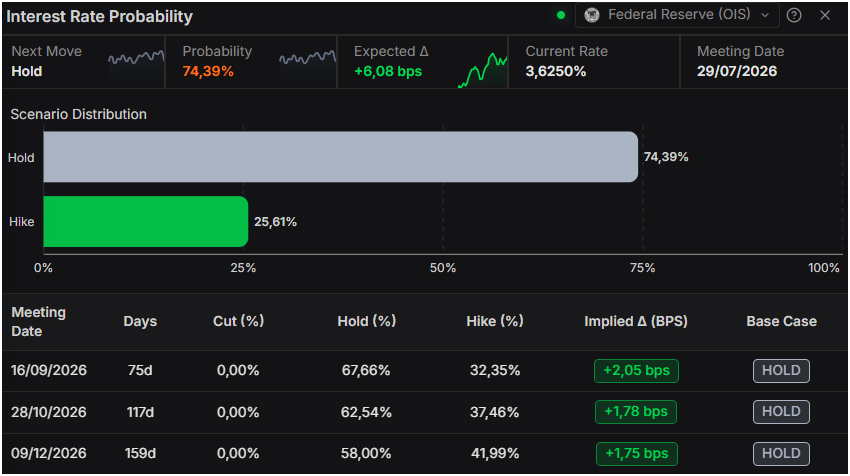
Money markets show a lower chance that the Federal Reserve will raise rates in 2026, with odds at 46%, according to Prime Terminal data.
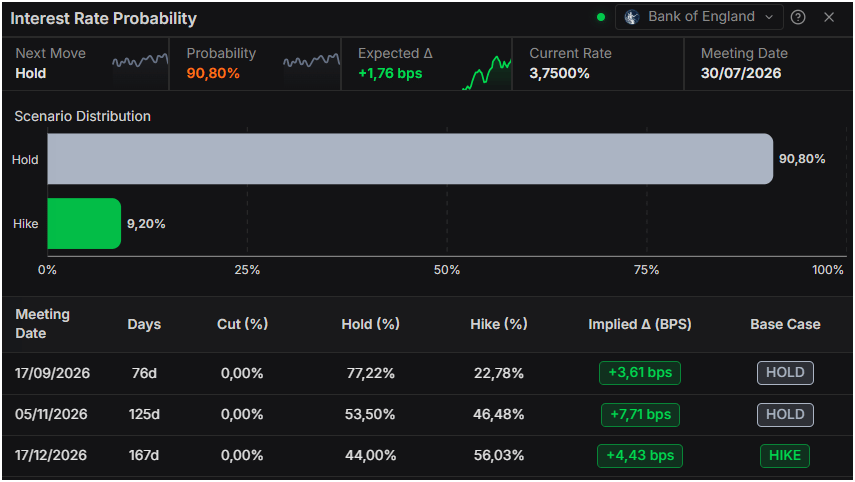
Meanwhile, futures imply a 70% chance of a Bank of England rate hike by the end of 2026.
GBP/USD Price Forecast: Technical outlook
In the daily chart, GBP/USD trades at 1.3354, holding below a key simple moving average (SMA) cluster now converging near 1.3409, which keeps the pair capped in the near term. Price sits under this overhead SMA resistance and the broader downward resistance trend line projected from around 1.3520, leaving the recent rebound looking more like a corrective bounce within a still constrained structure. The Relative Strength Index (14) at about 53 suggests mildly improving momentum, but not enough to offset the weight of these overhead levels.
On the topside, immediate resistance is seen at the SMA zone around 1.3409, with a subsequent barrier at the descending resistance trend line near 1.3520, where prior rallies have repeatedly stalled. On the downside, structural support is aligned with the longer-term upward support trend line originating near 1.3159, and a sustained break below that region would open the door to a deeper pullback despite the currently modestly positive momentum backdrop.
(The technical analysis of this story was written with the help of an AI tool.)
(This story was corrected on July 3 at 16:44 GMT to say that money markets show a lower chance that the Fed will raise rates in 2026 instead of the Fed is not expected to raise rates this year.)
Pound Sterling FAQs
The Pound Sterling (GBP) is the oldest currency in the world (886 AD) and the official currency of the United Kingdom. It is the fourth most traded unit for foreign exchange (FX) in the world, accounting for 12% of all transactions, averaging $630 billion a day, according to 2022 data. Its key trading pairs are GBP/USD, also known as ‘Cable’, which accounts for 11% of FX, GBP/JPY, or the ‘Dragon’ as it is known by traders (3%), and EUR/GBP (2%). The Pound Sterling is issued by the Bank of England (BoE).
The single most important factor influencing the value of the Pound Sterling is monetary policy decided by the Bank of England. The BoE bases its decisions on whether it has achieved its primary goal of “price stability” – a steady inflation rate of around 2%. Its primary tool for achieving this is the adjustment of interest rates. When inflation is too high, the BoE will try to rein it in by raising interest rates, making it more expensive for people and businesses to access credit. This is generally positive for GBP, as higher interest rates make the UK a more attractive place for global investors to park their money. When inflation falls too low it is a sign economic growth is slowing. In this scenario, the BoE will consider lowering interest rates to cheapen credit so businesses will borrow more to invest in growth-generating projects.
Data releases gauge the health of the economy and can impact the value of the Pound Sterling. Indicators such as GDP, Manufacturing and Services PMIs, and employment can all influence the direction of the GBP. A strong economy is good for Sterling. Not only does it attract more foreign investment but it may encourage the BoE to put up interest rates, which will directly strengthen GBP. Otherwise, if economic data is weak, the Pound Sterling is likely to fall.
Another significant data release for the Pound Sterling is the Trade Balance. This indicator measures the difference between what a country earns from its exports and what it spends on imports over a given period. If a country produces highly sought-after exports, its currency will benefit purely from the extra demand created from foreign buyers seeking to purchase these goods. Therefore, a positive net Trade Balance strengthens a currency and vice versa for a negative balance.
Author

Christian Borjon Valencia
FXStreet
Markets analyst, news editor, and trading instructor with over 14 years of experience across FX, commodities, US equity indices, and global macro markets.

















