Australia’s Unemployment Rate jumps to 4.5% in July, vs 4.4% expected

Australia’s Unemployment Rate climbed to 4.5% in July from 4.4% in June, according to the official data released by the Australian Bureau of Statistics (ABS) on Thursday. The figure came in above the market consensus of 4.4%.
Furthermore, the Australian Employment Change arrived at -15.8K in July from a rise of 80.2K in June (revised from 76.3K), compared with the consensus forecast of a 15K increase.
The participation rate in Australia decreased to 66.9% in July from 67% in June. Meanwhile, Full-Time Employment increased by 16.3K in the same period from a growth of 48.9K in the previous reading (revised from 29.3K). The Part-Time Employment declined by 32.2K in July versus a rise of 47K prior.
Sean Crick, ABS head of labour statistics, said with the key highlights noted below
The majority of the fall in employment came from males, which fell by 11,000 people. There were 10,000 fewer males employed part-time, and 1,000 fewer in full-time employment in July.
Female employment recorded a smaller fall of 5,000, with females employed part-time falling by 22,000 but full-time rising by 17,000.
There were 12 million less hours worked this month, with those employed full-time working 7 million less hours, and those employed part-time working 5 million less hours.
Market reaction to the Australia’s employment data
The Australian Dollar (AUD) attracts some sellers following the employment data. At the time of writing, the AUD/USD pair is trading 0.26% lower on the day to trade at 0.7106.
Australian Dollar Price This week
The table below shows the percentage change of Australian Dollar (AUD) against listed major currencies this week. Australian Dollar was the weakest against the Swiss Franc.
| USD | EUR | GBP | JPY | CAD | AUD | NZD | CHF | |
|---|---|---|---|---|---|---|---|---|
| USD | -0.99% | -0.61% | -0.57% | -0.54% | -0.36% | -0.85% | -1.62% | |
| EUR | 0.99% | 0.53% | 0.43% | 0.49% | 0.59% | 0.14% | -0.63% | |
| GBP | 0.61% | -0.53% | -0.02% | -0.08% | 0.05% | -0.38% | -1.21% | |
| JPY | 0.57% | -0.43% | 0.02% | 0.03% | 0.15% | -0.29% | -1.09% | |
| CAD | 0.54% | -0.49% | 0.08% | -0.03% | 0.13% | -0.32% | -1.13% | |
| AUD | 0.36% | -0.59% | -0.05% | -0.15% | -0.13% | -0.44% | -1.26% | |
| NZD | 0.85% | -0.14% | 0.38% | 0.29% | 0.32% | 0.44% | -0.83% | |
| CHF | 1.62% | 0.63% | 1.21% | 1.09% | 1.13% | 1.26% | 0.83% |
The heat map shows percentage changes of major currencies against each other. The base currency is picked from the left column, while the quote currency is picked from the top row. For example, if you pick the Australian Dollar from the left column and move along the horizontal line to the US Dollar, the percentage change displayed in the box will represent AUD (base)/USD (quote).
This section below was published at 21:30 GMT on Wednesday as a preview of the Australia Employment report
- The Australian Unemployment Rate is forecast to hold steady at 4.4% in July.
- Australia is expected to have added 15K jobs in the month, fewer than the 76.3K gained in June.
- AUD/USD gains upward momentum ahead of the Australian employment report.
Australia will release the July monthly employment report on Thursday at 01:30 GMT. Ahead of the announcement, analysts anticipate a modest 15K increase in job creation, while the Unemployment Rate is expected to remain steady at 4.4%. The Australian Bureau of Statistics (ABS) report is also expected to show that the Participation Rate stood at 66.9% in the month following the 67% recorded in the previous month.
ABS separately reports full-time and part-time positions through the monthly Employment Change. Generally speaking, full-time jobs entail working 38 hours or more per week, usually include additional benefits, and typically provide a consistent income. On the other hand, part-time employment generally means higher hourly rates but lacks consistency and benefits. That’s why the economy prefers full-time jobs. In June, Australia added 47K part-time positions and a modest 29.3K full-time ones.
Australian unemployment rate seen steady in July
The soft anticipated figures could have a near-term negative impact on the Australian Dollar (AUD), although market attention remains elsewhere: the Middle East.
While Australian employment data can shape future Reserve Bank of Australia (RBA) monetary policy decisions, policymakers are clearly focusing on inflation. At the August meeting, the Board decided to keep the Official Cash Rate (OCR) unchanged at 4.35%, as expected.
“While the impact of the Middle East conflict on inflation has so far been less than expected, headline inflation is still too high. Trimmed mean inflation also remains elevated and is little changed from the March quarter. Oil and most related commodity prices remain higher than they were prior to the Middle East conflict,” the RBA’s August statement reads.
Inflation risks are tilted to the upside, while “labour market conditions have eased by a little more than expected in recent months. Labour market leading indicators point to only limited easing in the near term,” the statement adds, suggesting that the anticipated soft outcome will be considered encouraging by the RBA rather than a new point of concern.
Regarding the United States (US)-Iran war, there’s not much new going on, and that’s actually concerning. Both sides refrain from launching fresh attacks on the other, yet negotiations to end the conflict seem utopian at this point. Each side's demands are a line the other side will not cross. As a result, Oil prices are slowly but steadily rising, which ultimately exacerbates and confirms inflation-related concerns.
Back to the Australian employment data release, and as previously mentioned, the anticipated figures are expected to have a negative, yet temporary impact. A much better-than-anticipated outcome could spur some near-term AUD demand, yet whether the currency could sustain such gains will depend on risk-related sentiment and US Dollar (USD) weakness or strength.
When will the Australian employment report be released and how could it affect AUD/USD?
The ABS July employment report will be released early on Thursday. As previously noted, the Australian economy is expected to have added 15K new jobs in the month, while the Unemployment Rate is forecast at 4.4%. Market participants will also be attentive to the breakdown of full-time and part-time positions.
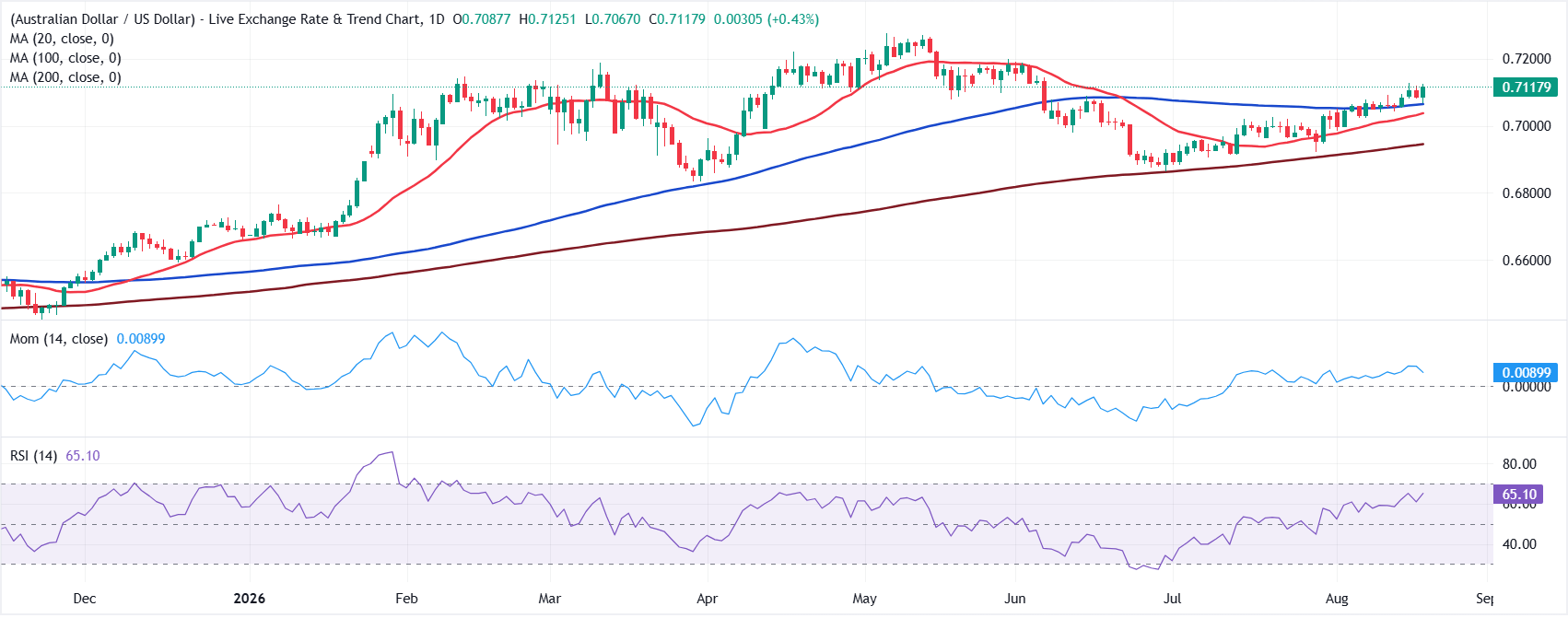
Valeria Bednarik, Chief Analyst at FXStreet, notes: “The AUD/USD pair trades around the 0.7100 mark amid broad USD weakness, not far below the August peak at 0.7129. Technically, the pair is bullish, with the daily chart showing buyers aligned around the 100-day Simple Moving Average (SMA) at around 0.7060. The 20-day SMA meanwhile advances below the longer one, signaling increased buying interest. Finally, technical indicators in the same chart remain within positive levels, although lacking clear directional strength.”
Bednarik adds: “ As long as the pair holds above the mentioned 0.7060 region, the bullish stance will remain in place regardless of intraday movements. Below the level, however, the retracement can extend towards the 0.7030 price zone before buying interest shows signs. Immediate near-term resistance is located at 0.7030, while additional gains could see AUD/USD reaching 0.7070 before some selling interest appears.”
RBA FAQs
The Reserve Bank of Australia (RBA) sets interest rates and manages monetary policy for Australia. Decisions are made by a board of governors at 11 meetings a year and ad hoc emergency meetings as required. The RBA’s primary mandate is to maintain price stability, which means an inflation rate of 2-3%, but also “..to contribute to the stability of the currency, full employment, and the economic prosperity and welfare of the Australian people.” Its main tool for achieving this is by raising or lowering interest rates. Relatively high interest rates will strengthen the Australian Dollar (AUD) and vice versa. Other RBA tools include quantitative easing and tightening.
While inflation had always traditionally been thought of as a negative factor for currencies since it lowers the value of money in general, the opposite has actually been the case in modern times with the relaxation of cross-border capital controls. Moderately higher inflation now tends to lead central banks to put up their interest rates, which in turn has the effect of attracting more capital inflows from global investors seeking a lucrative place to keep their money. This increases demand for the local currency, which in the case of Australia is the Aussie Dollar.
Macroeconomic data gauges the health of an economy and can have an impact on the value of its currency. Investors prefer to invest their capital in economies that are safe and growing rather than precarious and shrinking. Greater capital inflows increase the aggregate demand and value of the domestic currency. Classic indicators, such as GDP, Manufacturing and Services PMIs, employment, and consumer sentiment surveys can influence AUD. A strong economy may encourage the Reserve Bank of Australia to put up interest rates, also supporting AUD.
Quantitative Easing (QE) is a tool used in extreme situations when lowering interest rates is not enough to restore the flow of credit in the economy. QE is the process by which the Reserve Bank of Australia (RBA) prints Australian Dollars (AUD) for the purpose of buying assets – usually government or corporate bonds – from financial institutions, thereby providing them with much-needed liquidity. QE usually results in a weaker AUD.
Quantitative tightening (QT) is the reverse of QE. It is undertaken after QE when an economic recovery is underway and inflation starts rising. Whilst in QE the Reserve Bank of Australia (RBA) purchases government and corporate bonds from financial institutions to provide them with liquidity, in QT the RBA stops buying more assets, and stops reinvesting the principal maturing on the bonds it already holds. It would be positive (or bullish) for the Australian Dollar.
Economic Indicator
Employment Change s.a.
The Employment Change released by the Australian Bureau of Statistics is a measure of the change in the number of employed people in Australia. The statistic is adjusted to remove the influence of seasonal trends. Generally speaking, a rise in Employment Change has positive implications for consumer spending, stimulates economic growth, and is bullish for the Australian Dollar (AUD). A low reading, on the other hand, is seen as bearish.
Read more.Next release: Thu Aug 20, 2026 01:30
Frequency: Monthly
Consensus: 15K
Previous: 76.3K
Source: Australian Bureau of Statistics
Author

FXStreet Team
FXStreet
Composed of a group of economic journalists and FX experts, the FXStreet content team produces and oversees all content published on FXStreet. It provides a purely journalistic approach to the Forex market.

















