Australia’s CPI inflation jumps to 4.9% YoY in October, beats 4.8% expected


Australia’s Consumer Price Index (CPI) climbed by 4.9% year-over-year (YoY) in October, compared to a 4.3% growth reported in September, the latest data published by the Australian Bureau of Statistics (ABS) showed on Wednesday.
The market forecast was a 4.8% print for the reported period.
The monthly Consumer Price Index rose by 0.5% in October, compared to the previous reading of a rise of 0.8%.
Meanwhile, the Trimmed Mean CPI increased 0.5% MoM in October. Annually, the Trimmed Mean CPI advanced 3.8% YoY during the same period.
AUD/USD reaction to Australia's Consumer Price Index data
The Australian Dollar (AUD) attracts some buyers following Australia's CPI report. The AUD/USD pair is up 0.23% on the day to trade at 0.6657 at the press time.
Australian Dollar Price This week
The table below shows the percentage change of Australian Dollar (AUD) against listed major currencies this week. Australian Dollar was the strongest against the Japanese Yen.
| USD | EUR | GBP | JPY | CAD | AUD | NZD | CHF | |
|---|---|---|---|---|---|---|---|---|
| USD | 0.09% | -0.16% | 0.45% | -0.52% | -0.45% | -0.12% | -0.41% | |
| EUR | -0.09% | -0.25% | 0.38% | -0.60% | -0.55% | -0.20% | -0.49% | |
| GBP | 0.16% | 0.25% | 0.29% | -0.35% | -0.31% | 0.05% | -0.25% | |
| JPY | -0.45% | -0.38% | -0.29% | -0.97% | -0.82% | -0.59% | -0.99% | |
| CAD | 0.52% | 0.60% | 0.35% | 0.97% | 0.11% | 0.40% | 0.11% | |
| AUD | 0.45% | 0.55% | 0.31% | 0.82% | -0.11% | 0.36% | 0.06% | |
| NZD | 0.12% | 0.20% | -0.05% | 0.59% | -0.40% | -0.36% | -0.29% | |
| CHF | 0.41% | 0.49% | 0.25% | 0.99% | -0.11% | -0.06% | 0.29% |
The heat map shows percentage changes of major currencies against each other. The base currency is picked from the left column, while the quote currency is picked from the top row. For example, if you pick the Australian Dollar from the left column and move along the horizontal line to the US Dollar, the percentage change displayed in the box will represent AUD (base)/USD (quote).
This section below was published on November 24 at 20:30 GMT on Tuesday as a preview of Australia’s CPI inflation report.
- Australian Consumer Price Index is expected to have accelerated at the fastest annual pace in the last three years in October.
- Hot inflation pressures coupled with growing signs of economic slowdown are likely to pose a challenge for the Reserve Bank of Australia.
- The Australian Dollar is set for its sharpest monthly decline in years in November.
The Australian Bureau of Statistics (ABS) will publish October’s Consumer Price Index (CPI) on Wednesday at 00:30 GMT. The market consensus anticipates a sharp acceleration in consumer prices to a 4.8% year-over-year rate, which is the fastest level since the 4.9% seen in October 2023.
The report comes with the Australian Dollar (AUD) immersed in a sharp sell-off against the US Dollar (USD). The AUD/USD pair has depreciated nearly 6% in November, as investors ramp up bets on a steeper monetary tightening cycle by the US Federal Reserve (Fed), while the Reserve Bank of Australia (RBA) is seen done with hikes and set to cut rates at least once in 2027.
What to expect from Australia’s inflation rate data?
Against this background, Wednesday’s CPI report might pose a headache for RBA policymakers. The central bank’s main goal is to keep inflation steady in the 2% to 3% range, and the expected 4.8% CPI would add pressure to tighten borrowing costs further, as the economic consequences of the five rate hikes delivered in 2026 start to arise.
Macroeconomic data released in previous weeks revealed that the Unemployment Rate rose to 4.9% in October, and that net employment fell by nearly 80K over the last two months, highlighting a fast deterioration of the labour market.
Beyond that, services and manufacturing activity contracted at their fastest pace in years in November, according to preliminary S&P Global Purchasing Managers' Index (PMI) data released earlier this week, altogether pointing out to weak Gross Domestic Product (GDP) growth in the last quarter of the year
Strategists at Rabobank argue that Australia now offers a “salient case study” of the risks associated with delayed action on inflation. They note that the RBA’s policy rate is “now 50bps above its peak during the Covid-19 inflation wave,” which they suggest may vindicate Fed Governor Lisa Cook’s warning that “failure to do enough to tackle inflation in the short term may necessitate a harsher response in the future.”
That said, Rabobank experts warn that the jobless rate is “now above the RBA’s estimate of the non-accelerating inflation rate of unemployment (NAIRU) and perilously close to triggering the Sahm Rule recession indicator,” underscoring mounting concerns that policy may be tipping from restrictive into overtight territory.
The RBA anticipated in its last monetary policy statement that inflation risks will remain skewed to the upside in the coming months, while “tighter monetary policy is expected to keep GDP growth below potential”. With this in mind, a strong inflation reading would only raise concerns about stagflation – an economic environment characterized by high consumer prices, declining growth, and rising unemployment – potentially putting additional pressure on the Aussie.
How could Australia’s Consumer Price Index report affect AUD/USD?
As previously mentioned, high inflation figures are likely to pose a serious challenge for RBA policymakers while, in this case, softer-than-expected CPI figures might be welcomed as a relief and provide limited support to the Aussie. And it will be limited because the reasons for the Australian Dollar’s sharp decline are not exclusively domestic.
The US Dollar has surged across the board over the last few weeks, boosted by bets of Fed monetary tightening, a trend that looks unlikely to reverse as long as US macroeconomic data keeps fuelling economic exceptionalism rhetoric.
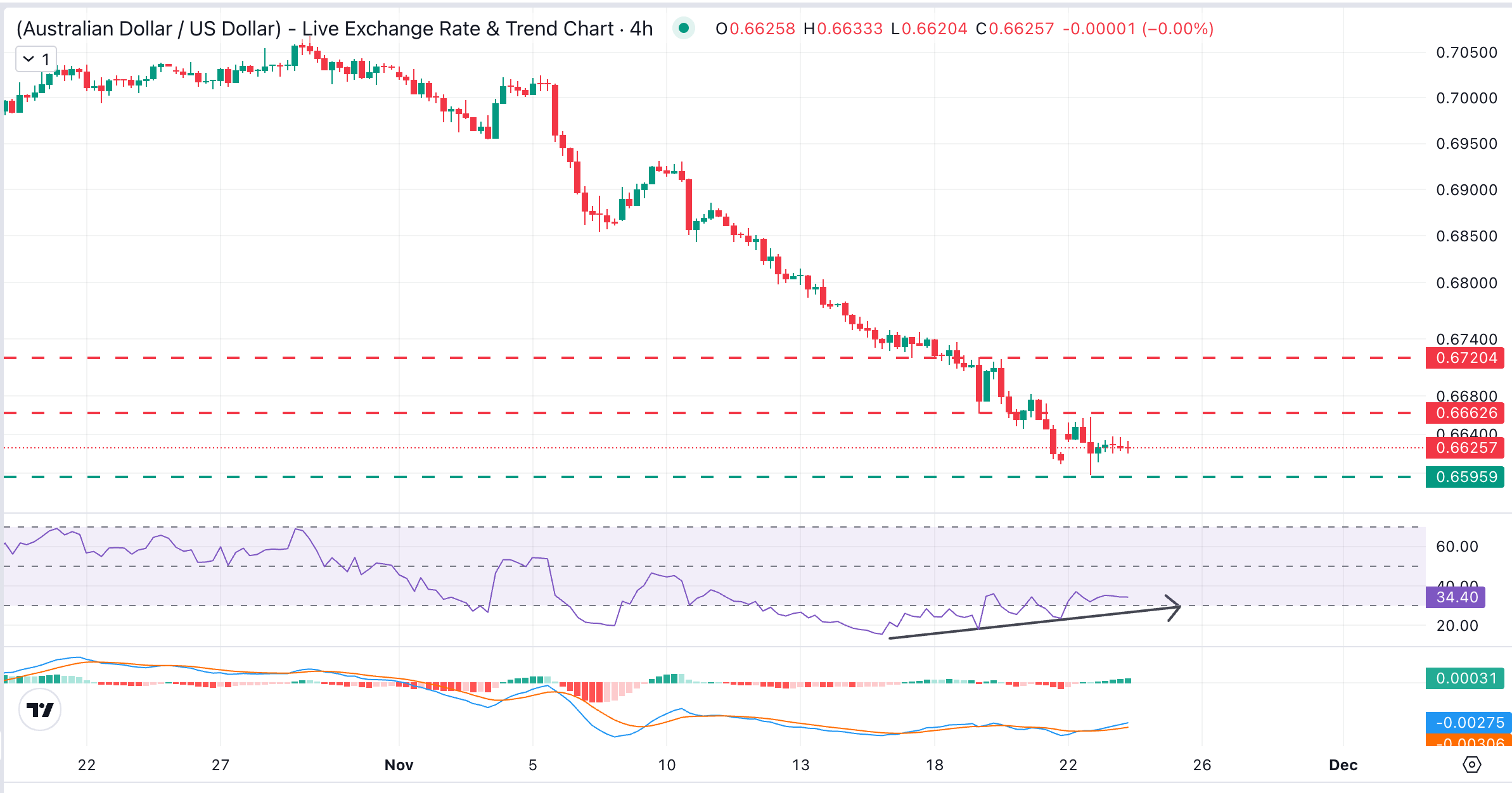
From a technical perspective, the AUD/USD shows an intense bearish trend, says Guillermo Alcalá, Forex analyst at FXStreet. “The pair has lost nearly 6% in November and 8.5% from September’s highs and is not showing any sign of an immediate trend reversal, except for the bullish divergence in the 4-hour Relative Strength Index (RSI)”, according to Alcalá.
Momentum indicators are mixed, with the RSI just above the oversold area, while the Moving Average Convergence Divergence (MACD) histogram has popped up above zero. Alcalá, however, observes that bulls “need solid reasons to gain the necessary confidence to break resistances at Monday’s high near 0.6560 and the November 19 high at 0.6720 before raising expectations of any significant recovery.
On the downside, the area below 0.6600 is holding bears for now. If this level finally gives way, Alcalá points out to the 0.6500 psychological level and the November 2025 lows near 0.6420 as the next bearish targets.
RBA FAQs
The Reserve Bank of Australia (RBA) sets interest rates and manages monetary policy for Australia. Decisions are made by a board of governors at 11 meetings a year and ad hoc emergency meetings as required. The RBA’s primary mandate is to maintain price stability, which means an inflation rate of 2-3%, but also “..to contribute to the stability of the currency, full employment, and the economic prosperity and welfare of the Australian people.” Its main tool for achieving this is by raising or lowering interest rates. Relatively high interest rates will strengthen the Australian Dollar (AUD) and vice versa. Other RBA tools include quantitative easing and tightening.
While inflation had always traditionally been thought of as a negative factor for currencies since it lowers the value of money in general, the opposite has actually been the case in modern times with the relaxation of cross-border capital controls. Moderately higher inflation now tends to lead central banks to put up their interest rates, which in turn has the effect of attracting more capital inflows from global investors seeking a lucrative place to keep their money. This increases demand for the local currency, which in the case of Australia is the Aussie Dollar.
Macroeconomic data gauges the health of an economy and can have an impact on the value of its currency. Investors prefer to invest their capital in economies that are safe and growing rather than precarious and shrinking. Greater capital inflows increase the aggregate demand and value of the domestic currency. Classic indicators, such as GDP, Manufacturing and Services PMIs, employment, and consumer sentiment surveys can influence AUD. A strong economy may encourage the Reserve Bank of Australia to put up interest rates, also supporting AUD.
Quantitative Easing (QE) is a tool used in extreme situations when lowering interest rates is not enough to restore the flow of credit in the economy. QE is the process by which the Reserve Bank of Australia (RBA) prints Australian Dollars (AUD) for the purpose of buying assets – usually government or corporate bonds – from financial institutions, thereby providing them with much-needed liquidity. QE usually results in a weaker AUD.
Quantitative tightening (QT) is the reverse of QE. It is undertaken after QE when an economic recovery is underway and inflation starts rising. Whilst in QE the Reserve Bank of Australia (RBA) purchases government and corporate bonds from financial institutions to provide them with liquidity, in QT the RBA stops buying more assets, and stops reinvesting the principal maturing on the bonds it already holds. It would be positive (or bullish) for the Australian Dollar.
Economic Indicator
Consumer Price Index (YoY)
The Consumer Price Index (CPI), released by the Australian Bureau of Statistics on a monthly basis, measures the changes in the price of a comprehensive basket of goods and services acquired by household consumers. The indicator is the primary measure of headline inflation after a new methodology was applied to transition from quarterly to monthly readings, applying to data from April 2024 onwards. The YoY reading compares prices in the reference month to the same month a year earlier. A high reading is seen as bullish for the Australian Dollar (AUD), while a low reading is seen as bearish.
Read more.Next release: Wed Jan 06, 2027 00:30
Frequency: Monthly
Consensus: -
Previous: -
Source: Australian Bureau of Statistics
Author
FXStreet Team
FXStreet
Composed of a group of economic journalists and FX experts, the FXStreet content team produces and oversees all content published on FXStreet. It provides a purely journalistic approach to the Forex market.