Blockchain: 5G’s Secret Weapon

Longtime readers know that my brother, sister and I attended the University of Washington.
This made me a lifetime UW football fan; I'm still a season-ticket holder. I’ve seen my team win … and I’ve seen them lose. And UW was handed many losses thanks to two-time All-American Keyshawn Johnson of USC.
Now retired, Johnson was one of the fastest players during his NFL days. That’s why I was especially interested when he recently ran in one of the most unusual races I have ever seen in my life.
What was so unique? He ran a 40-yard race against Verizon's (VZ) new 5G network.
The race was to see whether Johnson could run 40 yards in less than the time it would take Verizon to download an entire, hour-long episode of HBO’s "Hard Knocks."
The point of the race was to show the world how fast the new 5G network is going to be …
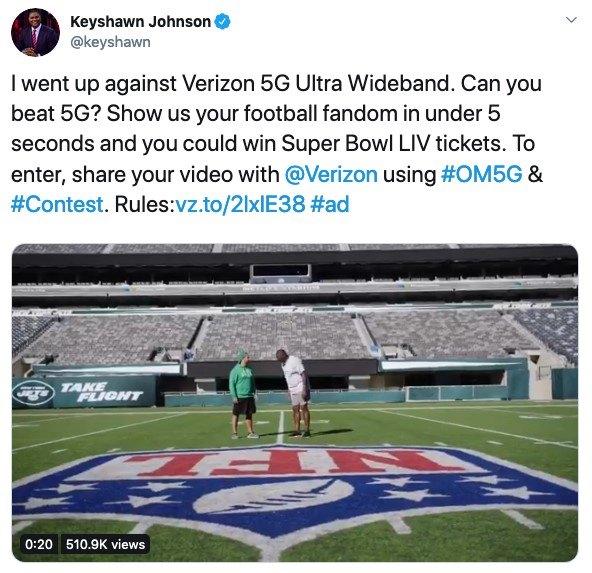
And Keyshawn Johnson got clobbered.
It only took 3.6 seconds to download the entire hour-long show over Verizon's 5G network.
This speed is going to translate into some of the most amazing media-viewing experiences you will ever have.
Verizon is offering its new 5G network in 13 NFL stadiums. And it's not the only one. AT&T (T) is using its 5G network at its AT&T Stadium, where the Dallas Cowboys play, to deliver amazing augmented reality, or AR, experiences.
Augmented Reality overlays digital imagery on real life.
For example, you can point your smartphone camera toward AT&T Stadium and see 36-foot-tall digital versions of Dallas Cowboys players yelling chants as you walk through the gates.
Inside the stadium, you can pose for a picture with the digital

Cowboys, like this:
Augmented reality requires the lightning-fast movement of massive amounts of data which wasn’t possible … until now.
All because of 5G.
What do these digital Cowboys have to do with blockchain? A lot …
These lightning-fast 5G networks come with a few setbacks. Namely in security. Despite cybersecurity being a $123 billion business, according to Gartner, these nascent 5G networks are remarkably insecure.
See, 5G relies mostly on software, which is much harder to protect than the hardware traditionally used in network connectivity. This leaves a massive amount of data zooming over airwaves without protection.
Remember the Capital One (COF) hacking earlier this summer? The weak link was the open-source web application firewall (WAF) — the software that Capital One used in the Cloud.
Back in 2017, hacker NotPetya combined ransomware and wiper software to invade corporate networks through a corrupted software upgrade. It worked. Systems crashed worldwide, and big-name corporations were out $10 billion in losses.
Add the vulnerability of a super-fast 5G network that connects devices previously isolated, and you have a hacker’s dream.
Without the means to secure this data — and pay for the exchange of it — the full rollout of 5G could be in jeopardy.
That’s where blockchain technology comes in.
It can ensure the protection of the user and the transactional data.
After all, while some cryptocurrency wallets have been hacked, NO ONE has ever hacked Bitcoin. Why?
Because blockchain is the most secure computing network in the world. This security is exactly why the business world is rapidly incorporating blockchain technology into their corporate databases.
The key factor of blockchain security is decentralization. There is no central location for cyber thieves to search for your personal data, which actually makes it MORE secure.
And if the impossible happened and one chain was hacked? Then the hacker spent all that time, energy and resources to get one person’s information.
Decentralization means that any potential infiltration is contained.
Beyond security, blockchain also offers the ability to verify transactions in real time.
For example, if you were charged 10 cents for that AR photo of you with the digital Dallas Cowboys, you’d need a secure payment method that isn’t susceptible to external attacks.
Blockchain delivers that. This is exactly what it does for cryptocurrencies like Bitcoin already.
Just like it could for a sensor-equipped refrigerator that automatically orders milk for you when you run low …
Or smart locks that automatically lock your home or car door when you leave …
Or smart shopping carts that automatically tally your purchases as they’re are added to your cart.
Don’t make the mistake of thinking that 5G is just for entertainment. 5G is going to usher in the world of the Internet of Things (IoT) and connect devices previously isolated.
Not just devices; it's going to connect entire industries.
But that can only happen with the help of blockchain.
And people are beginning to take note …
Cybersecurity expert Cybersecurity Ventures forecasts that total global spending on cybersecurity will exceed $1 trillion cumulatively over the five-year period from 2017 to 2021.
As I’ve said before, a piece of that action will without doubt find its way into the pockets of blockchain service providers. Adding blockchain-focused stocks to your portfolio now will make you as rich as Keyshawn Johnson.
Author

Tony Sagami
Weiss Crypto Ratings
Tony Sagami is one of the early pioneers in the application of technical and quantitative analysis to mutual funds and stocks. A veteran investment adviser and a leading expert on technology investing, he is the editor for Dr.