The Australian Dollar rebounds above 0.6600 as Jensen Huang's return revives risk appetite


The Australian Dollar (AUD) extends its rebound on Tuesday, with the AUD/USD pair moving away from its 11-month low, benefiting from improved market sentiment following Jensen Huang’s return as Nvidia’s Chief Executive Officer (CEO). However, diverging monetary policy outlooks between Australia and the United States (US) could limit the pair’s recovery potential.
Jensen Huang’s return breathes new life into the Australian Dollar
Jensen Huang’s reinstatement as Nvidia’s CEO, less than two weeks after his resignation, reignites optimism surrounding the Artificial Intelligence (AI) sector. The announcement encourages investors to return to technology stocks following a sharp sell-off, also benefiting risk-sensitive currencies such as the Australian Dollar.
The Aussie suffered particularly from deteriorating market sentiment, losing more than 2.40% last week. Renewed risk appetite therefore provides a catalyst for an upward correction, while the magnitude of recent losses suggests that the bearish move may have become overstretched.
However, a revival of investment in the AI sector could also benefit the US Dollar (USD) by strengthening the appeal of US assets. Improving market sentiment does not necessarily guarantee a sustained weakening of the Greenback against the Aussie.
Reserve Bank of Australia faces the risk of excessive monetary tightening
Beyond market sentiment, domestic fundamentals remain concerning for the Australian Dollar. The Reserve Bank of Australia (RBA) faces emerging signs of economic deterioration after raising interest rates five times this year, bringing its policy rate to 4.85%. The Australian economy shed 43.5K jobs in October, while the Unemployment Rate climbed to 4.9% from 4.7%. This deterioration fuels concerns about the consequences of monetary tightening on economic activity.
Rabobank highlights that the Unemployment Rate is approaching a threshold historically associated with recession risks. "That is now above the RBA’s estimate of the Non-Accelerating Inflation Rate of Unemployment (NAIRU) and perilously close to triggering the Sahm Rule recession indicator," notes the bank.
Markets are now pricing in two RBA interest rate cuts in 2027, with the first reduction potentially coming as early as May, according to Bloomberg. ANZ Bank, meanwhile, expects a first rate cut in June. However, the Australian central bank could have limited room to support the economy if inflationary pressures continue to intensify.
The Fed keeps the pressure on the Aussie
In contrast to the RBA, the US Federal Reserve (Fed) appears far from completing its monetary tightening cycle. New York Fed President John Williams reiterated on Monday that the central bank still has work to do to bring inflation back to its 2% target, a level he does not expect to reach before 2028. Last week, Fed Governor Christopher Waller even raised the possibility of a 50-basis-point (bps) interest rate hike in December.
According to the CME FedWatch tool, markets are fully pricing in a 25 bps rate hike in December and see a 65% chance of another increase in January.
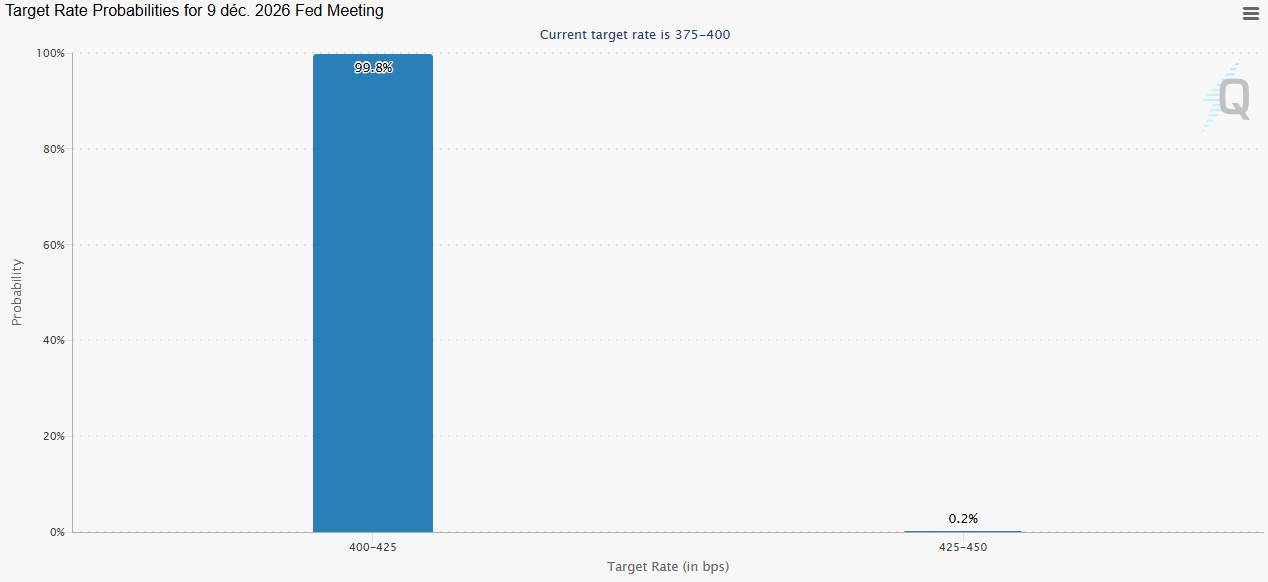
This divergence in monetary policy trajectories could continue to favor the US Dollar over the medium term, limiting AUD/USD’s ability to turn its current rebound into a sustained bullish reversal.
Australian and US inflation data hold the key to the next move
Wednesday’s release of inflation data from both economies could challenge current monetary policy expectations. In Australia, the Consumer Price Index (CPI) is expected to accelerate to 4.8% YoY in October, up from 4.3% in September. Stronger-than-expected underlying inflation could also revive speculation about further RBA monetary tightening, despite deteriorating labor market conditions.
In the United States, the Personal Consumption Expenditures (PCE) Price Index is forecast to rise 3.8% YoY in October, compared with 3.6% previously. The core reading, the Fed’s preferred inflation gauge, is expected to accelerate to 3.2% from 3.1% in September.
Stronger-than-expected Australian inflation, combined with softer US figures, would provide a favorable backdrop for an extension of the AUD/USD recovery. Conversely, confirmation of growing monetary policy divergence could quickly bring sellers back into the market.
Technical Analysis: AUD/USD attempts to establish a floor around 0.6600
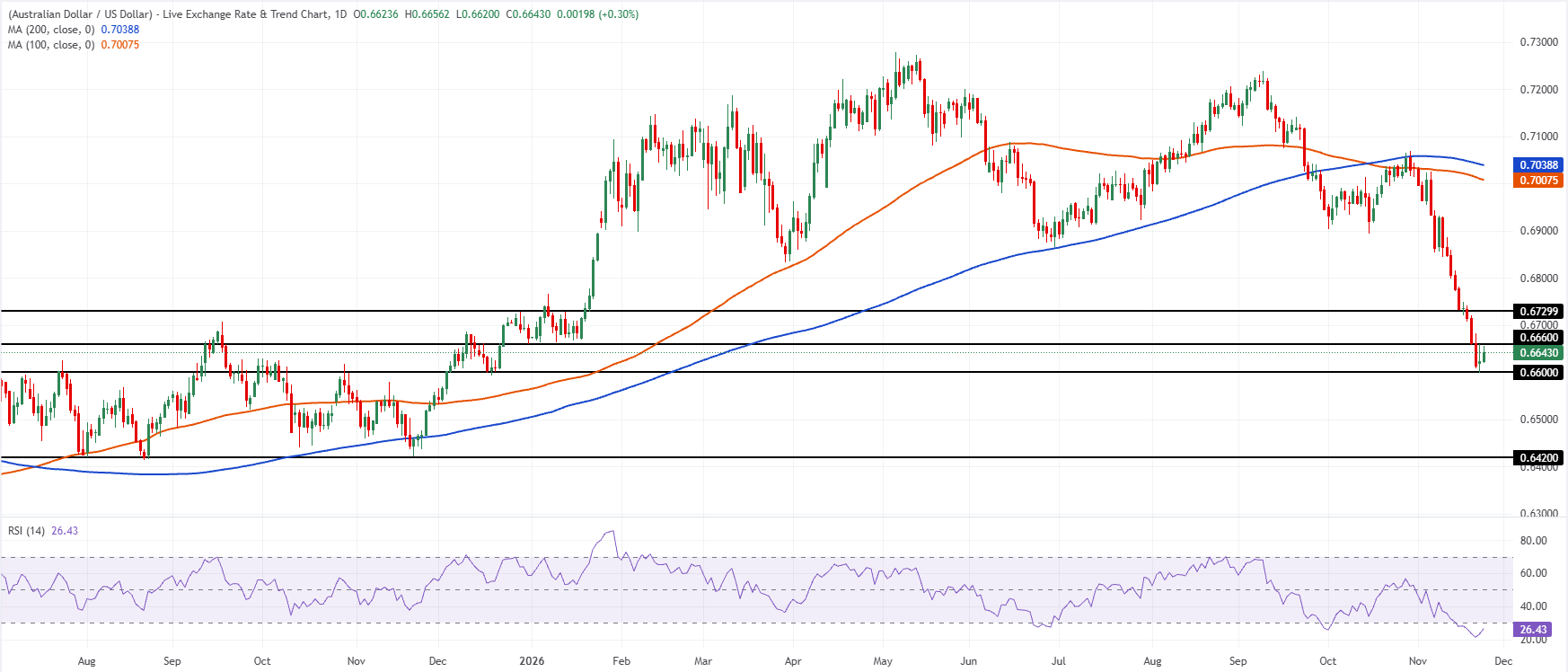
AUD/USD maintains a broadly bearish technical outlook on the daily chart despite its recent rebound from the 0.6600 psychological area. The pair remains well below its 100-day and 200-day Simple Moving Averages (SMAs), currently at 0.7008 and 0.7039, respectively. The bearish crossover between these two moving averages further reinforces the negative medium-term bias.
However, the daily Relative Strength Index (RSI) is recovering to 26, remaining in oversold territory and suggesting room for a further upward correction.
On the upside, a break above immediate resistance at 0.6660 could allow AUD/USD to extend its recovery towards 0.6730, a former support level that could now act as resistance. Conversely, a sustained break below 0.6600 could expose the major support area at 0.6420.
At this stage, the recovery appears more consistent with a corrective rebound within a broader downtrend than a genuine bullish reversal.
Author
Ghiles Guezout
FXStreet
Ghiles Guezout is a Market Analyst with a strong background in stock market investments, trading, and cryptocurrencies. He combines fundamental and technical analysis skills to identify market opportunities.