New Zealand Dollar rises as the Opportunity Party takes the balance of power


NZD/USD trades slightly higher on Friday, off the daily highs, after briefly breaking above the 0.5500 psychological level. The New Zealand Dollar (NZD) attempts to stabilize after hitting its lowest level since March 2009 earlier this week, as the final results of New Zealand's general election put the Opportunity Party in a kingmaker position.
Despite the absence of a parliamentary majority, the Kiwi's positive reaction suggests that investors are currently favoring a scenario of economic policy continuity rather than prolonged political paralysis. However, monetary policy expectations and fragile global risk appetite remain significant obstacles to a sustained recovery in the currency.
Seven seats that could determine New Zealand's political future
The final results released on Friday by New Zealand's Electoral Commission show that the incumbent center-right coalition, comprising the National Party, ACT New Zealand and New Zealand First, secured 65 seats in the 130-seat parliament, down from 67 in the preliminary election-night count.
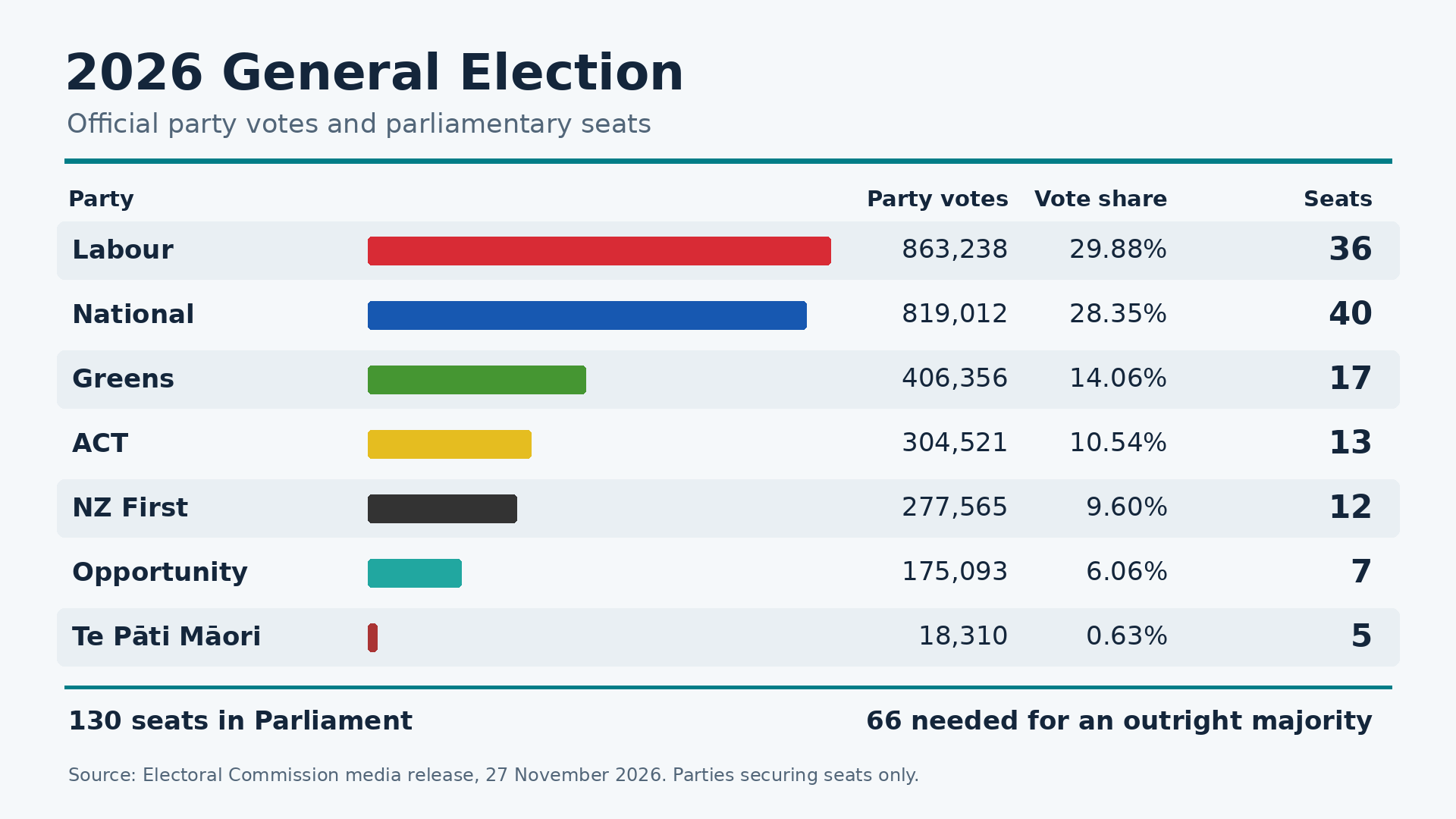
Prime Minister Christopher Luxon is therefore just one seat short of retaining a parliamentary majority. Meanwhile, the left-wing bloc, led by Labour leader Chris Hipkins, secured 58 seats, while the centrist Opportunity Party entered parliament for the first time with seven lawmakers.
This configuration puts the centrist party, led by Qiulae Wong, in a particularly strong negotiating position. An agreement with the incumbent coalition would deliver a comfortable majority of 72 seats, while an alliance with the left-wing bloc would secure only 65 seats, still one short of a majority.
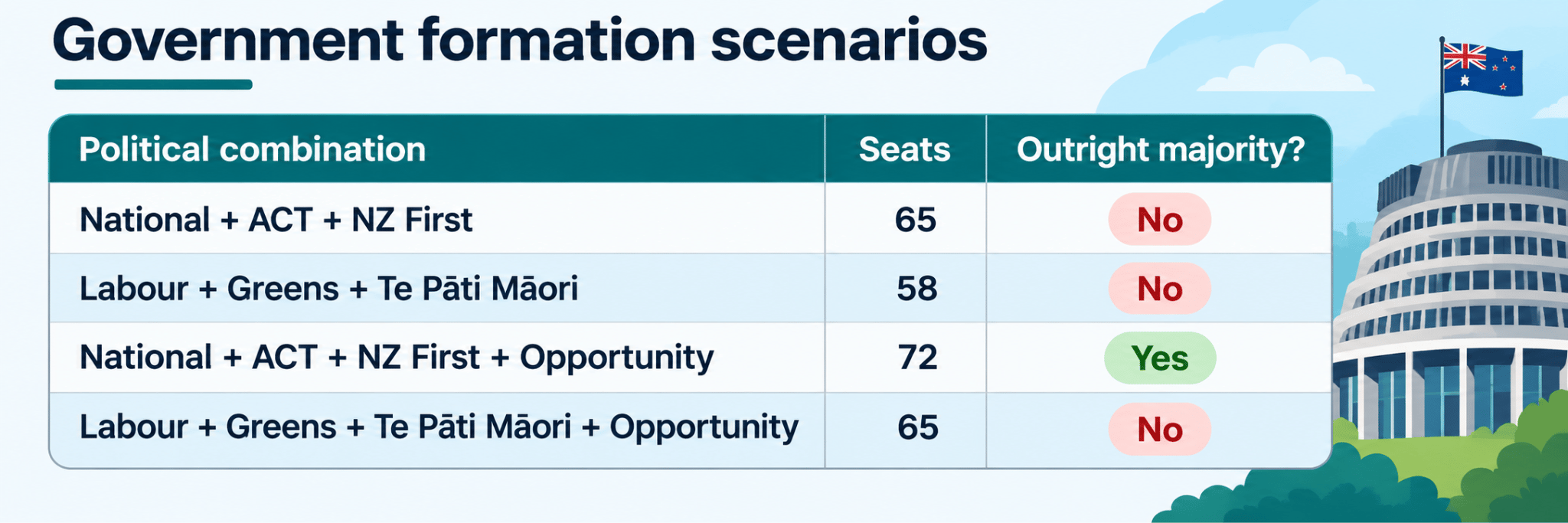
This parliamentary arithmetic could partly explain the relatively favorable reaction of the New Zealand Dollar. Although Christopher Luxon's coalition has lost its outright majority, the continuation of the incumbent government appears to offer the most straightforward path to forming a parliamentary majority.
The Kiwi finds political relief, but fiscal risks remain
For financial markets, the main issue over the coming weeks may be less about who forms the next government than about the economic and fiscal concessions required to secure a coalition agreement. The Opportunity Party's centrist positioning could limit concerns about abrupt changes in economic policy. A swift agreement would also reduce uncertainty surrounding business investment decisions and could help stabilize the New Zealand Dollar.
Conversely, prolonged negotiations or costly fiscal commitments could reignite investor concerns about public finances. A more expansionary fiscal policy could put upward pressure on government bond yields and complicate the central bank's monetary policy outlook.
In a more adverse scenario, failure to form a viable government could pave the way for fresh elections, prolonging political uncertainty and exposing the Kiwi to renewed selling pressure.
For now, however, the modest market reaction suggests that investors view the election outcome as a political negotiation rather than an immediate threat to New Zealand's economic outlook.
Monetary policy divergence remains the main obstacle to a sustained NZD/USD recovery
Beyond political developments in Wellington, the New Zealand Dollar's outlook remains largely dependent on evolving interest rate expectations. The dovish stance of the Reserve Bank of New Zealand (RBNZ) contrasts with the increasingly hawkish rhetoric from the Federal Reserve (Fed). In the United States (US), hotter-than-expected inflation in October and an upward revision to third-quarter Gross Domestic Product (GDP) growth have reinforced expectations of further monetary tightening.
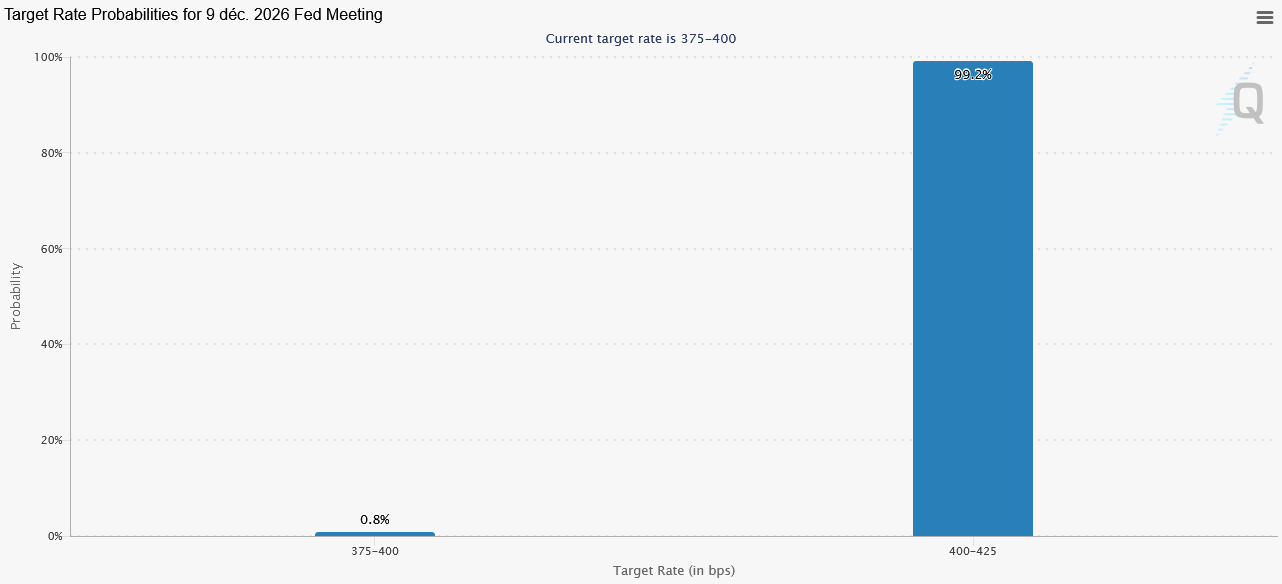
According to the CME FedWatch tool, markets now consider a 25-basis-point (bps) interest rate hike at the December 9 meeting a near certainty, while an additional rate increase is being priced in for January.
Analysts at Mitsubishi UFJ Financial Group (MUFG) highlight that strengthening US economic momentum “is encouraging the Fed to raise rates further into restrictive territory in an attempt to dampen growth and ease upside inflation risks.” However, the bank tempers this outlook, warning that policymakers “will also be wary of the risk that a more sustained period of equity market weakness and tightening of financial conditions including a stronger US Dollar would help to dampen the need for rate hikes.”
This creates a challenging environment for the Kiwi. Rising US interest rate expectations support the US Dollar (USD), while volatility in artificial intelligence-related stocks and geopolitical tensions in the Middle East undermine demand for risk-sensitive currencies. As a result, global financial conditions and monetary policy expectations could outweigh domestic political developments in driving the New Zealand Dollar over the coming weeks.
The release of the US Nonfarm Payrolls (NFP) report for November, scheduled for December 4, will therefore represent the next major catalyst for NZD/USD, potentially reshaping expectations for the Fed's monetary policy trajectory.
NZD/USD attempts to build a floor below 0.5500
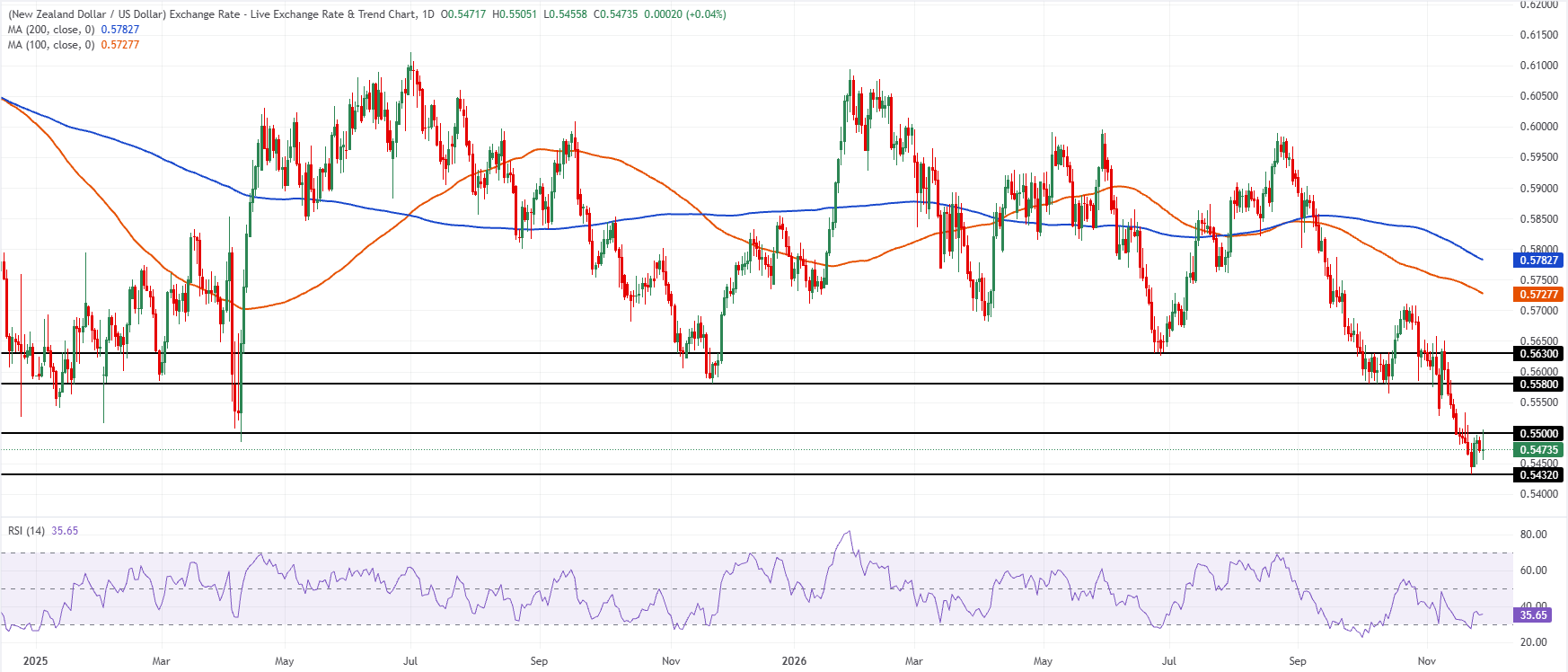
NZD/USD attempts to recover from its recent low at 0.5432, but the technical outlook on the daily chart remains broadly bearish. The pair trades well below its 100-day and 200-day Simple Moving Averages (SMA), currently located at 0.5728 and 0.5783, respectively, with both pointing lower. The 14-day Relative Strength Index (RSI) recovers to around 36 after recently dipping into oversold territory, suggesting that bearish momentum is easing without confirming a bullish reversal.
The 0.5500 psychological mark represents the first resistance level to overcome. A daily close above this threshold could open the door to a recovery toward 0.5580, followed by 0.5630, two former support levels that could now act as resistance.
Conversely, another failure to break above 0.5500 could send NZD/USD back toward its recent low at 0.5432. A break below this support would expose the pair to the 0.5400 psychological level and reinforce the broader bearish trend.
Ultimately, greater clarity surrounding New Zealand's political landscape offers the Kiwi an opportunity to stabilize, but a sustained bullish reversal may require a more significant shift in US monetary policy expectations and an improvement in global risk sentiment.
Author
Ghiles Guezout
FXStreet
Ghiles Guezout is a Market Analyst with a strong background in stock market investments, trading, and cryptocurrencies. He combines fundamental and technical analysis skills to identify market opportunities.