|

Ichimoku cloud analysis: GBP/USD, AUD/USD, USD/JPY

Ichimoku cloud analysis: GBP/USD, AUD/USD, USD/JPY

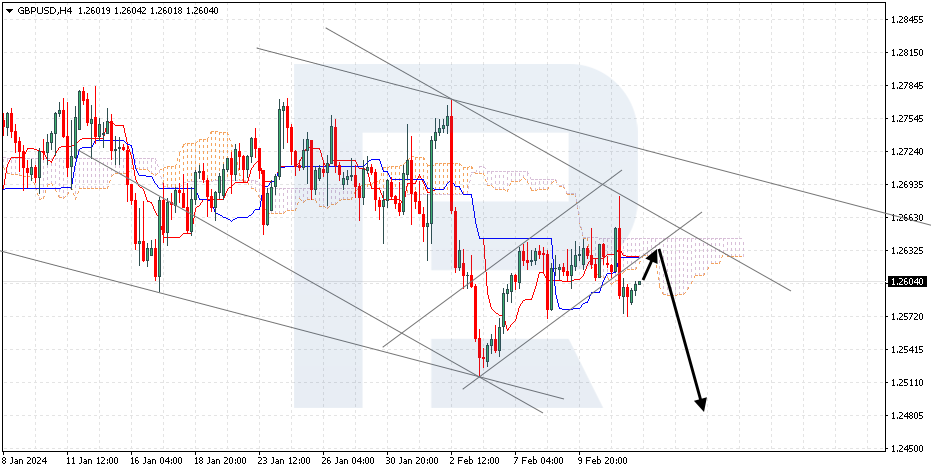
GBP/USD, “Great Britain Pound vs US Dollar”

GBPUSD has found a foothold under the lower boundary of the bullish channel. The instrument is going below the Ichimoku Cloud, which suggests a downtrend. A test of the lower boundary of the Cloud at 1.2630 is expected, followed by a decline to 1.2480. An additional signal confirming the decline could be a rebound from the lower boundary of the bullish channel. The scenario can be cancelled by a breakout of the upper boundary of the Cloud with the price finding a foothold above 1.2675, which will mean further growth to 1.2765.
Chart

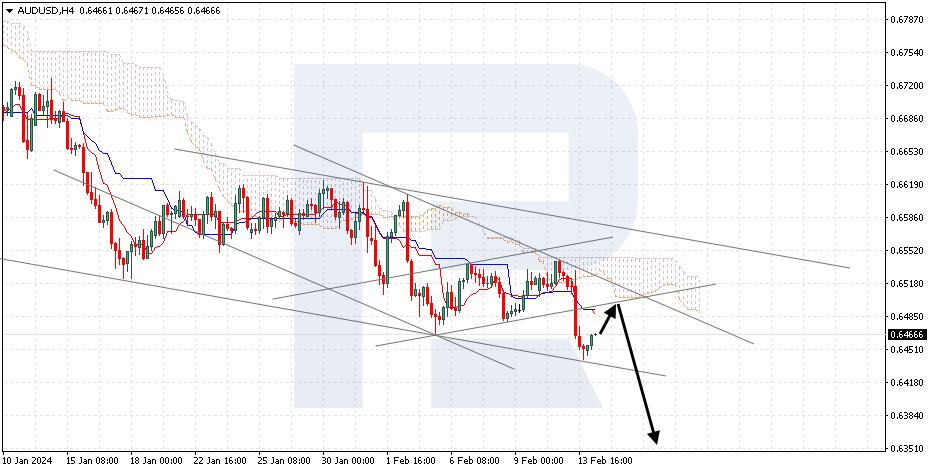
AUD/USD, “Australian Dollar vs US Dollar”

AUDUSD is rebounding from the lower boundary of the bearish channel. The instrument is going below the Ichimoku Cloud, which suggests a downtrend. A test of the Tenkan-Sen line at 0.6500 is expected, followed by a decline to 0.6350. An additional signal confirming the decline could be a rebound from the lower boundary of the bullish channel. The scenario can be cancelled by a breakout of the upper boundary of the Cloud with the price finding a foothold above 0.6560, which will mean further growth to 0.6750.
Chart

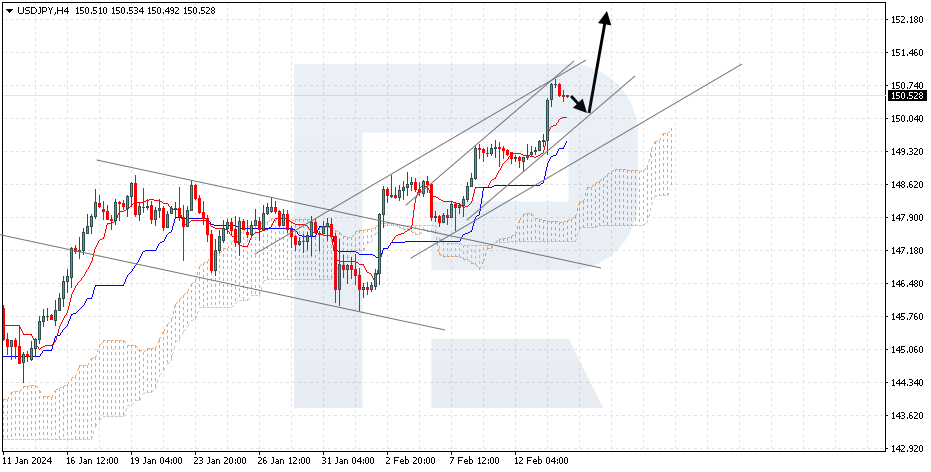
USD/JPY, “US Dollar vs Japanese Yen”

USDJPY is rising within a bullish impulse. The instrument is going above the Ichimoku Cloud, which suggests an uptrend. A test of the Tenkan-Sen line at 150.15 is expected, followed by a rise to 152.35. An additional signal confirming the rise might be a rebound from the lower boundary of the bullish channel. The scenario can be cancelled by a breakout of the lower boundary of the Cloud with the price finding a foothold under 147.05, which will mean a further decline to 146.15.
Chart

Author

RoboForex Team

RoboForex Team is a group of professional financial experts with high experience on financial market, whose main purpose is to provide traders with quality and up-to-date market information.


More from RoboForex Team
Share:

Editor's Picks

AUD/USD sits at fresh 10-month lows, nears 0.6700

AUD/USD refreshes ten-month lows below 0.6750 and approaches 0.6700 in Wednesday’s Asian session. Fed rate-hike bets, along with fresh exchange of fire between the US and Iran, underpin the safe-haven US Dollar. Furthermore, the RBA’s dovish tilt weighs on the Aussie and the pair.

USD/JPY defends bids near 159.50 on hawkish BoJ Ueda

USD/JPY is defending bids near 159.50 in the Asian session on Wednesday, holding a three-day losing streak after hawkish commentary from BoJ Governor Ueda supports the Japanese Yen amid looming intervention risks. Meanwhile, escalating Middle East tensions revive US Dollar demand amid hawkish Fed bets, which could limit the pair's downside.


Gold tumbles to its lowest in over a year as Fed rate hike bets build

Gold (XAU/USD) falls below $3,800 on Wednesday, hitting its lowest level since September 2025 as traders increasingly expect the Federal Reserve (Fed) to keep interest rates higher for longer.

Bitcoin stalls as ETF outflows mount ahead of Fed Minutes

Bitcoin stalls near $65,000 on Wednesday as buyers struggle to sustain a recovery from last week’s decline toward $62,000. Weakening institutional demand so far this week from BTC spot Exchange Traded Funds continues to weigh on sentiment.

Nvidia offers up double beat in third quarter

Nvidia (NVDA) shares jumped 3% afterhours as the leading AI chipmaker easily surpassed Wall Street's projections for the third quarter. The semiconductor powerhouse posted adjusted earnings per share of $2.68, 8.5% or $0.21 better than the consensus. Revenue of $115.85 billion clobbered the consensus by $7.1 billion or 6.6%.

Gold isn't being sold for the reason most people think
Gold (XAU/USD) remains under heavy selling pressure on Monday, hitting its lowest level in 13 months. The precious metal is struggling to recover despite escalating geopolitical tensions in the Middle East, a backdrop that would normally encourage investors to seek protection in safe-haven assets. However, the main driver behind Gold's decline is not the geopolitical uncertainty itself.