Pound Sterling retreats against US Dollar in light volume conditions before New Year
- The Pound Sterling falls back against the US Dollar as the latter rebounds.
- Goldman Sachs sees the BoE reducing interest rates in each quarter of the next year.
- The US Dollar flattens in illiquid trading conditions before New Year celebrations.

The Pound Sterling (GBP) drops to near 1.2550 after failing to extend the intraday high of 1.2600 and turns negative against the US Dollar (USD) in Monday's North American session. The GBP/USD pair falls as the US Dollar (USD) bounces back in thin trading volume conditions before New Year celebrations. The US Dollar Index (DXY), which tracks the Greenback’s value against six major currencies, rises to near 108.30 and is set to end the year with almost 6.7% gains.
The USD performed strongly this year even though the Federal Reserve (Fed) reduced its key borrowing rates by 100 basis points (bps) to 4.25%-4.50%. The Greenback has gained significantly in the last three months after Republican Donald Trump’s victory in the United States (US) Presidential election as policies such as immigration control, higher import tariffs, and lower taxes are expected to be inflationary and pro-growth.
The Fed has also signaled fewer interest rate cuts in 2025 amid strong economic growth prospects, a slowdown in the disinflation trend, and better labor market conditions than previously forecasted. However, Fed Chair Jerome Powell refrained from guiding the likely impact of Trump’s policies on the economy.
"It is very premature to make any kind of conclusions,” Powell said on December 18. “We don’t know what will be tariffed, from what countries, for how long, in what size," he added.
This week, the major trigger for the Pound Sterling and the US Dollar will be the final estimates for the December S&P Global and US ISM Manufacturing Purchasing Managers’ Index (PMI) data
Pound Sterling drops as market experts see more interest rate cuts by the BoE in 2025 compared to market pricing
- The Pound Sterling faces pressure against its major peers on Monday. The British currency drops amid a mild increase in the Bank of England's (BoE) dovish bets for 2025.
- Traders price in a 53-basis points (bps) interest rate reduction for the next year, up from the 46 bps estimated after the policy announcement on December 19, when the Bank of England (BoE) left borrowing rates unchanged at 4.75% with a 6-3 vote split. Before the policy announcement, market participants were anticipating that only one Monetary Policy Committee (MPC) would vote for a rate cut.
- The BoE has been the slowest among European and North American nations to reduce interest rates this year. The BoE has reduced its key borrowing rates by 50 bps, while other peers such as the Federal Reserve (Fed) and the European Central Bank (ECB) pushed their borrowing rates lower by 100 bps. The Bank of Canada (BoC) and the Swiss National Bank (SNB) lowered interest rates by even more due to higher risks of inflation undershooting their respective targets.
- "UK wage growth and services inflation have remained notably stickier than elsewhere, despite signs of material labor market rebalancing,” analysts at Goldman Sachs said in a note. “As a result, the BoE has been more cautious than other major central banks," they added. However, the investment banking firm expects continued quarterly cuts through 2025, more than what markets expect, as a “weaker labor market cools underlying inflation.”
British Pound PRICE Today
The table below shows the percentage change of British Pound (GBP) against listed major currencies today. British Pound was the strongest against the Swiss Franc.
| USD | EUR | GBP | JPY | CAD | AUD | NZD | CHF | |
|---|---|---|---|---|---|---|---|---|
| USD | 0.35% | 0.20% | -0.20% | -0.07% | 0.04% | -0.19% | 0.47% | |
| EUR | -0.35% | -0.13% | -0.59% | -0.46% | -0.38% | -0.59% | 0.07% | |
| GBP | -0.20% | 0.13% | -0.42% | -0.30% | -0.25% | -0.44% | 0.21% | |
| JPY | 0.20% | 0.59% | 0.42% | 0.10% | 0.29% | 0.16% | 0.70% | |
| CAD | 0.07% | 0.46% | 0.30% | -0.10% | 0.10% | -0.06% | 0.53% | |
| AUD | -0.04% | 0.38% | 0.25% | -0.29% | -0.10% | -0.20% | 0.46% | |
| NZD | 0.19% | 0.59% | 0.44% | -0.16% | 0.06% | 0.20% | 0.66% | |
| CHF | -0.47% | -0.07% | -0.21% | -0.70% | -0.53% | -0.46% | -0.66% |
The heat map shows percentage changes of major currencies against each other. The base currency is picked from the left column, while the quote currency is picked from the top row. For example, if you pick the British Pound from the left column and move along the horizontal line to the US Dollar, the percentage change displayed in the box will represent GBP (base)/USD (quote).
Technical Analysis: Pound Sterling faces pressure near 1.2600
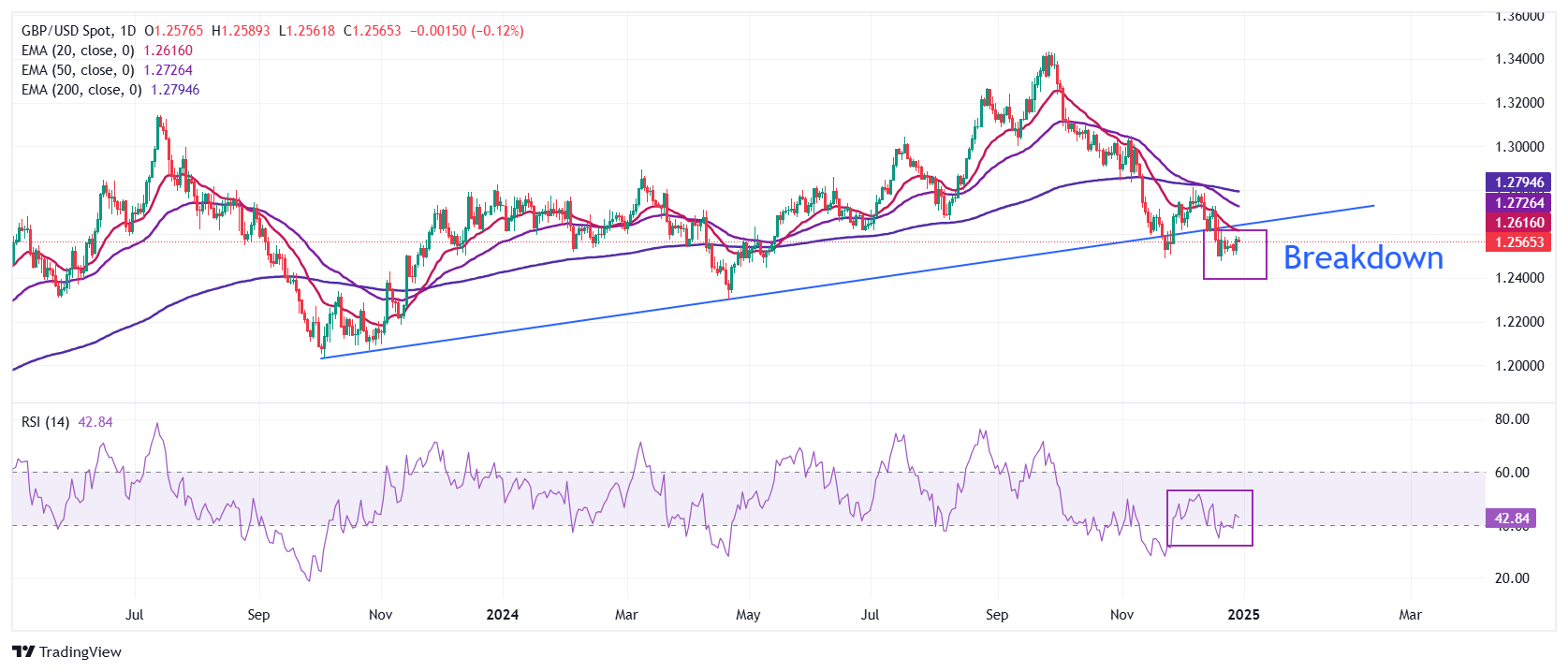
The Pound Sterling trades broadly sideways against the US Dollar below 1.2600 on Monday. The outlook of the GBP/USD pair remains vulnerable as it trades below the upward-sloping trendline around 1.2600, which is plotted from the October 2023 low of 1.2035.
All short-to-long-term Exponential Moving Averages (EMAs) are sloping down, suggesting a strong bearish trend in the long run.
The 14-day Relative Strength Index (RSI) hovers around 40.00. A fresh downside momentum could trigger if the oscillator sustains below this level.
Looking down, the pair is expected to find a cushion near the April 22 low at around 1.2300 if it breaks below the immediate support of 1.2485. On the upside, the December 17 high at 1.2730 will act as key resistance.
BoE FAQs
The Bank of England (BoE) decides monetary policy for the United Kingdom. Its primary goal is to achieve ‘price stability’, or a steady inflation rate of 2%. Its tool for achieving this is via the adjustment of base lending rates. The BoE sets the rate at which it lends to commercial banks and banks lend to each other, determining the level of interest rates in the economy overall. This also impacts the value of the Pound Sterling (GBP).
When inflation is above the Bank of England’s target it responds by raising interest rates, making it more expensive for people and businesses to access credit. This is positive for the Pound Sterling because higher interest rates make the UK a more attractive place for global investors to park their money. When inflation falls below target, it is a sign economic growth is slowing, and the BoE will consider lowering interest rates to cheapen credit in the hope businesses will borrow to invest in growth-generating projects – a negative for the Pound Sterling.
In extreme situations, the Bank of England can enact a policy called Quantitative Easing (QE). QE is the process by which the BoE substantially increases the flow of credit in a stuck financial system. QE is a last resort policy when lowering interest rates will not achieve the necessary result. The process of QE involves the BoE printing money to buy assets – usually government or AAA-rated corporate bonds – from banks and other financial institutions. QE usually results in a weaker Pound Sterling.
Quantitative tightening (QT) is the reverse of QE, enacted when the economy is strengthening and inflation starts rising. Whilst in QE the Bank of England (BoE) purchases government and corporate bonds from financial institutions to encourage them to lend; in QT, the BoE stops buying more bonds, and stops reinvesting the principal maturing on the bonds it already holds. It is usually positive for the Pound Sterling.
Author
Sagar Dua
FXStreet
Sagar Dua is associated with the financial markets from his college days. Along with pursuing post-graduation in Commerce in 2014, he started his markets training with chart analysis.