 Sam Seiden
Independent Analyst

I have been involved with the markets for almost 20 years. I started on the institution side of the business but have spent much more time trading and building financial education content for the retail trader and investor world. While I truly feel I am speaking the truth when it comes to supply and demand, how the markets really work and how money is really made and lost in markets, I am and likely will always be very outnumbered when it comes to popular belief regarding strategies; and that is perfectly fine with me. It really comes down to two schools of thought. Should your trading or investing strategy focus on market timing, which means identifying market turning points in advance and then taking action at those turning points, like I am always suggesting? Or, should you focus on trend trading and try and capture part of the meat of the move which is popular belief.
When most people hear my ideas for the first time, the initial words I often hear are: “Seems high risk,” “Is this contrarian,” “Picking tops and bottoms can’t be done,” and so on… Most people focus on “trend” trading and staying out of market turns. I understand this because that is what the trading books tell people to do. It’s also what Wall Street professionals tell the public is best for them. Two problems with that though… First, people who read trading books and employ conventional technical analysis and such tend not to be very profitable. Second, what Wall Street suggests is typically better for them, not for you. Still though, the vast majority want to focus on the middle, the trend, and not the turning points and I get that. In other words, most people are far more comfortable buying after price has risen and selling after price has fallen.
A while back a friend sent me an email with a quote from someone who is regarded as one of the best traders in our life time, Paul Tudor Jones. If you don’t know him, look him up. The email said “Sam, you’re going to love this quote,” my friend was correct. When I read this quote I could not believe it. It was like the words in the quote were coming right out of my mouth, only they were not from me. They were from someone who is worth over $3,000,000,000.00 (yes, that’s 3 billion according to reports). The quote said exactly this:
“I believe the very best money is made at the market turns. Everyone says you get killed trying to pick tops and bottoms and you make all your money by playing the trend in the middle. Well, for twelve years I have been missing the meat in the middle but I have made a lot of money at tops and bottoms.” – Paul Tudor Jones (source: Business Insider)
I could not agree more with Mr. Jones. Being in the trend is great, but I get in at the turn before the trend is under way. I honestly can’t figure out how you would even enter into a trend after it is well underway. To me, that is VERY high risk and low reward trading. Where do you enter, how in the world do you properly manage risk and reward when buying after a rally in price? Let me share a trade in the NASDAQ from last week to help illustrate my point. The yellow box represents where banks were selling the NASDAQ and the circled area is where I entered the trade and sold short.
Nasdaq Futures 6/11/15. Active Income Profit: $1,159.60
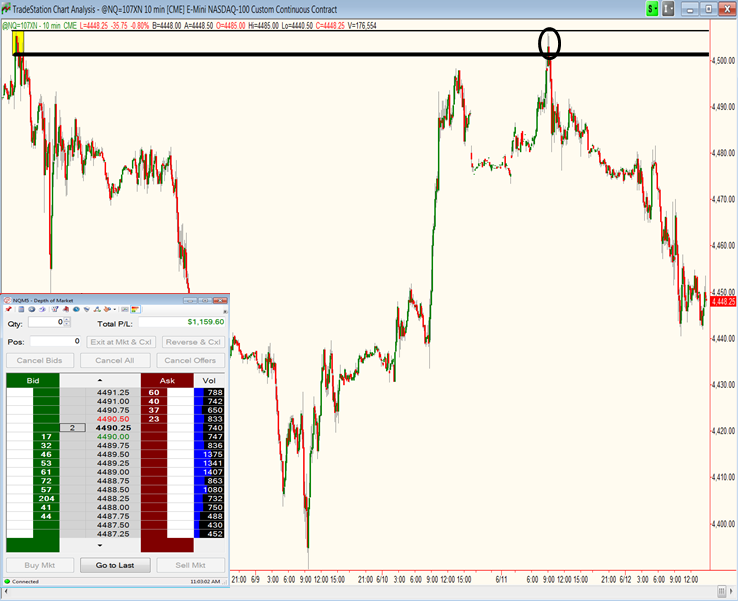
Each entry, as you can see, is getting in at the turn just like Mr. Jones is suggesting. The reason why my ideas are the opposite of the masses is because I didn’t learn to trade like the masses. I learned to trade from the Wall Street side of the business, on a trading floor, dealing with some of the largest order flow in the market. From that experience, there is only one way to do it. You buy where the significant buy orders are and sell where the significant sell orders are (supply and demand), again, just like Mr. Jones is suggesting. The masses learn to trade from trading books, seminars, the internet and so on. Also, keep in mind that I am not just talking about short term trading for income. I am equally talking about long term trading for passive income and wealth.
Believe me, I am not trying to twist your arm or beat up trading books. As someone involved in the somewhat unregulated world of financial education, I feel it’s my responsibility to share these ideas and different views with you.
Hope this was helpful, have a great day.
Note: All information on this page is subject to change. The use of this website constitutes acceptance of our user agreement. Please read our privacy policy and legal disclaimer. Opinions expressed at FXstreet.com are those of the individual authors and do not necessarily represent the opinion of FXstreet.com or its management. Risk Disclosure: Trading foreign exchange on margin carries a high level of risk, and may not be suitable for all investors. The high degree of leverage can work against you as well as for you. Before deciding to invest in foreign exchange you should carefully consider your investment objectives, level of experience, and risk appetite. The possibility exists that you could sustain a loss of some or all of your initial investment and therefore you should not invest money that you cannot afford to lose. You should be aware of all the risks associated with foreign exchange trading, and seek advice from an independent financial advisor if you have any doubts.
Editors’ Picks

EUR/USD weakens toward 1.1600 as firm US data revives the US Dollar
The EUR/USD edged lower on Thursday, down some 0.21% as market sentiment remains risk averse due to the ongoing conflict in the Middle East. This and solid US economic data pushed the pair lower towards the 1.1600 figure ahead of Friday’s session.

GBP/USD drifts lower heading into NFP range
GBP/USD edged lower by 0.2% on Thursday, settling close to 1.3350 in a strained trading session that kept the pair pinned near three-month lows. Price briefly recovered earlier in the day on reports that Iran had indirectly signaled openness to talks with the CIA, but the bounce faded as Israeli officials reportedly advised Washington to disregard the overture.

USD/JPY: Bulls defend 157.00 as upside-pressure builds
USD/JPY advanced on Thursday during the North American session, up by nearly 0.30% as the Greenback is boosted by risk appetite deterioration, solid US jobs data and hawkish comments by the Richmond Fed President Thomas Barkin. At the time of writing, the pair trades at 157.50 above its opening price.
Editors’ Picks

AUD/USD slides nearly 1% to test the 0.7000 handle
AUD/USD fell about 1% on Thursday, wrapping the day up near the 0.7010 level after testing below the key 0.7000 handle intraday. The pair has now pulled back sharply from Tuesday's bounce, with two consecutive bearish sessions erasing most of the week's early gains. Price continues to chop within the roughly 150-pip consolidation band between 0.7000 and the year-to-date high close to 0.7150 that has defined the range since early February.
EUR/USD weakens toward 1.1600 as firm US data revives the US Dollar
The EUR/USD edged lower on Thursday, down some 0.21% as market sentiment remains risk averse due to the ongoing conflict in the Middle East. This and solid US economic data pushed the pair lower towards the 1.1600 figure ahead of Friday’s session.

Gold slumps below $5,100 as US Dollar gains
Gold price tumbles to near $5,085 during the early Asian session on Friday. The precious metal loses ground amid a stronger US Dollar. The US employment report for February will take center stage later on Friday.

NYSE parent Intercontinental Exchange partners with OKX, invests at a $25B valuation
OKX announced an investment from Intercontinental Exchange, raising its valuation to $25 billion, alongside a partnership to expand regulated crypto futures and tokenized equity offerings globally.

Two PMIs, two Chinas Premium
China’s economic data are often treated with a degree of caution by global investors. The challenge is not necessarily that the numbers are incorrect, but that they can describe very different parts of a vast and complex economy. Nowhere is that more evident than in China’s PMIs.
RECOMMENDED LESSONS
Making money in forex is easy if you know how the bankers trade!

I’m often mystified in my educational forex articles why so many traders struggle to make consistent money out of forex trading. The answer has more to do with what they don’t know than what they do know. After working in investment banks for 20 years many of which were as a Chief trader its second knowledge how to extract cash out of the market.
5 Forex News Events You Need To Know

In the fast moving world of currency markets where huge moves can seemingly come from nowhere, it is extremely important for new traders to learn about the various economic indicators and forex news events and releases that shape the markets. Indeed, quickly getting a handle on which data to look out for, what it means, and how to trade it can see new traders quickly become far more profitable and sets up the road to long term success.
Top 10 Chart Patterns Every Trader Should Know

Chart patterns are one of the most effective trading tools for a trader. They are pure price-action, and form on the basis of underlying buying and selling pressure. Chart patterns have a proven track-record, and traders use them to identify continuation or reversal signals, to open positions and identify price targets.
7 Ways to Avoid Forex Scams

The forex industry is recently seeing more and more scams. Here are 7 ways to avoid losing your money in such scams: Forex scams are becoming frequent. Michael Greenberg reports on luxurious expenses, including a submarine bought from the money taken from forex traders. Here’s another report of a forex fraud. So, how can we avoid falling in such forex scams?
What Are the 10 Fatal Mistakes Traders Make
Trading is exciting. Trading is hard. Trading is extremely hard. Some say that it takes more than 10,000 hours to master. Others believe that trading is the way to quick riches. They might be both wrong. What is important to know that no matter how experienced you are, mistakes will be part of the trading process.
The challenge: Timing the market and trader psychology

Successful trading often comes down to timing – entering and exiting trades at the right moments. Yet timing the market is notoriously difficult, largely because human psychology can derail even the best plans. Two powerful emotions in particular – fear and greed – tend to drive trading decisions off course.