 Sam Seiden
Independent Analyst

The goal for most traders is consistent profits, life-long income from speculating in markets. The key word in that sentence is “consistent.” Anyone can have profitable trades here and there, but do they produce consistent income and profits from trading? I have a friend who day trades the S&P Mini and has a winning percentage of around 80% but the problem is, he doesn’t make consistent income from trading. Sounds crazy I know, but one loss for him tends to wipe out all of the profits (hope he doesn’t read this article)…
In the Extended Learning Track (XLT), one of the “Odds Enhancers” we focus on for every short term and long term trading opportunity is Profit Zone. Without a path for price to move after we enter a position on the chart, there is no trading opportunity. What we are looking for are supply and demand levels with very little activity between them. There are many supply and demand levels on a chart. Often, there is a very quality supply and demand level on a chart but the problem is, they are too close to each other or there is too much trading activity between them which again means no trade. Typically, we are looking for opportunities on the chart that offer us at least 3:1 reward to risk to the first target. Often we are looking for more but this is a safe minimum to make a trade acceptable to take.
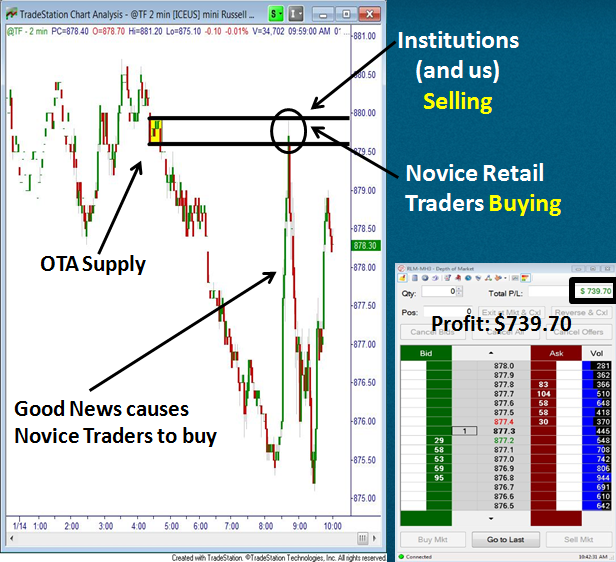
At this point, you’re probably wondering what any of this has to do with the title of the article. Let me explain through a trade we took that we found in the Extended Learning Track (XLT). This was a trade in the Russell (TF). Notice the supply level on the chart, shaded in yellow. The supply level is the origin of a strong decline in price and has with it some very key Odds Enhancers that make this a significant level where institutions are likely selling, where supply greatly exceeds demand. The trade was to bet on a downside move, selling short at the supply level to a novice buyer for a potential move down in price. What made this trade work well are two specific things. First was the quality supply level. Second, notice the rally that brought price up to the supply level where we sold short. There was good news, people started buying in a hurry, and price shot up quickly. Notice specifically the big green candles. There is no picture of demand in that rally. This means that when price reached the supply level where we sold short, price was likely to fall just as fast as it rallied because there was no significant demand to stop it from falling. Lets go over these two most important pictures on a chart so that you can start seeing this picture of opportunity also:
1) Quality Supply and Demand Levels: To identify market turning points and market moves in advance with a high degree of accuracy, you need to be able to know where institutions and banks are buying and selling in the markets. To accomplish this, you must be able to quantify real supply and demand in a market. For this, a solid understanding of the Odds Enhancers is key. To summarize… One of the two most important pictures on a price chart is a quality supply or demand level.
2) A Clear Profit Zone: Just as it is important to identify strong supply and demand levels on a chart. It is equally important to be able to identify areas on the price chart where there is very little supply or demand. These are the areas where price will move quickly through.
Everything you need to see is on the price charts, if you know what you’re looking for. If you have been schooled in the theories of conventional technical analysis, you may be blinded by illusions of chart patterns that never really worked for anyone. Have no fear, there is a cure. Remove everything from your charts but price and price alone. Next, read next week’s article and I will take things back to basics and help you identify real demand and supply on price charts. My hope is that today’s little nugget of information helps you achieve the consistency you’re looking for.
Have a great day.
Note: All information on this page is subject to change. The use of this website constitutes acceptance of our user agreement. Please read our privacy policy and legal disclaimer. Opinions expressed at FXstreet.com are those of the individual authors and do not necessarily represent the opinion of FXstreet.com or its management. Risk Disclosure: Trading foreign exchange on margin carries a high level of risk, and may not be suitable for all investors. The high degree of leverage can work against you as well as for you. Before deciding to invest in foreign exchange you should carefully consider your investment objectives, level of experience, and risk appetite. The possibility exists that you could sustain a loss of some or all of your initial investment and therefore you should not invest money that you cannot afford to lose. You should be aware of all the risks associated with foreign exchange trading, and seek advice from an independent financial advisor if you have any doubts.
Editors’ Picks

EUR/USD drops below 1.1600 on broad USD strength
EUR/USD stays under bearish pressure and trades at a fresh six-week low below 1.1600 on Tuesday. Despite stronger-than-forecast inflation data from the Eurozone, the pair struggles to stage a rebound as the US Dollar continues to attract safe haven flows amid escalating geopolitical tensions in the Middle East.

GBP/USD attacks 1.3300, refreshing three-month lows
GBP/USD is deep in the red near 1.3300, accelerating its downside to renew three-month lows in European trading on Tuesday. The ongoing escalation in the Iran war, combined with rising Oil prices, weighs negatively on the higher-yielding Pound Sterling as the US Dollar capitalizes on increased haven demand.

Japanese Yen flat lines vs. rallying USD; bearish bias remains amid BoJ rate hike delay
The USD/JPY pair extends its sideways consolidative price move through the early European session. Spot prices remain below the highest level in over five weeks, touched the precious day, and currently trade below mid-157.00s, nearly unchanged for the day.
Editors’ Picks
EUR/USD drops below 1.1600 on broad USD strength
EUR/USD stays under bearish pressure and trades at a fresh six-week low below 1.1600 on Tuesday. Despite stronger-than-forecast inflation data from the Eurozone, the pair struggles to stage a rebound as the US Dollar continues to attract safe haven flows amid escalating geopolitical tensions in the Middle East.

WTI jumps over 6% to top $75 amid US-Iran war risks
WTI jumps more than 6%, breaking above the $75 mark. Oil prices surge as the US-Iran war raises fears of supply disruptions. Goldman Sachs estimates an $18 per barrel geopolitical risk premium in Oil.

Gold drops below $5,200 on stronger USD, rallying US yields
Gold attracts some intraday selling and falls below $5,200 on Tuesday. The US Dollar climbs to a fresh high since January 20 and turns out to be a key factor exerting downward pressure on the commodity. Meanwhile, the benchmark 10-year US Treasury bond yield rises nearly 2% on the day, putting additional weight on XAU/USD's shoulders.

Crypto Today: Bitcoin, Ethereum, XRP pull back as sentiment remains in extreme market fear
The cryptocurrency market is broadly in the red on Tuesday as the Middle East grapples with an escalating war. Bitcoin (BTC) is in a pullback, trading below $67,000 at the time of writing, and most altcoins follow suit.

Middle East conflict ramps up a gear as energy price spike rips through markets
It’s another risk off day as geopolitical headwinds continue to batter financial markets. Although markets calmed during the US session and US stocks managed to post gains on Monday, this has not fed through to the European session, and stocks and bonds are sharply lower for a second day.
RECOMMENDED LESSONS
Making money in forex is easy if you know how the bankers trade!

I’m often mystified in my educational forex articles why so many traders struggle to make consistent money out of forex trading. The answer has more to do with what they don’t know than what they do know. After working in investment banks for 20 years many of which were as a Chief trader its second knowledge how to extract cash out of the market.
5 Forex News Events You Need To Know

In the fast moving world of currency markets where huge moves can seemingly come from nowhere, it is extremely important for new traders to learn about the various economic indicators and forex news events and releases that shape the markets. Indeed, quickly getting a handle on which data to look out for, what it means, and how to trade it can see new traders quickly become far more profitable and sets up the road to long term success.
Top 10 Chart Patterns Every Trader Should Know

Chart patterns are one of the most effective trading tools for a trader. They are pure price-action, and form on the basis of underlying buying and selling pressure. Chart patterns have a proven track-record, and traders use them to identify continuation or reversal signals, to open positions and identify price targets.
7 Ways to Avoid Forex Scams

The forex industry is recently seeing more and more scams. Here are 7 ways to avoid losing your money in such scams: Forex scams are becoming frequent. Michael Greenberg reports on luxurious expenses, including a submarine bought from the money taken from forex traders. Here’s another report of a forex fraud. So, how can we avoid falling in such forex scams?
What Are the 10 Fatal Mistakes Traders Make
Trading is exciting. Trading is hard. Trading is extremely hard. Some say that it takes more than 10,000 hours to master. Others believe that trading is the way to quick riches. They might be both wrong. What is important to know that no matter how experienced you are, mistakes will be part of the trading process.
The challenge: Timing the market and trader psychology

Successful trading often comes down to timing – entering and exiting trades at the right moments. Yet timing the market is notoriously difficult, largely because human psychology can derail even the best plans. Two powerful emotions in particular – fear and greed – tend to drive trading decisions off course.