 Brandon Wendell, CMT
Brandon Wendell
Most people receive their financial education from television or a broker’s recommendation. They rely on the “expert’s” opinions rather than educate themselves and make their own. The problem is that the experts are not always looking out for your best interests. There have been numerous media releases about former brokers, and even a former SEC Director of Trading and Markets, discussing the conflicts of interests and how the equity markets have been rigged.
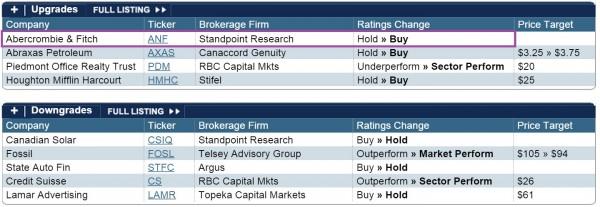
Further evidence of this bad advice are the upgrades and downgrades that brokerages provide to the public. Time after time the stocks that were upgraded saw a price jump into a supply zone only to see investors squander money as the broker’s information led them to losing choices.
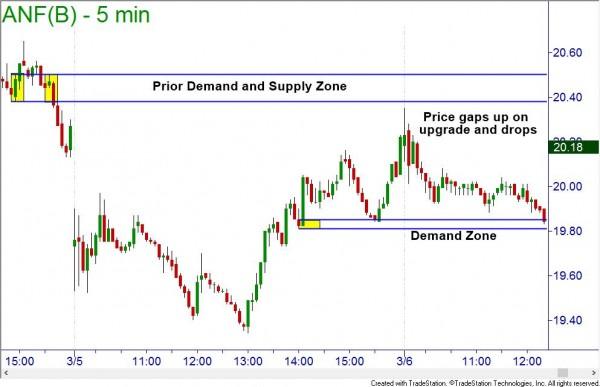
The following upgrade on Abercrombie and Fitch on March 6th is an example. On the morning of the upgrade the stock gapped into a supply zone and those unfortunate people who bought the upgrade saw their money disappear.
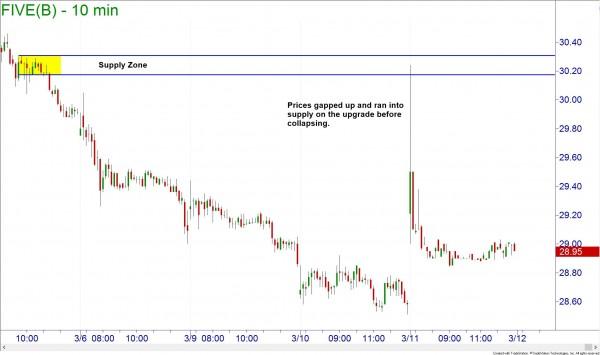
Some may think this is a rare occurrence, but it happens more often than you would think. On the following week, March 11th, the upgrade for Five Below suffered the same fate.
Similar price movement happens when there are downgrades on stocks. Instead of stocks dropping after the brokerage lowered their expectations, the prices usually dropped into a demand zone where someone was able to purchase them at a great discount before the prices rose dramatically.
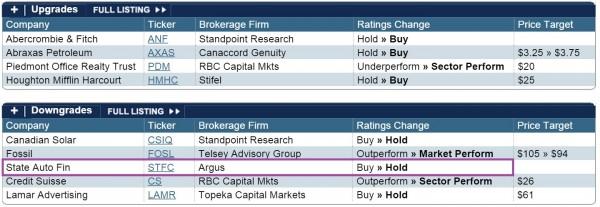
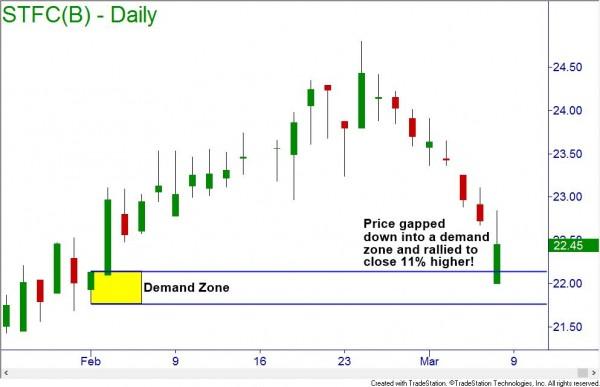
The inverse price movement doesn’t happen with every upgrade/downgrade, but it does happen enough that it should make you suspicious. Even when there is news on a security, it appears that the professionals take the opposite action of the novices who trade with the news. Alliance Fiber Optic had news that sent the stock’s price spiraling downward. It sharply rallied from strong buyers who took advantage of the wholesale prices. Two days later, there was a downgrade on the stock and, not surprisingly, the price rallied intraday after a small drop.
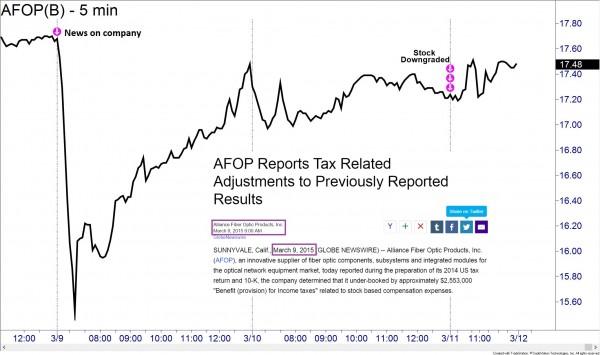
News on companies is often just as bad as the upgrades/downgrades. Most of the time novice traders will sell the stock when there is bad news and buy if there is good. When this happens, prices usually move directly into a supply or demand zone before professionals take advantage of the reversal that follows.
Best Buy (BBY) was on a great rally in 2013 into 2014 before a bad earnings report led to a sell off.
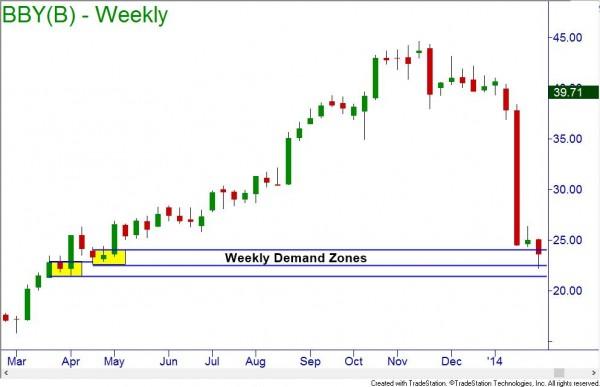
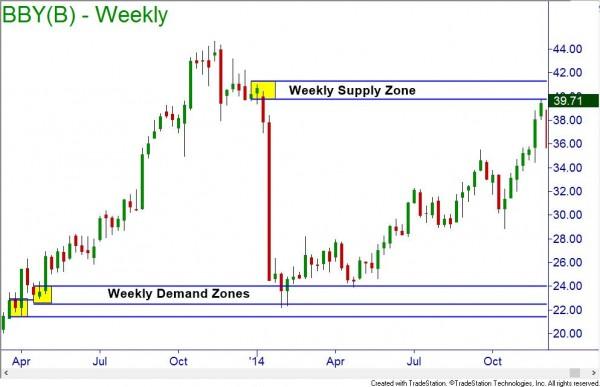
The sell off moved prices right into a weekly demand zone, where professionals took the opportunity to buy at wholesale prices.
So now that we know there is an inherent problem with the equity markets, what can be done about it to protect our money and allow us to profit in our trades and investments? Well, the first thing you should do is to remove yourself from the negative input. There is no need to watch retail news.
When I used to work as a hedge fund trader we paid thousands of dollars to get news as fast as possible. If you want the news first you must be prepared to pay a lot of money for it. Professional traders do not want to wait for the retail news because by the time it is broadcasted to the masses on television or via the internet, the professionals would have already positioned themselves to take advantage of the novice reaction to it.
Another simple solution is to trust your charts. News and recommendations influence people’s thoughts and perceptions. These thoughts and perceptions cause people to act and buy or sell securities. We can see these actions via our charts. By using Online Trading Academy’s Core Strategy, we can easily identify supply and demand zones where the professionals will take advantage of the novice news chasers.
We can then trade with the professionals who are usually on the correct side of the market. This increases our chances for success in our trades and investments and, most importantly, protects us from losing our precious capital. We need to reverse the old saying when it comes to brokerages; we need to do as they do, not as they say!
Neither Freedom Management Partners nor any of its personnel are registered broker-dealers or investment advisers. I will mention that I consider certain securities or positions to be good candidates for the types of strategies we are discussing or illustrating. Because I consider the securities or positions appropriate to the discussion or for illustration purposes does not mean that I am telling you to trade the strategies or securities. Keep in mind that we are not providing you with recommendations or personalized advice about your trading activities. The information we are providing is not tailored to any individual. Any mention of a particular security is not a recommendation to buy, sell, or hold that or any other security or a suggestion that it is suitable for any specific person. Keep in mind that all trading involves a risk of loss, and this will always be the situation, regardless of whether we are discussing strategies that are intended to limit risk. Also, Freedom Management Partners’ personnel are not subject to trading restrictions. I and others at Freedom Management Partners could have a position in a security or initiate a position in a security at any time.
Editors’ Picks

EUR/USD flirts with yearly lows in the sub-1.1600 area
EUR/USD adds to Monday’s heavy losses and breaks below the key 1.1600 support on Tuesday, putting the YTD lows around 1.1570 to the test. The pair’s deep pullback comes as the US Dollar extend its strong bounce, always propped up by the intense flight-to-safety environment.

GBP/USD attacks 1.3300, refreshing three-month lows
GBP/USD is deep in the red near 1.3300, accelerating its downside to renew three-month lows in European trading on Tuesday. The ongoing escalation in the Iran war, combined with rising Oil prices, weighs negatively on the higher-yielding Pound Sterling as the US Dollar capitalizes on increased haven demand.

Japanese Yen flat lines vs. rallying USD; bearish bias remains amid BoJ rate hike delay
The USD/JPY pair extends its sideways consolidative price move through the early European session. Spot prices remain below the highest level in over five weeks, touched the precious day, and currently trade below mid-157.00s, nearly unchanged for the day.
Editors’ Picks
EUR/USD flirts with yearly lows in the sub-1.1600 area
EUR/USD adds to Monday’s heavy losses and breaks below the key 1.1600 support on Tuesday, putting the YTD lows around 1.1570 to the test. The pair’s deep pullback comes as the US Dollar extend its strong bounce, always propped up by the intense flight-to-safety environment.

Oil targets the $80.00 mark amid US-Iran crisis
Crude oil has surged to levels not seen in over a year, trading near the $78.00 mark per barrel and edging closer to a potential test of the key $80.00 threshold. The sharp advance in WTI continues to draw support from escalating geopolitical tensions in the Middle East, the effective shutdown of shipping through the Strait of Hormuz, and mounting concerns over supply disruptions.

Gold remains offered around $5,170
Gold comes under renewed and marked selling pressure on Tuesday, hovering around the $5,170 mark per troy ounce and reversing four consecutive daily advances. The yellow metal’s bearish tone comes on the back of the increasing demand for the Greenback at the time when investors continue to trim bets on further Fed rate cuts.

Crypto Today: Bitcoin, Ethereum, XRP pull back as sentiment remains in extreme market fear
The cryptocurrency market is broadly in the red on Tuesday as the Middle East grapples with an escalating war. Bitcoin (BTC) is in a pullback, trading below $67,000 at the time of writing, and most altcoins follow suit.

Middle East conflict ramps up a gear as energy price spike rips through markets
It’s another risk off day as geopolitical headwinds continue to batter financial markets. Although markets calmed during the US session and US stocks managed to post gains on Monday, this has not fed through to the European session, and stocks and bonds are sharply lower for a second day.
RECOMMENDED LESSONS
Making money in forex is easy if you know how the bankers trade!

I’m often mystified in my educational forex articles why so many traders struggle to make consistent money out of forex trading. The answer has more to do with what they don’t know than what they do know. After working in investment banks for 20 years many of which were as a Chief trader its second knowledge how to extract cash out of the market.
5 Forex News Events You Need To Know

In the fast moving world of currency markets where huge moves can seemingly come from nowhere, it is extremely important for new traders to learn about the various economic indicators and forex news events and releases that shape the markets. Indeed, quickly getting a handle on which data to look out for, what it means, and how to trade it can see new traders quickly become far more profitable and sets up the road to long term success.
Top 10 Chart Patterns Every Trader Should Know

Chart patterns are one of the most effective trading tools for a trader. They are pure price-action, and form on the basis of underlying buying and selling pressure. Chart patterns have a proven track-record, and traders use them to identify continuation or reversal signals, to open positions and identify price targets.
7 Ways to Avoid Forex Scams

The forex industry is recently seeing more and more scams. Here are 7 ways to avoid losing your money in such scams: Forex scams are becoming frequent. Michael Greenberg reports on luxurious expenses, including a submarine bought from the money taken from forex traders. Here’s another report of a forex fraud. So, how can we avoid falling in such forex scams?
What Are the 10 Fatal Mistakes Traders Make
Trading is exciting. Trading is hard. Trading is extremely hard. Some say that it takes more than 10,000 hours to master. Others believe that trading is the way to quick riches. They might be both wrong. What is important to know that no matter how experienced you are, mistakes will be part of the trading process.
The challenge: Timing the market and trader psychology

Successful trading often comes down to timing – entering and exiting trades at the right moments. Yet timing the market is notoriously difficult, largely because human psychology can derail even the best plans. Two powerful emotions in particular – fear and greed – tend to drive trading decisions off course.