 Sam Seiden
Independent Analyst

Walmart, Tesco, Costco, Sam’s Club just to name a few, these are some of the biggest retailers in the world; huge operations that make fortunes in revenue. How do they do it? What is their big secret? Simple, at the end of the day they have simply mastered the skill of buying at wholesale prices and selling at retail prices. Wait, this is supposed to be an article on investing so why write about the retail world of gadgets, clothes, appliances, toilet paper and more? It’s an important topic if you want to understand how to be a successful investor. When you look at the buying and selling actions of the major retailers in the markets they operate in, they are no different than the actions of the successful investor. So, if you’re looking for more income or wealth and thinking of starting a retail business, you may want to think again and consider a path that may be much easier. The difference is that the average investor can do all this from the comforts of their own home.
Let’s get more specific with these actions so that you can become a better investor by the end of this article. For Walmart to profit they have to make sure that there are many willing buyers to pay the retail prices they are charging. When we invest, we must do exactly the same thing. We need retail buyers who are willing to buy at the retail (supply) price levels we are charging when taking profit on an investment that we bought, whether it be an up or a downside move in the market. Take the example below from a recent opportunity found using the Daily Market Overview, one of our daily services for members. In the session, our XLT instructor identified a supply level in the oil market. This is a price level that, according to our rule based analysis, had much more willing supply than demand. Another word for a supply level is “retail.” Next, price rallied up to our pre-determined supply (retail) level which means people were convinced that oil was worth buying at our retail price. After they bought, price declined as it should and we were able to buy lower, profiting from this move.
Again, this is really no different from paying extreme retail prices for a new car. As soon as you sign the papers and drive it off the lot the price declines dramatically. The first step in this process is to accurately identify key supply (retail) prices in a market. The second step is to wait for someone to buy from you at that level. Just like people walk into Walmart each day and pay retail prices; people will be more than willing to pay your retail prices in the markets. This is because most people buy on good news and in strong up trends. In both cases, they are typically buying at or near retail prices.
Oil Market – April 21st, 2015
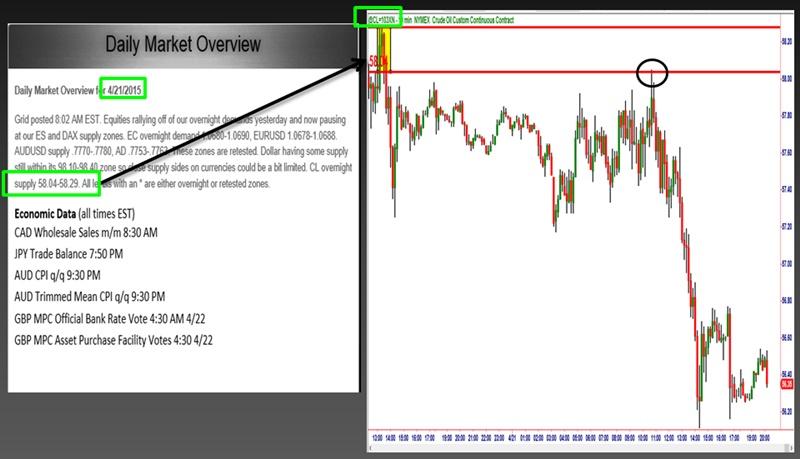
Take a good look at the chart and specifically at the supply level and then the rally into it followed by the decline. That picture is the same picture of price movement if you were to buy something at Walmart and then try to sell it at a garage sale at your home. You are going to sell it for a much lower price than you bought it for at the store. Whether we are talking the oil Market or a Walmart product, the chart is identical. Just like the retail store, you must know what retail price to sell at (supply levels) and you must have the patience and discipline to wait for someone to be willing to buy at that level.
You really do have your own retail business going at your home if you think about it. Smart investors know price levels that are too low (demand/wholesale) and price levels that are too high (supply/retail). They buy at wholesale prices from people who are conditioned and willing to sell at wholesale prices. They also sell at retail prices to buyers who are conditioned and willing to buy at retail prices. Then, they just repeat the same simple process over and over for their entire life. Those who pay retail prices in the markets create wealth for Wall Street. Those who pay wholesale prices create wealth for themselves. Another way to say that: Some people create their own pension from the financial system; others create it for Wall Street. Who are you?
Hope this was helpful, have a great day.
Note: All information on this page is subject to change. The use of this website constitutes acceptance of our user agreement. Please read our privacy policy and legal disclaimer. Opinions expressed at FXstreet.com are those of the individual authors and do not necessarily represent the opinion of FXstreet.com or its management. Risk Disclosure: Trading foreign exchange on margin carries a high level of risk, and may not be suitable for all investors. The high degree of leverage can work against you as well as for you. Before deciding to invest in foreign exchange you should carefully consider your investment objectives, level of experience, and risk appetite. The possibility exists that you could sustain a loss of some or all of your initial investment and therefore you should not invest money that you cannot afford to lose. You should be aware of all the risks associated with foreign exchange trading, and seek advice from an independent financial advisor if you have any doubts.
Editors’ Picks

EUR/USD eyes nine-day EMA barrier after rebounding from 1.1600
EUR/USD gains ground after registering modest losses in the previous session, trading around 1.1620 during the Asian hours on Friday. The technical analysis of the daily chart suggests an ongoing bearish bias as the pair remains within the descending channel pattern.

GBP/USD: Pound Sterling ticks up against US Dollar in countdown to US NFP
The Pound Sterling trades marginally higher to near 1.3365 against the US Dollar during the Asian trading session on Friday. The GBP/USD pair edges up as the US Dollar ticks down ahead of the United States Nonfarm Payrolls data for February, which will be published at 13:30 GMT.

USD/JPY struggles near 157.50, eyes turn to US NFP
USD/JPY edges lower to near 157.50 in the Asian session on Friday after posting modest gains in the previous session. Broad US Dollar weakness, Japanese FX intervention risks and a risk-off market mood undermine the major, despite uncertainty over the BoJ interest rate hikes. All eyes now remain on the US Nonfarm Payrolls data.
Editors’ Picks
EUR/USD eyes nine-day EMA barrier after rebounding from 1.1600
EUR/USD gains ground after registering modest losses in the previous session, trading around 1.1620 during the Asian hours on Friday. The technical analysis of the daily chart suggests an ongoing bearish bias as the pair remains within the descending channel pattern.
GBP/USD: Pound Sterling ticks up against US Dollar in countdown to US NFP
The Pound Sterling trades marginally higher to near 1.3365 against the US Dollar during the Asian trading session on Friday. The GBP/USD pair edges up as the US Dollar ticks down ahead of the United States Nonfarm Payrolls data for February, which will be published at 13:30 GMT.

Gold rises but remains on track for weekly loss in five weeks
Gold price recovers its recent losses from the previous session on Friday. The yellow metal advances as the broader precious metals market rebounds on safe-haven demand. However, the yellow metal is on track for its first weekly decline in five weeks as escalating Middle East tensions push oil prices higher, fueling inflation concerns and reducing bets on Federal Reserve rate cuts.

Bitcoin, Ethereum and Ripple at risk as US-Iran war extends
Bitcoin, Ethereum, and Ripple trade cautiously at press time on Friday, close to key support levels after a roughly 2% pullback the previous day. Bitcoin holds above $71,000, Ethereum at $2,000, and XRP continues to consolidate in a sideways range.

The market compass is pointing at a barrel of Oil
The Asian open is arriving with equities leaning the wrong way, and the reason is not complicated. The market’s compass needle has snapped firmly toward crude. In this tape, oil is not just another input price; it is the gravitational center around which every asset class is orbiting.
RECOMMENDED LESSONS
Making money in forex is easy if you know how the bankers trade!

I’m often mystified in my educational forex articles why so many traders struggle to make consistent money out of forex trading. The answer has more to do with what they don’t know than what they do know. After working in investment banks for 20 years many of which were as a Chief trader its second knowledge how to extract cash out of the market.
5 Forex News Events You Need To Know

In the fast moving world of currency markets where huge moves can seemingly come from nowhere, it is extremely important for new traders to learn about the various economic indicators and forex news events and releases that shape the markets. Indeed, quickly getting a handle on which data to look out for, what it means, and how to trade it can see new traders quickly become far more profitable and sets up the road to long term success.
Top 10 Chart Patterns Every Trader Should Know

Chart patterns are one of the most effective trading tools for a trader. They are pure price-action, and form on the basis of underlying buying and selling pressure. Chart patterns have a proven track-record, and traders use them to identify continuation or reversal signals, to open positions and identify price targets.
7 Ways to Avoid Forex Scams

The forex industry is recently seeing more and more scams. Here are 7 ways to avoid losing your money in such scams: Forex scams are becoming frequent. Michael Greenberg reports on luxurious expenses, including a submarine bought from the money taken from forex traders. Here’s another report of a forex fraud. So, how can we avoid falling in such forex scams?
What Are the 10 Fatal Mistakes Traders Make
Trading is exciting. Trading is hard. Trading is extremely hard. Some say that it takes more than 10,000 hours to master. Others believe that trading is the way to quick riches. They might be both wrong. What is important to know that no matter how experienced you are, mistakes will be part of the trading process.
The challenge: Timing the market and trader psychology

Successful trading often comes down to timing – entering and exiting trades at the right moments. Yet timing the market is notoriously difficult, largely because human psychology can derail even the best plans. Two powerful emotions in particular – fear and greed – tend to drive trading decisions off course.