 Sam Seiden
Independent Analyst

Often, I write articles about the importance of having or owning a competitive edge. It is amazing to me that people in general focus very little on this most important topic. Most traders read trading books and learn to buy and sell where everyone else who reads the books buys and sells, which ensures you will not have an edge. With most things in life, trading for sure, there is a winner and a loser. The consistent winner has an edge over the loser that includes two things:
Mental: Having a mental edge is a combination of proper reality based thinking (void of illusion), having extreme self-control and focus.
Strategy: Having a strategic edge means owning a rule based strategy that ensures success over your opponent. Your strategy must offer you the lowest risk, highest reward and highest probability entry.
I started my career on the floor of the Chicago Mercantile Exchange facilitating institutional order flow. In other words, I started on the institution side of the business, not the retail side. So, I had the privilege of learning how the game of making and losing money really happens in trading. In this piece, I want to share with you one of the tricks that allow Online Trading Academy students to enjoy a trading edge that can’t be obtained by reading a trading book.
To convey this important nugget of information let’s use a trading opportunity from the Mastermind Community at Online Trading Academy.
Euro Income Trade – Supply/Demand Grid 3/5/15
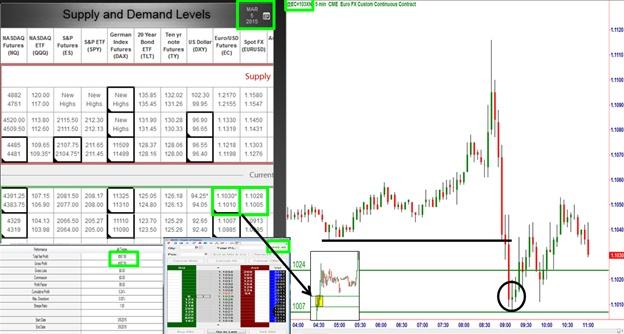
The Supply and Demand levels grid you see above is a service my team and I produce each day for Mastermind Community Members. It offers three supply and demand levels on 20 of the biggest markets in the world. On March 5th, two of the levels on the grid were demand levels in the Euro Futures and Spot. This is a level where our strategy told us there were unfilled buy orders from banks and institutions, strong demand. Make sure you understand that this demand level is NOT the black line on the chart. The demand level on the grid was just below that and to the left, not seen on the chart here but shown in the little box. The black line is from the lows of the price action on the chart which many would look at as conventional price “support.” Every trading book is going to draw a line from that area and extend it right, calling it “support.” So that means, we know that when price comes back to that level retail traders will typically buy at that level and place their protective sell stop just below the level. We also know that most retail traders lose money… When price came back to that level and retail traders bought, price then dipped below it triggering their sell stops. Keep in mind that our demand level is sitting just below that black line which is where we are willing buyers. So, when the retail sell stops were being triggered who do you think was buying and filling those orders? If you said banks and financial institutions you are correct, for the most part. This is exactly where Online Trading Academy students were instructed to buy also. Partly because of the demand and partly because we knew retail sell stops would be sitting at that level which is where we want to buy. Being able to out think your competition means understanding exactly how your competition thinks and acts which was the case here. The short term income trade worked out fine for a gain of a little more than $1,000.
My hope from this piece is that you understand how important it is to have a competitive edge when putting your hard earned money at risk in the markets. Each day wealth is transferred from those without an edge into the accounts of those who have that important edge.
Note: All information on this page is subject to change. The use of this website constitutes acceptance of our user agreement. Please read our privacy policy and legal disclaimer. Opinions expressed at FXstreet.com are those of the individual authors and do not necessarily represent the opinion of FXstreet.com or its management. Risk Disclosure: Trading foreign exchange on margin carries a high level of risk, and may not be suitable for all investors. The high degree of leverage can work against you as well as for you. Before deciding to invest in foreign exchange you should carefully consider your investment objectives, level of experience, and risk appetite. The possibility exists that you could sustain a loss of some or all of your initial investment and therefore you should not invest money that you cannot afford to lose. You should be aware of all the risks associated with foreign exchange trading, and seek advice from an independent financial advisor if you have any doubts.
Editors’ Picks

EUR/USD flirts with three-day lows near 1.1570
EUR/USD resumes its march south on Thursday, revisting the 1.1570 region, or three-day lows, ahead of the opening bell in Asia. The intense sell-off in the pair comes in response to the solid performance of the US Dollar amid the still unresolved crisis in the Middle East. Moving forward, investors are expected to shift their focus to the release of the US NFP on Friday.

GBP/USD stays offered near 1.3340
GBP/USD fades Wednesday’s uptick and trades with decent losses in the 1.3340 zone in the latter part of Thursday’s session. Cable’s weakness, alongside the rest of the risk complex, follows the strong performance of the Greenback amid intense geopolitical jitters.

Japanese Yen turns upside down against US Dollar as dovish Fed bets recede
The Japanese Yen gives back its early gains and turns negative against the US Dollar during the European trading session on Thursday. The USD/JPY pair rises to near 157.35 as the US Dollar resumes its upside journey after a corrective move. As of writing, the US Dollar Index trades 0.4% higher to near 99.15.
Editors’ Picks

AUD/USD looks weak, breaches below 0.7000
AUD/USD quickly forgets about Wednesday’s advance and resumes the weekly correction, breaching below the 0.7000 mark to hit fresh two-day troughs and opening the door to a potential challenge of monthly lows in the 0.6950-0.6940 band. In the meantime, the increasing flight-to-safety environment is expected to keep the Aussie and its risk-linked peers under intense pressure for now.
EUR/USD flirts with three-day lows near 1.1570
EUR/USD resumes its march south on Thursday, revisting the 1.1570 region, or three-day lows, ahead of the opening bell in Asia. The intense sell-off in the pair comes in response to the solid performance of the US Dollar amid the still unresolved crisis in the Middle East. Moving forward, investors are expected to shift their focus to the release of the US NFP on Friday.

Gold: further weakness could challenge $5,000
Gold comes under fresh selling pressure on Thursday, slipping back below the $5,100 mark per troy ounce. Persistent strength in the US Dollar (USD) is preventing the yellow metal from building a meaningful recovery, even as markets remain risk-averse amid the deepening conflict in the Middle East.

XRP rises as crypto market steadies despite Middle East war
Ripple (XRP) continues to demonstrate notable resilience as the cryptocurrency market navigates the persistent war in the Middle East after the United States (US) and Israel attacked Iran on Saturday.

Two PMIs, two Chinas Premium
China’s economic data are often treated with a degree of caution by global investors. The challenge is not necessarily that the numbers are incorrect, but that they can describe very different parts of a vast and complex economy. Nowhere is that more evident than in China’s PMIs.
RECOMMENDED LESSONS
Making money in forex is easy if you know how the bankers trade!

I’m often mystified in my educational forex articles why so many traders struggle to make consistent money out of forex trading. The answer has more to do with what they don’t know than what they do know. After working in investment banks for 20 years many of which were as a Chief trader its second knowledge how to extract cash out of the market.
5 Forex News Events You Need To Know

In the fast moving world of currency markets where huge moves can seemingly come from nowhere, it is extremely important for new traders to learn about the various economic indicators and forex news events and releases that shape the markets. Indeed, quickly getting a handle on which data to look out for, what it means, and how to trade it can see new traders quickly become far more profitable and sets up the road to long term success.
Top 10 Chart Patterns Every Trader Should Know

Chart patterns are one of the most effective trading tools for a trader. They are pure price-action, and form on the basis of underlying buying and selling pressure. Chart patterns have a proven track-record, and traders use them to identify continuation or reversal signals, to open positions and identify price targets.
7 Ways to Avoid Forex Scams

The forex industry is recently seeing more and more scams. Here are 7 ways to avoid losing your money in such scams: Forex scams are becoming frequent. Michael Greenberg reports on luxurious expenses, including a submarine bought from the money taken from forex traders. Here’s another report of a forex fraud. So, how can we avoid falling in such forex scams?
What Are the 10 Fatal Mistakes Traders Make
Trading is exciting. Trading is hard. Trading is extremely hard. Some say that it takes more than 10,000 hours to master. Others believe that trading is the way to quick riches. They might be both wrong. What is important to know that no matter how experienced you are, mistakes will be part of the trading process.
The challenge: Timing the market and trader psychology

Successful trading often comes down to timing – entering and exiting trades at the right moments. Yet timing the market is notoriously difficult, largely because human psychology can derail even the best plans. Two powerful emotions in particular – fear and greed – tend to drive trading decisions off course.