 Sam Seiden
Independent Analyst

Have you ever wondered why the percentage of people who fail at trading is so high? I have heard that 90% or more of people who dive into the trading world end up losing their money. What about average investors, do most people really achieve their long term financial goals? Compare for a moment, the average trader or investor’s returns to the average Wall Street firm’s returns. We would probably all agree it’s a lopsided equation. But, what does the average trader or investor do? The average person “buys stock.” What is Wall Street’s primary business? If you said “selling stocks,” you’re correct. So, one group is buying stocks and the other is selling, and the sellers are making all the money. Understand that I am not suggesting we should all stop buying stocks and start selling them. I am, however, strongly suggesting that you start thinking and acting like the average Wall Street firm (or consistently profitable trader) who is laughing all the way to the bank, typically with your money.
Why is this profit equation so out of balance? Why do the masses lose and the few successful traders do so well? To answer that question you need to think about how the average trader or investor is trained and conditioned to “buy” into a market, or a stock for that matter. This includes you, me, and anyone else you know. Take yourself back to grade school, high school, college, grad school, and also include just about any trading book you have ever read. I remember the lessons on how to buy into a market. When it’s a stock, we are taught to make sure:
It’s a good company
It has strong management
It has a healthy balance sheet
It has very strong earnings, especially compared to competitors
The stock is in an uptrend
When all these things are present with a stock, where do you think the price of the stock is? Do you think it’s ever low? It can’t be by definition. When all those items are true, the price of the stock (market) is always high and typically at price levels where the average Wall Street firm or consistently profitable market speculator is selling. People don’t realize that almost everyone from a young age is taught and conditioned to do this completely backwards. I mean, think about how you profit buying and selling anything else in life. We always try and buy things when they are cheap and sell when price is high. Why is it that when people put their hard earned money at risk in the market, they do the exact opposite? The core reason is because of a mass illusion which is this: people think that how you buy and sell things in other parts of your life is somehow different from how you properly buy and sell in the financial markets. The truth is, there is no difference! This is the single most important edge the consistently profitable trader (or Wall Street firm) has over the massive investing public around the world.
Who Really Makes money?
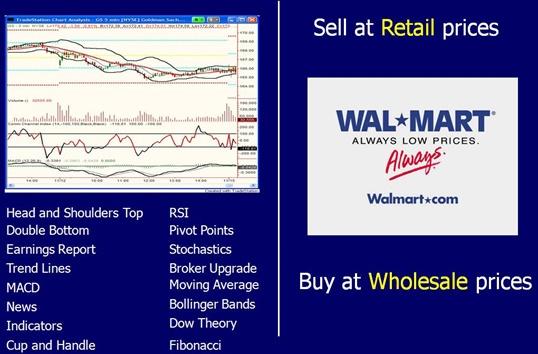
Consider the two pictures above on the left and right. Ask yourself, who really makes consistent profits? Let’s start on the left. Many traders and investors load their charts with indicators and oscillators, so many that it becomes hard to see the candles on the chart. I have also listed a few of the many conventional Technical Analysis terms below the chart. Now, truly ask yourself this question: Do you really know anyone who makes a consistent low risk living year after year with the chart or items on the left? I already know the answer to this question, which is no. This is because there is a major flaw with that school of thought. Everything you see there lags price and only gives buy signals after price has moved higher which guarantees you are not going to buy low and sell high. Instead, this school of thought has you buying high and selling low which is exactly what the consistently profitable trader wants you to do. What about the picture on the right, do they make consistent profits? You bet they do. Walmart makes more money than some countries print. How do they do it? What is their big secret? They buy at wholesale prices and sell at retail prices and people line up day and night to pay the retail prices they are offering. What a great trading company! What I pride myself on in trading is acting exactly like Walmart. It may not sound fun, exciting, or sexy to desire being Walmart but trust me… in trading, you want to be Walmart because like the average Wall Street firm or consistently profitable trader, they are laughing all the way to the bank.
Gold (GC) Core Strategy Trade
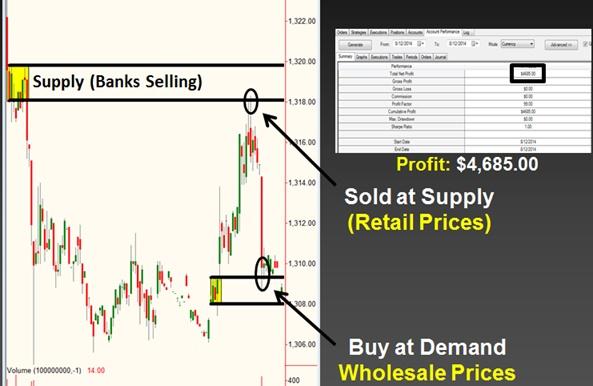
There are two very important components to consistently profitable trading. First, understand that how you make money in any other part of life, buying low and selling high, is exactly how you profit when speculating in the financial markets. Second, learn to identify wholesale and retail prices on a chart. Once you can do this, just buy at wholesale prices (demand levels) and sell at retail prices (supply levels). Let me walk you through a trade I took in Gold to help you begin to identify the buying and selling patterns of Walmart, Costco, Goldman Sachs, JP Morgan, and the rest. First, look at the level identified as Supply (shaded yellow above). We call this a supply level or “retail” price level because price could not stay at that level and declined from that level. This happens because supply exceeds demand at that level. Now notice the area identified as Demand (shaded yellow). We call this demand or “wholesale” prices because price could not stay at that level and had to rally away. This can only happen because demand exceeds supply at that price level. The distance between the demand and supply level on the chart is the zone or “profit margin.” Am I analyzing this market or product any different than Walmart, Costco, or Goldman Sachs would? Nope… The trade I took, which is shown, was simply selling short at predetermined retail prices (supply) to someone who was willing to buy at that price, then taking profits by buying back the short position closer to predetermined wholesale prices (demand) from someone who was more than willing to sell at wholesale prices. Why would someone buy at retail prices and sell at wholesale prices? Simple, because they are conditioned to do this through conventional education and Wall Street.
How is this any different than how Walmart profits each day? What I do may be boring because I am doing the same thing every day, buying at wholesale prices and selling at retail prices, but I am not in the trading and investing world for excitement. The main idea to take from this piece is to understand that how you make money buying and selling anything is exactly how you make money trading. There is no difference. Also, if you’re thinking that I should stop writing about this concept because too many people will catch on and then the supply/demand strategy will not work for the rest of us anymore. Have no fear… There are an endless amount of people who will always be willing to buy at retail prices and sell at wholesale prices. Everyone is taught to do this backwards from a very young age, the conditioning of the belief system is so strong. If you want more comfort, just go to the book store and read a trading book. Almost all of them have you buying after price has already rallied. Let go of dangerous conventional thinking and embrace the opportunities that come with reality based thinking.
Hope this was helpful. Have a great day.
Note: All information on this page is subject to change. The use of this website constitutes acceptance of our user agreement. Please read our privacy policy and legal disclaimer. Opinions expressed at FXstreet.com are those of the individual authors and do not necessarily represent the opinion of FXstreet.com or its management. Risk Disclosure: Trading foreign exchange on margin carries a high level of risk, and may not be suitable for all investors. The high degree of leverage can work against you as well as for you. Before deciding to invest in foreign exchange you should carefully consider your investment objectives, level of experience, and risk appetite. The possibility exists that you could sustain a loss of some or all of your initial investment and therefore you should not invest money that you cannot afford to lose. You should be aware of all the risks associated with foreign exchange trading, and seek advice from an independent financial advisor if you have any doubts.
Editors’ Picks

EUR/USD rebounds from session lows, stays below 1.1650
EUR/USD is recovers modestly from session lows but remains in the red below 1.1650 in European trading on Thursday. The pair faces headwinds from a renewed uptick in the US Dollar amid a negative shift in risk sentiment. Surging energy prices due to the Middle East war keep the bearish pressure intact on the Euro. The US Jobless Claims data are next of note.

GBP/USD stays weak near 1.3350 amid UK stagflation risks
GBP/USD sticks to losses near 1.3350 in the European session on Thursday. The Pound Sterling loses ground amid fears that the United Kingdom economy could face stagflation risks due to higher energy prices, while the US Dollar attracts fresh havem demand ahead of the US Jobless Claims data.

Japanese Yen turns upside down against US Dollar as dovish Fed bets recede
The Japanese Yen gives back its early gains and turns negative against the US Dollar during the European trading session on Thursday. The USD/JPY pair rises to near 157.35 as the US Dollar resumes its upside journey after a corrective move. As of writing, the US Dollar Index trades 0.4% higher to near 99.15.
Editors’ Picks
EUR/USD rebounds from session lows, stays below 1.1650
EUR/USD is recovers modestly from session lows but remains in the red below 1.1650 in European trading on Thursday. The pair faces headwinds from a renewed uptick in the US Dollar amid a negative shift in risk sentiment. Surging energy prices due to the Middle East war keep the bearish pressure intact on the Euro. The US Jobless Claims data are next of note.
GBP/USD stays weak near 1.3350 amid UK stagflation risks
GBP/USD sticks to losses near 1.3350 in the European session on Thursday. The Pound Sterling loses ground amid fears that the United Kingdom economy could face stagflation risks due to higher energy prices, while the US Dollar attracts fresh havem demand ahead of the US Jobless Claims data.

Gold climbs near $5,200 as Iran war fuels safe-haven demand
Gold price extends its gains for the second successive session on Thursday as traders seek safety amid the ongoing war in the Middle East. US and Israeli strikes across Iranian territory and widespread Iranian missile and drone retaliation across the Middle East, including attacks on regional targets and military sites, prolong the crisis and its impact.

Three reasons to be bearish on Bitcoin
Bitcoin is holding up well taking into account the uncertainty stemming from the Middle East. Despite this week’s rally, the long-term outlook remains bearish. Here are three reasons why I think the storm for the largest cryptocurrency isn't over yet.

Markets attempt to rally on positive news from Iran
There’s been an abrupt change in sentiment this morning, European stock markets are higher and oil and gas prices are moderating, after comments from Iran’s deputy minister about pre-conflict talks between Iran and the US.
RECOMMENDED LESSONS
Making money in forex is easy if you know how the bankers trade!

I’m often mystified in my educational forex articles why so many traders struggle to make consistent money out of forex trading. The answer has more to do with what they don’t know than what they do know. After working in investment banks for 20 years many of which were as a Chief trader its second knowledge how to extract cash out of the market.
5 Forex News Events You Need To Know

In the fast moving world of currency markets where huge moves can seemingly come from nowhere, it is extremely important for new traders to learn about the various economic indicators and forex news events and releases that shape the markets. Indeed, quickly getting a handle on which data to look out for, what it means, and how to trade it can see new traders quickly become far more profitable and sets up the road to long term success.
Top 10 Chart Patterns Every Trader Should Know

Chart patterns are one of the most effective trading tools for a trader. They are pure price-action, and form on the basis of underlying buying and selling pressure. Chart patterns have a proven track-record, and traders use them to identify continuation or reversal signals, to open positions and identify price targets.
7 Ways to Avoid Forex Scams

The forex industry is recently seeing more and more scams. Here are 7 ways to avoid losing your money in such scams: Forex scams are becoming frequent. Michael Greenberg reports on luxurious expenses, including a submarine bought from the money taken from forex traders. Here’s another report of a forex fraud. So, how can we avoid falling in such forex scams?
What Are the 10 Fatal Mistakes Traders Make
Trading is exciting. Trading is hard. Trading is extremely hard. Some say that it takes more than 10,000 hours to master. Others believe that trading is the way to quick riches. They might be both wrong. What is important to know that no matter how experienced you are, mistakes will be part of the trading process.
The challenge: Timing the market and trader psychology

Successful trading often comes down to timing – entering and exiting trades at the right moments. Yet timing the market is notoriously difficult, largely because human psychology can derail even the best plans. Two powerful emotions in particular – fear and greed – tend to drive trading decisions off course.