 Sam Seiden
Independent Analyst

I remember my days on the trading floor of the Chicago Mercantile Exchange. My job was to facilitate institution order flow. Each day, I would take orders from banks, institutions, money managers, and so on and facilitate the execution of those orders into the various markets. Having the real buy and sell orders from the institutions in front of me, you could clearly see where the strongest demand and supply was in the markets. If I wanted to know where the S&P was going to stop falling and turn higher, all I had to do is look in front of me and see where the largest amount of buy orders were below current price, the markets real demand and vice versa for supply. Each day, price just moved from where the significant buy orders where (demand), to the price level where significant sell orders were (supply).
Today, we don’t have much in the way of paper orders anymore like I dealt with on the trading floor. Just about everything has gone electronic. However, from my 30,000 foot view of how people understand and trade the markets today, it is so clear what has happened over the years. What is such a simple and obvious equation has turned into complex math driven strategies, endless combinations of indicators, PhD level economics, and much more due to the technology boom of the past decade. While technology has advanced so much and change happens almost daily, how we make money buying and selling in markets has not changed one bit. What caused price to turn and move many years ago is exactly what causes price to turn and move today. It is still 100% the simple supply and demand equation as it always has been.
OTA Supply/Demand Grid, August 5/6, 2014
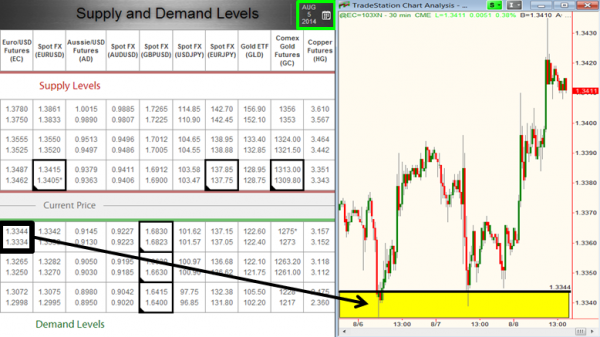
Therefore, it is our job to use price charts to figure out where those orders are, the demand and supply. At Online Trading Academy, we look for the picture that represents those orders as that is where prices turn which is the origin of any market move. To do this, we use a checklist called “Odds Enhancers.” Above is the Supply/Demand grid in the Mastermind Community, a service for our graduates each day. Notice last week, the grid identified where banks were buying Euros. Let me share some Odds Enhancers with you here that helped identify this key level for our grads. I will do this in hopes of improving your short term trading for income and long term wealth.
1) How did price leave level?
The stronger the move in price away from an area, the more out of balance supply and demand is at the area. This is what causes the strong turn and move in price in a market, a big supply and demand imbalance.
2) How much time did price spend at the level?
At price levels where supply and demand are most out of balance, you always get the least amount of trading activity. Therefore, the less time price spends at a level, the more out of balance supply and demand is at the level. So, don’t focus on where price traded at but instead, become more interested in levels price could not trade at or had trouble trading at.
3) First retracement?
Most trading books tell us when we are buying at support or selling at resistance, don’t take the first retracement. Instead, let the level be tested a few times to make sure it’s strong. I would suggest the opposite with Odds Enhancer number three. We want to enter the position on the first retracement because it is at that point that supply or demand is strongest. With each successive retracement in price, the level is getting weaker, not stronger like the trading books suggest. Remember, it’s all about the orders.
There are more Odds Enhancers of course such as “profit zone” which is key but these are some that allowed us to determine where the significant demand and supply was July 5th in the Euro, above. Seeing where these orders are on the price chart is the key to everything we do. It is how we are able to attain the lowest risk, highest reward, and highest probability entry (and exit) in any market and time frame. The hardest part is realizing that how and why prices turn and move in markets has never changed, no matter how far technology advances. Faster and better number crunching will never be more important than knowing where banks are buying and selling. Keeping things simple is the single greatest challenge for the average person from my experience.
Hope this was helpful, have a great day.
Note: All information on this page is subject to change. The use of this website constitutes acceptance of our user agreement. Please read our privacy policy and legal disclaimer. Opinions expressed at FXstreet.com are those of the individual authors and do not necessarily represent the opinion of FXstreet.com or its management. Risk Disclosure: Trading foreign exchange on margin carries a high level of risk, and may not be suitable for all investors. The high degree of leverage can work against you as well as for you. Before deciding to invest in foreign exchange you should carefully consider your investment objectives, level of experience, and risk appetite. The possibility exists that you could sustain a loss of some or all of your initial investment and therefore you should not invest money that you cannot afford to lose. You should be aware of all the risks associated with foreign exchange trading, and seek advice from an independent financial advisor if you have any doubts.
Editors’ Picks

EUR/USD struggles to regain momentum in the low1.1600s
EUR/USD is giving some signs of life in the aftermath of two severe days of losses on Wednesday, reclaiming the 1.1600 hurdle and above on the back of the resurgence of a mild selling bias around the US Dollar. Moving forward, the usual US weekly Claims will take centre stage on Thursday ahead of Friday’s crucial NFP data.

GBP/USD appears bid around 1.3370
GBP/USD reverses part of its recent multi-day decline, gathering some balance and managing to reach the 1.3400 region, where some initial resistance seems to have turned up. Cable’s uptick comes in response to some loss of momentum in the Greenback despite the geopolitical scenario remaining fragile.

USD/JPY retraces to near 157.50 amid Japanese intervention fears
USD/JPY pulls back to near 157.50 in the Asian session on Wednesday as bulls turn cautious amid Japanese FX intervention fears following the recent rally to a nearly six-week high, reached Tuesday. Meanwhile, reduced bets for an immediate BoJ rate hike undermine the Japanese Yen, while the flight to safety benefits the US Dollar's status as a global reserve currency amid expectations for a less dovish Fed, keeping the downside limited for the pair.
Editors’ Picks

AUD/USD: Recovery now targets 0.7100
AUD/USD reverses two steep daily declines in a row, gathering fresh steam and retargeting the key 0.7100 barrier at the end of the NA session on Wednesday. Fresh selling pressure around the Greenback allows the Aussie to regain traction, coming back from Tuesday’s four-week lows near 0.6950.
EUR/USD struggles to regain momentum in the low1.1600s
EUR/USD is giving some signs of life in the aftermath of two severe days of losses on Wednesday, reclaiming the 1.1600 hurdle and above on the back of the resurgence of a mild selling bias around the US Dollar. Moving forward, the usual US weekly Claims will take centre stage on Thursday ahead of Friday’s crucial NFP data.

Gold recovers modestly despite intensifying Middle East crisis
Gold keeps its daily gains well in place, although a break above the $5,200 mark per troy ounce still remains elusive on Wednesday. The yellow metal’s rebound comes in response to the persistent flight-to-safety amid intense geopolitical tensions in the Middle East and the bearish performance of the US Dollar.

XRP rises alongside peers as ETFs attract inflows
Ripple (XRP) is gaining upside momentum, trading above $1.40 at the time of writing on Wednesday. The remittance token is rising in tandem with major crypto assets, including Bitcoin (BTC), which has crossed above the pivotal $70,000 level, and Ethereum (ETH), which is holding above $2,000.

First Venezuela, now Iran: The US-China energy war escalates Premium
At first glance, the latest escalation involving the United States with both Iran and Venezuela looks like another chapter in a long-running geopolitical story. But viewed through a broader strategic lens, something else may be unfolding: Energy.
RECOMMENDED LESSONS
Making money in forex is easy if you know how the bankers trade!

I’m often mystified in my educational forex articles why so many traders struggle to make consistent money out of forex trading. The answer has more to do with what they don’t know than what they do know. After working in investment banks for 20 years many of which were as a Chief trader its second knowledge how to extract cash out of the market.
5 Forex News Events You Need To Know

In the fast moving world of currency markets where huge moves can seemingly come from nowhere, it is extremely important for new traders to learn about the various economic indicators and forex news events and releases that shape the markets. Indeed, quickly getting a handle on which data to look out for, what it means, and how to trade it can see new traders quickly become far more profitable and sets up the road to long term success.
Top 10 Chart Patterns Every Trader Should Know

Chart patterns are one of the most effective trading tools for a trader. They are pure price-action, and form on the basis of underlying buying and selling pressure. Chart patterns have a proven track-record, and traders use them to identify continuation or reversal signals, to open positions and identify price targets.
7 Ways to Avoid Forex Scams

The forex industry is recently seeing more and more scams. Here are 7 ways to avoid losing your money in such scams: Forex scams are becoming frequent. Michael Greenberg reports on luxurious expenses, including a submarine bought from the money taken from forex traders. Here’s another report of a forex fraud. So, how can we avoid falling in such forex scams?
What Are the 10 Fatal Mistakes Traders Make
Trading is exciting. Trading is hard. Trading is extremely hard. Some say that it takes more than 10,000 hours to master. Others believe that trading is the way to quick riches. They might be both wrong. What is important to know that no matter how experienced you are, mistakes will be part of the trading process.
The challenge: Timing the market and trader psychology

Successful trading often comes down to timing – entering and exiting trades at the right moments. Yet timing the market is notoriously difficult, largely because human psychology can derail even the best plans. Two powerful emotions in particular – fear and greed – tend to drive trading decisions off course.