 Sam Seiden
Independent Analyst

Think about it… If you had the worlds unfilled buy and sell orders in front of you at each price level in the markets you were trading, how simple would trading be? You would know where price was going to turn as that would always happen at price levels where supply and demand are very much out of balance. You would also know where price was going to move as price always moves quickly through price levels where you have a lack of buy and sell orders. If it sounds like I am writing this article during a trading dream in fantasy land, think again. The truth is, we all have this information in front of us all the time, if you know what you’re looking for and what to be focused on when looking at a price chart.
When I talk about supply and demand levels, I am specifically talking about the size of buy and sell orders from willing buyers and sellers. I say “willing” because they have not bought all they wanted to buy yet. Let’s say I’m looking at the actual buy and sell orders, specifically the sell orders as I will reference that later in this piece. I am looking to short the market as I see a price level a little higher where there is a significant amount of unfilled supply and I see no significant buy orders (demand) until much further down in price. So, I am expecting price to turn lower from supply and fall down to demand. In that scenario, things are very set and there is almost a profit guaranteed barring any earth moving event where a huge set of new orders come into the market which hardly ever happens. This is a big reason people paid so much money for seats on the exchange years ago, it’s all about visibility to the significant orders. Now, let’s focus on the supply where we are expecting price to turn lower at. What if just above that supply area, there was an even larger amount of supply? Would you now feel even better about shorting at that level? Of course you would. This is like asking you how thick you want your floor, ceiling, and insulation in your house. We all pay the premium for “stronger.”
Let’s look at a trade I took last week in the NASDAQ Futures to help explain this exact same concept by looking at a price chart. The yellow shaded boxes (A and B) are two supply levels on top of each other and represent one thing and one thing only, price levels where there were significant unfilled sell orders (supply). With these two key supply levels present and the big profit zone below (circled area) below, the opportunity for a very high probability shorting opportunity was at hand. Why?
1) Two stacks of sell orders on top of each other (A and B). One was DBD and the other was RBD which is very strong as it is a little farther out on the curve. The benefit of two stacks of orders is that many buy orders will be filled at the first supply (A) meaning that if and when price gets through that level, moves higher, and maybe even reaches the next supply level (B), there will not be many buy orders left at the same time there are many sell orders. Hence, a major supply and demand imbalance which is where price always turns.
2) A key profit zone below. Notice the circled area on the chart. This is the price action below supply and prior to price reaching our supply levels. If you follow our rule based strategy at Online Trading Academy, there is no significant demand in that circle meaning no significant unfilled buy orders below (the floor is very weak and really not even there). This allows price to easily decline through that level which it did a bit later.
NASDAQ Income Trade 6/26/14 Profit: $760.00
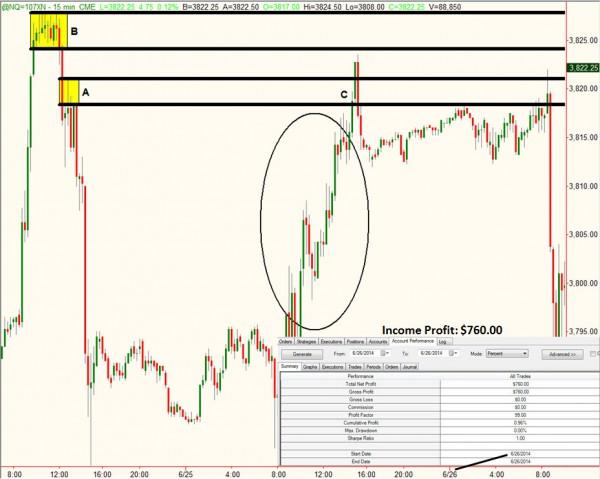
When price rallied back to our supply level (C), notice is struggled once it got close to the first supply (A). This is because the buy orders were met with plenty of sell orders. So many that for a while, price didn’t need to move higher to fill the buy orders. Then, once the sell orders were all filled at (A), price quickly moved higher toward (B) but remember, there were very few buy orders left as many were filled at the first supply level. Price could not even reach supply (B) because the supply and demand imbalance was so big and price proceeded to fall. My plan was to sell short at both (A) and (B) with a stop for the whole position above (B) but only the entry at (C) filled. Smaller position size than I would like but the trade produced a short term income profit of $760.00.
In many parts of our life, everyday things that all of us understand have moved from the physical world to the virtual world like trading and investing. The key is to understand that the governing dynamics never really change. With electronic trading all of a sudden you have so many new trading strategies over the past decade of technology advancement. The funny thing is, how people made and lost money in the markets 100 years ago is no different than today. The strategy that produced profits in any decade of any markets existence is the same strategy that produces profits today. Exactly how and why prices turn and move in markets never changes. It’s the same supply and demand equation no matter how advanced computers get.
Hope this was helpful. Have a great day.
Note: All information on this page is subject to change. The use of this website constitutes acceptance of our user agreement. Please read our privacy policy and legal disclaimer. Opinions expressed at FXstreet.com are those of the individual authors and do not necessarily represent the opinion of FXstreet.com or its management. Risk Disclosure: Trading foreign exchange on margin carries a high level of risk, and may not be suitable for all investors. The high degree of leverage can work against you as well as for you. Before deciding to invest in foreign exchange you should carefully consider your investment objectives, level of experience, and risk appetite. The possibility exists that you could sustain a loss of some or all of your initial investment and therefore you should not invest money that you cannot afford to lose. You should be aware of all the risks associated with foreign exchange trading, and seek advice from an independent financial advisor if you have any doubts.
Editors’ Picks

EUR/USD remains heavy near 1.1600 after hot EU inflation data
EUR/USD remains heavily offered near 1.1600, six-week lows, in the European session on Tuesday. The pair fails to find any inspiration from a surprise pick up in Eurozone inflation for February, as the US Dollar continues to attract safe haven flows amid escalating geopolitical tensions in the Middle East.

GBP/USD attacks 1.3300, refreshing three-month lows
GBP/USD is deep in the red near 1.3300, accelerating its downside to renew three-month lows in European trading on Tuesday. The ongoing escalation in the Iran war, combined with rising Oil prices, weighs negatively on the higher-yielding Pound Sterling as the US Dollar capitalizes on increased haven demand.

Japanese Yen flat lines vs. rallying USD; bearish bias remains amid BoJ rate hike delay
The USD/JPY pair extends its sideways consolidative price move through the early European session. Spot prices remain below the highest level in over five weeks, touched the precious day, and currently trade below mid-157.00s, nearly unchanged for the day.
Editors’ Picks
EUR/USD remains heavy near 1.1600 after hot EU inflation data
EUR/USD remains heavily offered near 1.1600, six-week lows, in the European session on Tuesday. The pair fails to find any inspiration from a surprise pick up in Eurozone inflation for February, as the US Dollar continues to attract safe haven flows amid escalating geopolitical tensions in the Middle East.

WTI jumps over 6% to top $75 amid US-Iran war risks
WTI jumps more than 6%, breaking above the $75 mark. Oil prices surge as the US-Iran war raises fears of supply disruptions. Goldman Sachs estimates an $18 per barrel geopolitical risk premium in Oil.

Gold falls below $5,300 as stronger USD counter Middle East woes
Gold attracts some intraday selling and falls below $5,300 on Tuesday. The US Dollar climbs to a fresh high since January 20 and turns out to be a key factor exerting downward pressure on the commodity. However, concerns about a broader regional conflict in the Middle East continue to weigh on investors' sentiment and underpin demand for the traditional safe-haven bullion.

Stellar risks deeper losses as derivatives metrics turn negative
Stellar is trading red below $0.16 at the time of writing on Tuesday, after a slight recovery the previous day. Weakening derivatives data caps the recovery, while an unfavorable technical outlook projects a deeper correction for the XLM token in the upcoming days.

Middle East conflict ramps up a gear as energy price spike rips through markets
It’s another risk off day as geopolitical headwinds continue to batter financial markets. Although markets calmed during the US session and US stocks managed to post gains on Monday, this has not fed through to the European session, and stocks and bonds are sharply lower for a second day.
RECOMMENDED LESSONS
Making money in forex is easy if you know how the bankers trade!

I’m often mystified in my educational forex articles why so many traders struggle to make consistent money out of forex trading. The answer has more to do with what they don’t know than what they do know. After working in investment banks for 20 years many of which were as a Chief trader its second knowledge how to extract cash out of the market.
5 Forex News Events You Need To Know

In the fast moving world of currency markets where huge moves can seemingly come from nowhere, it is extremely important for new traders to learn about the various economic indicators and forex news events and releases that shape the markets. Indeed, quickly getting a handle on which data to look out for, what it means, and how to trade it can see new traders quickly become far more profitable and sets up the road to long term success.
Top 10 Chart Patterns Every Trader Should Know

Chart patterns are one of the most effective trading tools for a trader. They are pure price-action, and form on the basis of underlying buying and selling pressure. Chart patterns have a proven track-record, and traders use them to identify continuation or reversal signals, to open positions and identify price targets.
7 Ways to Avoid Forex Scams

The forex industry is recently seeing more and more scams. Here are 7 ways to avoid losing your money in such scams: Forex scams are becoming frequent. Michael Greenberg reports on luxurious expenses, including a submarine bought from the money taken from forex traders. Here’s another report of a forex fraud. So, how can we avoid falling in such forex scams?
What Are the 10 Fatal Mistakes Traders Make
Trading is exciting. Trading is hard. Trading is extremely hard. Some say that it takes more than 10,000 hours to master. Others believe that trading is the way to quick riches. They might be both wrong. What is important to know that no matter how experienced you are, mistakes will be part of the trading process.
The challenge: Timing the market and trader psychology

Successful trading often comes down to timing – entering and exiting trades at the right moments. Yet timing the market is notoriously difficult, largely because human psychology can derail even the best plans. Two powerful emotions in particular – fear and greed – tend to drive trading decisions off course.