 Sam Seiden
Independent Analyst

As the old saying goes, “risk and reward go hand in hand.” I can’t tell you how many times I have heard that in the trading and investing world. Most people think the more reward you try to attain, the more risk you need to take on. Many years ago, I heard this so often that I believed it. However, after many years of trading experience I could not disagree more. It is very possible to attain plenty of reward taking on minimal risk if you know what to look for when analyzing price charts.
Whether you are trading for short term income which means creating a daily, weekly, or monthly income from the markets or investing for long term wealth which means creating annual income/growth to your retirement accounts, the key is buying where banks are buying and selling were banks are selling. The more precise we can be with analyzing supply and demand, the lower the risk and higher the reward our trading and investing can be.
11/14/14: Supply / Demand Grid DAX Futures Income Trade Profit: $1,431.58
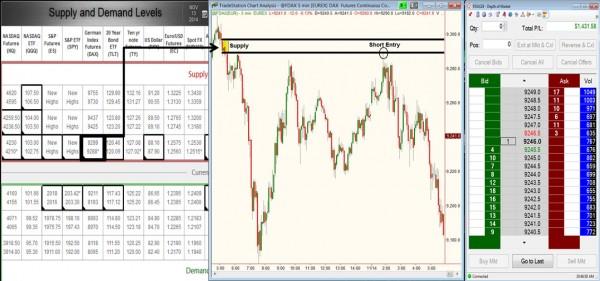
To help you understand this concept, let’s go over a trade I took last week utilizing the Supply / Demand grid which is one of our trading services for our students. The trade was in the DAX Futures. On the supply / demand grid, the first row of supply and demand is for short term income trading opportunities. The DAX supply was offered on the grid and can be seen on the chart (yellow shaded area). The price activity there told us that supply exceeded demand, that financial institutions were selling the DAX at that level and that they hadn’t sold all that they wanted to sell. In other words, there were plenty of sell orders left at that price level.
1) Price spent very little time at that level: The less time price spends at a level, the more out of balance supply and demand are at the level.
2) Price declined from that level in strong fashion: The stronger the move in price away from an area, the more out of balance supply and demand is at the level.
3) The first time price revisited the level, it touched the level and fell: This is a clue that there is lots of supply still left at that level.
4) Price moved very far away from that supply level before returning to the level where I sold short (circled area): The farther price moves away from a supply or demand level, the further it needs to move to return to the level. This is helps with probability of the trade and profit zone. Meaning, when sold short to the buyer on the other side of my trade, that buyer wasn’t buying a normal rally in price, they were buying after a huge rally in price which is a big mistake and almost always will lead to a loss which means a profit for us. Furthermore, they were buying right into a price level where our strategy already determined banks were selling the DAX. This means a very low probability buy for them and a high probability sell for us.
I have just listed a few clues and rules from our supply and demand strategy that helped us determine a very low risk turning point in the market, before it happened. At the same time the trade was low risk, the potential reward was very high as there was plenty of room for price to fall because of the distance price traveled on the initial decline as mentioned in point #4.
Whether we are looking at a short term income trade like the DAX above or a long term wealth trade which can also be found using the Supply / Demand grid, the rules and logic don’t change at all. It is easy to get caught up in all the news, fundamental data, economic reports, and so called expert opinions. However, any and all of that influence on price is reflected in price. So, instead of spending so much time analyzing the data to figure out where price will turn, why not skip all that and go right to the main question which is: “Where will price turn?” It is all about supply and demand and what that picture looks like on a price chart.
Hope this was helpful, have a great day.
Note: All information on this page is subject to change. The use of this website constitutes acceptance of our user agreement. Please read our privacy policy and legal disclaimer. Opinions expressed at FXstreet.com are those of the individual authors and do not necessarily represent the opinion of FXstreet.com or its management. Risk Disclosure: Trading foreign exchange on margin carries a high level of risk, and may not be suitable for all investors. The high degree of leverage can work against you as well as for you. Before deciding to invest in foreign exchange you should carefully consider your investment objectives, level of experience, and risk appetite. The possibility exists that you could sustain a loss of some or all of your initial investment and therefore you should not invest money that you cannot afford to lose. You should be aware of all the risks associated with foreign exchange trading, and seek advice from an independent financial advisor if you have any doubts.
Editors’ Picks

EUR/USD slumps below 1.1800 on hawkish Fed Minutes, eyes on ECB succession
The EUR/USD pair tumbles to a near two-week low around 1.1785 during the early Asian session on Thursday. The US Dollar strengthens against the Euro on hawkish FOMC minutes that revived speculation about potential interest rate hikes if inflation remains elevated.

GBP/USD struggles near four-week low vs. USD, below 1.3500 amid BoE rate cut bets
The GBP/USD pair is seen consolidating its weekly losses registered over the past three days and oscillating in a narrow range near a four-week trough, touched during the Asians session on Thursday. Spot prices currently trade just below the 1.3500 psychological mark and seem vulnerable to slide further.

USD/JPY: Bulls retain control around 155.00 amiid USD strength
USD/JPY consolidates the previous day's strong gains to around 155.00 early Thursday, with the bias remaining in favor of bulls as worries about Japan's fiscal health and the upbeat market mood continue to undermine the safe-haven Japanese Yen. Meanwhile, the FOMC Minutes showed that Fed officials remain split over the necessity and timing of further rate cuts amid concerns about inflation, which acts as a tailwind for the US Dollar and should support the currency pair.
Editors’ Picks

AUD/USD rebounds toward 0.7100 despite mixed Aussie jobs data
AUD/USD has picked up fresh bids toward 0.7100 despite the release of mixed Australian employment data, which showed that the economy added 17.8K new jobs in January and the jobless rate held steady at 4.1%, compared to a rise to 4.2% expected. The data does little to temper bets for additional tightening by the RBA, supporting the Aussie. The US Dollar, on the other hand, preserves the overnight gains led by less dovish FOMC Minutes, which could cap the upside for the currency pair.
USD/JPY: Bulls retain control around 155.00 amiid USD strength
USD/JPY consolidates the previous day's strong gains to around 155.00 early Thursday, with the bias remaining in favor of bulls as worries about Japan's fiscal health and the upbeat market mood continue to undermine the safe-haven Japanese Yen. Meanwhile, the FOMC Minutes showed that Fed officials remain split over the necessity and timing of further rate cuts amid concerns about inflation, which acts as a tailwind for the US Dollar and should support the currency pair.

Gold yearns for acceptance above the $5,000 mark
Gold preserves 2% advance seen on Wednesday as buyers gather pace early Thursday. The US Dollar holds January Fed Minutes-led gains ahead of more US macro data. Gold needs a sustained break above the key $5,000 barrier; daily RSI stays bullish.
Top Crypto Gainers: World Liberty Financial, Sky, and Cosmos confront major resistance
World Liberty Financial, Sky, and Cosmos rank among the top gainers over the last 24 hours but face critical overhead resistance levels. WLFI gained momentum at the World Liberty Forum, an invite-only conference held at Mar-a-Lago by US President Donald Trump’s family, while SKY and ATOM reversed off a crucial support level.

Mixed UK inflation data no gamechanger for the Bank of England
Food inflation plunged in January, but service sector price pressure is proving stickier. We continue to expect Bank of England rate cuts in March and June. The latest UK inflation read is a mixed bag for the Bank of England, but we doubt it drastically changes the odds of a March rate cut.
RECOMMENDED LESSONS
Making money in forex is easy if you know how the bankers trade!

I’m often mystified in my educational forex articles why so many traders struggle to make consistent money out of forex trading. The answer has more to do with what they don’t know than what they do know. After working in investment banks for 20 years many of which were as a Chief trader its second knowledge how to extract cash out of the market.
5 Forex News Events You Need To Know

In the fast moving world of currency markets where huge moves can seemingly come from nowhere, it is extremely important for new traders to learn about the various economic indicators and forex news events and releases that shape the markets. Indeed, quickly getting a handle on which data to look out for, what it means, and how to trade it can see new traders quickly become far more profitable and sets up the road to long term success.
Top 10 Chart Patterns Every Trader Should Know

Chart patterns are one of the most effective trading tools for a trader. They are pure price-action, and form on the basis of underlying buying and selling pressure. Chart patterns have a proven track-record, and traders use them to identify continuation or reversal signals, to open positions and identify price targets.
7 Ways to Avoid Forex Scams

The forex industry is recently seeing more and more scams. Here are 7 ways to avoid losing your money in such scams: Forex scams are becoming frequent. Michael Greenberg reports on luxurious expenses, including a submarine bought from the money taken from forex traders. Here’s another report of a forex fraud. So, how can we avoid falling in such forex scams?
What Are the 10 Fatal Mistakes Traders Make
Trading is exciting. Trading is hard. Trading is extremely hard. Some say that it takes more than 10,000 hours to master. Others believe that trading is the way to quick riches. They might be both wrong. What is important to know that no matter how experienced you are, mistakes will be part of the trading process.
The challenge: Timing the market and trader psychology

Successful trading often comes down to timing – entering and exiting trades at the right moments. Yet timing the market is notoriously difficult, largely because human psychology can derail even the best plans. Two powerful emotions in particular – fear and greed – tend to drive trading decisions off course.