 Rick Wright
Online Trading Academy

Hello traders! In this week’s newsletter I’d like to explain how you can use a skill you’ve developed over the course of your life to help get you a better stock price, thereby make you a better trader in the markets.
Let’s say you are a huge fan of crab legs. You can’t get enough of them and you look to buy crab legs whenever you go to the grocery store – if the price is right. Since you shop for crab legs every week, you know (in this example) that they are normally priced at $20 per pound. Every time you go to the grocery store your first destination is the fish counter; but this week the crab legs are priced at $40 per pound. Disappointed, you walk around the store doing your regular shopping trip. As you venture around the store the fish counter guy comes over the store’s intercom and you hear your favorite phrase: “Attention shoppers, for the next 5 minutes crab legs are only $10 per pound! Come on down and get them while they last!”
So what do you do? I would imagine that you would immediately sprint back to the fish counter; your half-filled grocery cart with the wobbly wheel squeaking and creaking as you race through the store. You breathlessly get to the counter and buy your favorite food – on sale! You then happily go about the rest of your shopping trip.
Another interesting example of buying things on sale is something we have in the States called “Black Friday.” The day after Thanksgiving many stores in the United States have huge percent markdowns on a large number of their popular products. The huge crowds are legendary as tens of thousands of shoppers jam into stores trying to buy their favorite toys/gadgets/gifts at deep discounts. Why do people do this, wading through the mass of humanity, pushing and shoving to buy things in this environment? The answer should be obvious: people want to save money! Buying something at half off lets you save a lot of money, or even purchase other items. Seems obvious, right?
Then why do people very often do the exact opposite in the world of trading? When prices are going down, getting cheaper, why do many novice traders throw out their tried and true grocery store shopping experiences and AVOID buying? Many novice traders are actually SELLING things that are cheap, which is the exact opposite of what they do in every other buying/shopping experience! When prices are already high and moving higher, why do novice traders start buying? “Crab legs for $100 per pound, come and get them!” Would you go sprinting to the fish counter to buy those high priced crab legs? Of course not!
The answer as to WHY should be a bit obvious: the overwhelming emotions of fear and greed cloud traders’ judgments when looking at their trading screens. Here is what I would rather have you do. At the very least, attempt to minimize/manage your emotions in trading (reading Dr. Woody Johnson’s articles on psychology should help you with that!) The next thing I would have you do is apply your grocery shopping experience to get a better stock price when you’re trading; buying things when they are cheap and selling them when expensive. (I still haven’t figured out how to short crab legs when priced high at the grocery store!)
So what do high/expensive and low/cheap prices look like on a chart? Let’s take a look.
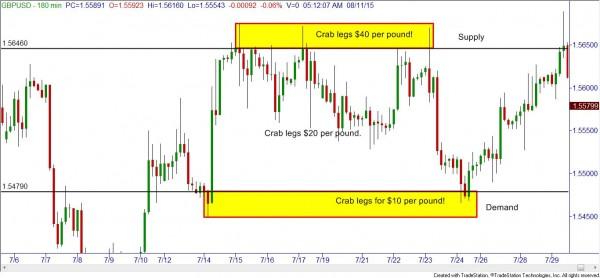
In this GBPUSD 180 minute chart, I’ve marked a supply zone and a demand zone. When prices are cheap, on sale, what do you do at the store? You look to buy! When stock prices are cheap, in one of our quality demand zones, I’m hoping you already know what to do! (That would be to buy.) When prices are expensive, not on sale, in fact marked UP in price, what do you do at the store? You aren’t buying! (Please tell me how to short crab legs at the store if you know how!) As a trader, when stock prices are expensive, in one of our quality supply zones, you should be looking to sell.
So there you have it. By applying your skills of shopping at the grocery store and using our supply and demand zones, you should become a better “shopper” for good prices in the market, hopefully making you a much better trader!
This content is intended to provide educational information only. This information should not be construed as individual or customized legal, tax, financial or investment services. As each individual's situation is unique, a qualified professional should be consulted before making legal, tax, financial and investment decisions. The educational information provided in this article does not comprise any course or a part of any course that may be used as an educational credit for any certification purpose and will not prepare any User to be accredited for any licenses in any industry and will not prepare any User to get a job. Reproduced by permission from OTAcademy.com click here for Terms of Use: https://www.otacademy.com/about/terms
Editors’ Picks

EUR/USD climbs to daily highs near 1.1820
EUR/USD now picks up pace and advances to the area of daily peaks north of the 1.1800 barrier at the end of the week. The pair’s decent move higher comes against the backdrop of a generalised lack of direction in the FX galaxy and the mild offered stance in the US Dollar.

GBP/USD trims losses, retests 1.3460
After briefly challenging its key 200-day SMA near 1.3440, GBP/USD now manages to regain some balance and revisit the 1.3460 zone on Friday. Cable’s pullback comes as the selling pressure on the Greenback gathers traction, reigniting some recovery in the risk-linked space.

Japanese Yen gives back half of early gains against USD ahead of US PPI data
The Japanese Yen (JPY) surrenders half of its early gains against the US Dollar (USD) during the European trading session on Friday. The USD/JPY pair rebounds to near 155.90 as the JPY falls back, but is still 0.15% down.
Editors’ Picks

EUR/USD: Fed calm, ECB steady, but the Dollar still leads Premium
EUR/USD is still struggling to find real traction. The pair has tried to stabilise, but momentum keeps fading, leaving the door open to further weakness.

Gold: Falling US yields, geopolitics help XAU/USD hold ground Premium
Gold (XAU/USD) gained traction and climbed above $5,200, ending the fourth consecutive week in positive territory. The next round of US-Iran talks and crucial macroeconomic data releases from the US will be watched closely by market participants in the short term.

GBP/USD: Will Pound Sterling defend key 1.3450 support ahead of US jobs data? Premium
The Pound Sterling (GBP) entered a bearish consolidation phase against the US Dollar (USD), after having tested critical support near the 1.3450 level on several occasions.

Bitcoin: Another month of losses, and it’s been five
Bitcoin (BTC) price is stabilizing around $68,000 at the time of writing on Friday, but the Crypto King is poised to close February on a fragile footing, marking its fifth consecutive month of losses since October and a rare start to the year with back-to-back monthly corrections.

US Dollar: At a crossroads; Fed steady, tariffs in flux Premium
The US Dollar’s (USD) upward momentum from the previous week seems to have encountered a tough nut to crack in the 98.00 region, as measured by the US Dollar Index (DXY).
RECOMMENDED LESSONS
Making money in forex is easy if you know how the bankers trade!

I’m often mystified in my educational forex articles why so many traders struggle to make consistent money out of forex trading. The answer has more to do with what they don’t know than what they do know. After working in investment banks for 20 years many of which were as a Chief trader its second knowledge how to extract cash out of the market.
5 Forex News Events You Need To Know

In the fast moving world of currency markets where huge moves can seemingly come from nowhere, it is extremely important for new traders to learn about the various economic indicators and forex news events and releases that shape the markets. Indeed, quickly getting a handle on which data to look out for, what it means, and how to trade it can see new traders quickly become far more profitable and sets up the road to long term success.
Top 10 Chart Patterns Every Trader Should Know

Chart patterns are one of the most effective trading tools for a trader. They are pure price-action, and form on the basis of underlying buying and selling pressure. Chart patterns have a proven track-record, and traders use them to identify continuation or reversal signals, to open positions and identify price targets.
7 Ways to Avoid Forex Scams

The forex industry is recently seeing more and more scams. Here are 7 ways to avoid losing your money in such scams: Forex scams are becoming frequent. Michael Greenberg reports on luxurious expenses, including a submarine bought from the money taken from forex traders. Here’s another report of a forex fraud. So, how can we avoid falling in such forex scams?
What Are the 10 Fatal Mistakes Traders Make
Trading is exciting. Trading is hard. Trading is extremely hard. Some say that it takes more than 10,000 hours to master. Others believe that trading is the way to quick riches. They might be both wrong. What is important to know that no matter how experienced you are, mistakes will be part of the trading process.
The challenge: Timing the market and trader psychology

Successful trading often comes down to timing – entering and exiting trades at the right moments. Yet timing the market is notoriously difficult, largely because human psychology can derail even the best plans. Two powerful emotions in particular – fear and greed – tend to drive trading decisions off course.