 Rick Wright
Online Trading Academy

For this week’s offering, I wanted to share with you a slice of real-life trading action taken directly from the Crown Jewel of Online Trading Academy’s Educational Program. As well as teaching students in the Live classroom environment and the ongoing Live Trading rooms known as the Extended Learning Track, or XLT, I also have the exceptionally distinct pleasure of working in the Mastermind Community within Online Trading Academy. The Mastermind Community was setup just over 2 years ago, as a place for our most elite students to interact, share trading ideas and develop their speculative skills to the highest level. It is exactly what it says on the tin, a community where like-minded individuals meet together to achieve their goals in the markets.
Some months ago, I was invited to participate in the Mastermind Trade Rooms, a part of the community where students and instructors alike, work together on their analysis and trade plans. These more informal sessions are a unique environment where personally I get to work with students on an equal level, creating quite a different dynamic to the regular instructor and student relationship. Every two weeks I host what I now call “The Trader’s Gym Session,” where we attempt to hone our skills and encourage one another to be the best we can be. Last week’s session was a particularly good one, as a trade I had been personally waiting for, came to its entry point thus giving us a great opportunity to discuss the setup in more detail and the thought process behind it. The reason why I feel this is a good example to highlight, is because it clearly demonstrates the common pitfalls of FX trading, and how a trader needs to be disciplined enough to follow their trade plan so as to make sure that they avoid the regular mistakes that most people fall prey to.
Firstly, let’s take a look at the chart and the setup itself that occurred during the live trade room:
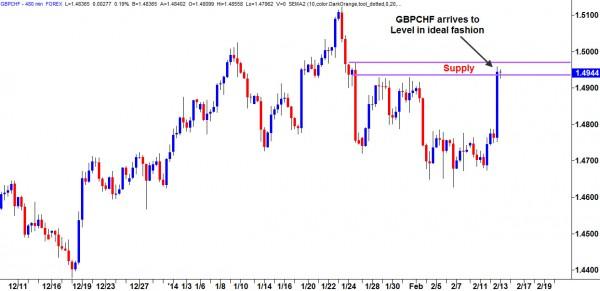
The trade in question as you can see, was on one of my favourite currency pairs to work with, the GBPCHF. One of the reasons why I like this particular currency is because of its sheer volatility. When this market gets moving it really does cover some ground, which is especially ideal if you’re looking for those bigger moves, which do happen on a weekly basis if you look at the right pairs. Just remember though, volatility can really punish the novice trader if they don’t understand what a truly low risk and high reward trade setup looks like. I would advise any new start-up trader to only start working with bigger moving pairs when they have a solid trade plan and more experience on their side.
As you can see from the above snapshot, the GBPCHF had rallied impressively to a previously recognised area of supply, as marked on our chart. Having already recognised the major imbalance between the willing buyers and the willing sellers which caused the initial drop from the zone, the group and I recognised that this was a low risk and high probability shorting opportunity, which also offered an attractive reward at the price just below 1.4800. It was time to take the trade. Let’s see how things progressed:
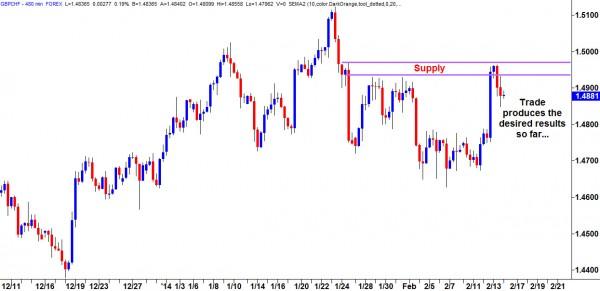
Over a short period of time, prices dropped nicely from our level, producing just over 1:1, also suggesting that this would be a safe time to move stop loss orders to breakeven, taking the risk out of the trade. This is a common practice amongst traders of all styles and varieties, however in my personal experience it is not something that I like to do in my own trading. The reason for this reluctance is due to the fact that if the level is a good one, there can often be the risk of what I call the “shakeout.” A shakeout is where price returns to the original entry area for a second attempt at entry. If you think about this logically, it makes perfect sense because if the level is a good one, the largest funds and institutions will do everything in their power to push the price back to the original ideal entry, because this offers the greatest reward potential and of course the lowest risk. This shakeout often results in many traders being taken out on their original trades, only then having to watch the price go in the direction, which they originally thought it would. Here is an example of what I’m talking about:
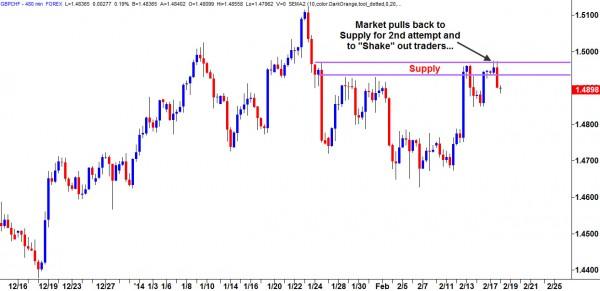
As we can see above, this is a perfect example of the shakeout we’re talking about. Price returns aggressively back to the original supply area and goes a tiny amount higher and then proceeds to drop. Ironically, before taking this trade, I explained to the students in the mastermind room, that I don’t like to move my stop to break even aggressively because I’m conscious of the shakeouts that can happen and would rather give the trade room to breath and hopefully hit the target. In my own currency trading I pretty much live by the saying, “A watched pot never boils.” By leaving the trade alone I have often found good things happen as we can see in the example below:
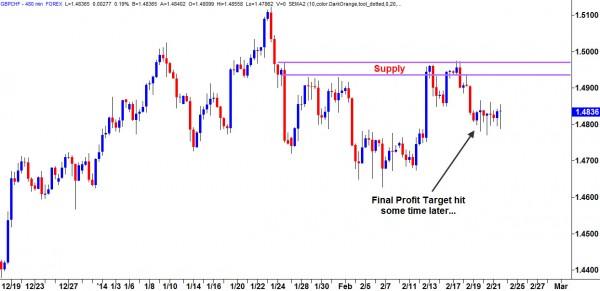
Just over 150 pips later, the final profit target was hit just below 1.4800 giving us a solid setup and a great risk to reward profile as well. However, just think about how differently things would have turned out if we would have moved our stop loss orders too quickly after the first initial drop from the supply zone? We would have ended up with a breakeven trade and little else. So why do people move the stops so quickly then and run the risk of being shaken out? Purely because they often see the risk as more important than the reward. I would advise you to simply accept the risk on the trade and allow the reward to come, as long as it was a valid setup in the first place of course. If you now your risk and you know your reward then let the market do its thing…you may be pleasantly surprised.
Have a great week ahead.
This content is intended to provide educational information only. This information should not be construed as individual or customized legal, tax, financial or investment services. As each individual's situation is unique, a qualified professional should be consulted before making legal, tax, financial and investment decisions. The educational information provided in this article does not comprise any course or a part of any course that may be used as an educational credit for any certification purpose and will not prepare any User to be accredited for any licenses in any industry and will not prepare any User to get a job. Reproduced by permission from OTAcademy.com click here for Terms of Use: https://www.otacademy.com/about/terms
Editors’ Picks

EUR/USD climbs to daily highs near 1.1820
EUR/USD now picks up pace and advances to the area of daily peaks north of the 1.1800 barrier at the end of the week. The pair’s decent move higher comes against the backdrop of a generalised lack of direction in the FX galaxy and the mild offered stance in the US Dollar.

GBP/USD trims losses, retests 1.3460
After briefly challenging its key 200-day SMA near 1.3440, GBP/USD now manages to regain some balance and revisit the 1.3460 zone on Friday. Cable’s pullback comes as the selling pressure on the Greenback gathers traction, reigniting some recovery in the risk-linked space.

Japanese Yen gives back half of early gains against USD ahead of US PPI data
The Japanese Yen (JPY) surrenders half of its early gains against the US Dollar (USD) during the European trading session on Friday. The USD/JPY pair rebounds to near 155.90 as the JPY falls back, but is still 0.15% down.
Editors’ Picks

EUR/USD: Fed calm, ECB steady, but the Dollar still leads Premium
EUR/USD is still struggling to find real traction. The pair has tried to stabilise, but momentum keeps fading, leaving the door open to further weakness.

Gold: Falling US yields, geopolitics help XAU/USD hold ground Premium
Gold (XAU/USD) gained traction and climbed above $5,200, ending the fourth consecutive week in positive territory. The next round of US-Iran talks and crucial macroeconomic data releases from the US will be watched closely by market participants in the short term.

GBP/USD: Will Pound Sterling defend key 1.3450 support ahead of US jobs data? Premium
The Pound Sterling (GBP) entered a bearish consolidation phase against the US Dollar (USD), after having tested critical support near the 1.3450 level on several occasions.

Bitcoin: Another month of losses, and it’s been five
Bitcoin (BTC) price is stabilizing around $68,000 at the time of writing on Friday, but the Crypto King is poised to close February on a fragile footing, marking its fifth consecutive month of losses since October and a rare start to the year with back-to-back monthly corrections.

US Dollar: At a crossroads; Fed steady, tariffs in flux Premium
The US Dollar’s (USD) upward momentum from the previous week seems to have encountered a tough nut to crack in the 98.00 region, as measured by the US Dollar Index (DXY).
RECOMMENDED LESSONS
Making money in forex is easy if you know how the bankers trade!

I’m often mystified in my educational forex articles why so many traders struggle to make consistent money out of forex trading. The answer has more to do with what they don’t know than what they do know. After working in investment banks for 20 years many of which were as a Chief trader its second knowledge how to extract cash out of the market.
5 Forex News Events You Need To Know

In the fast moving world of currency markets where huge moves can seemingly come from nowhere, it is extremely important for new traders to learn about the various economic indicators and forex news events and releases that shape the markets. Indeed, quickly getting a handle on which data to look out for, what it means, and how to trade it can see new traders quickly become far more profitable and sets up the road to long term success.
Top 10 Chart Patterns Every Trader Should Know

Chart patterns are one of the most effective trading tools for a trader. They are pure price-action, and form on the basis of underlying buying and selling pressure. Chart patterns have a proven track-record, and traders use them to identify continuation or reversal signals, to open positions and identify price targets.
7 Ways to Avoid Forex Scams

The forex industry is recently seeing more and more scams. Here are 7 ways to avoid losing your money in such scams: Forex scams are becoming frequent. Michael Greenberg reports on luxurious expenses, including a submarine bought from the money taken from forex traders. Here’s another report of a forex fraud. So, how can we avoid falling in such forex scams?
What Are the 10 Fatal Mistakes Traders Make
Trading is exciting. Trading is hard. Trading is extremely hard. Some say that it takes more than 10,000 hours to master. Others believe that trading is the way to quick riches. They might be both wrong. What is important to know that no matter how experienced you are, mistakes will be part of the trading process.
The challenge: Timing the market and trader psychology

Successful trading often comes down to timing – entering and exiting trades at the right moments. Yet timing the market is notoriously difficult, largely because human psychology can derail even the best plans. Two powerful emotions in particular – fear and greed – tend to drive trading decisions off course.