
Order Flow Trader is an incredibly effective trading tool to use and simply by looking through the charts it is clear just how many fantastic moves it catches. The thing about Order Flow Trader is that it works brilliantly well in trending markets but not so well in range-bound markets which is where we start to see quite choppy price action and thus conflicting signals, as underlying market positioning adjusts and re-adjusts.
However there are some ways that we can increase the success of Order Flow Trader by filtering out some of the weaker signals. Here are a few tips & tricks to bare in mind when trading using Order Flow Trader.
How do we identify continuation?
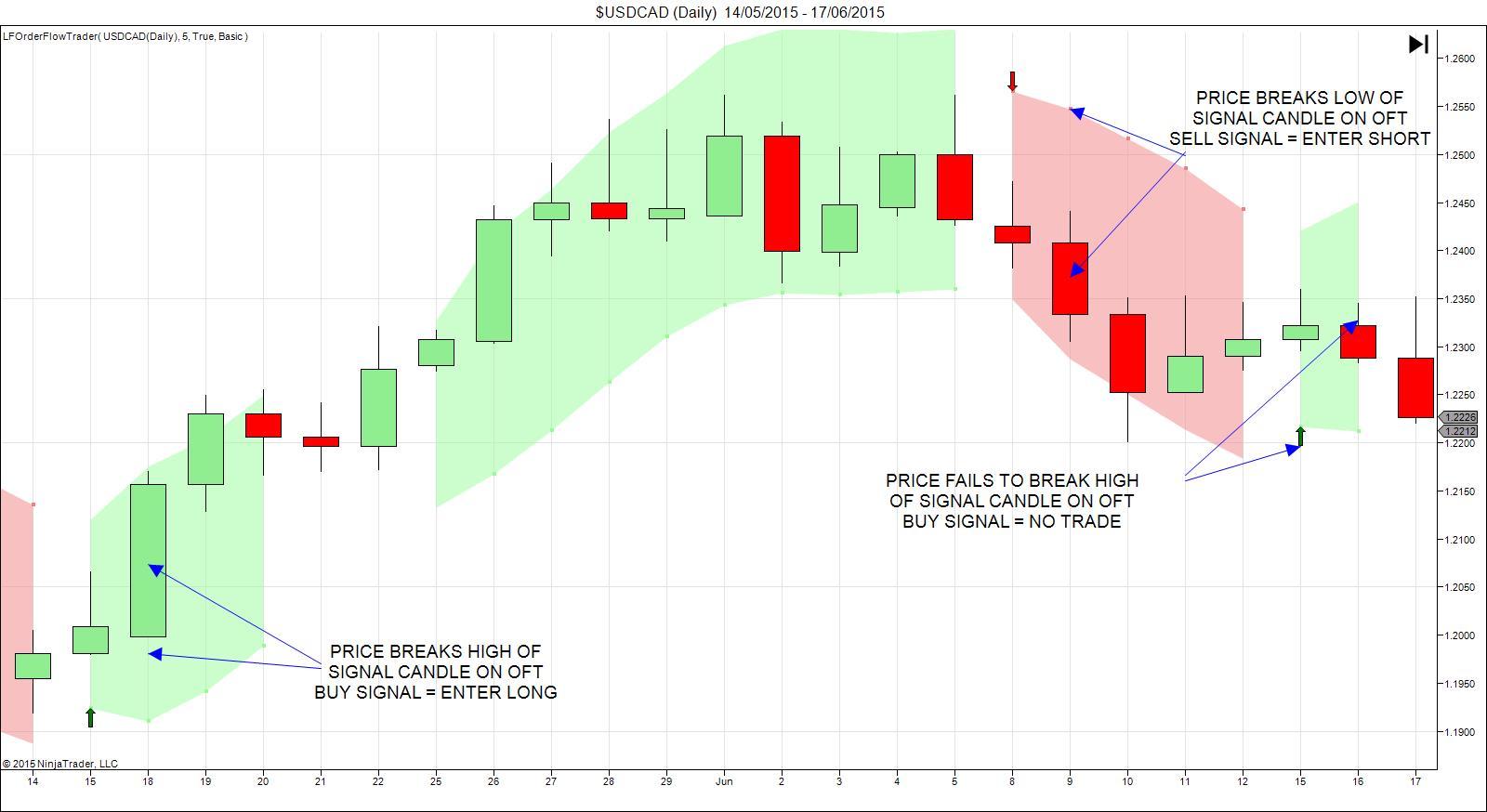
If we see an OFT buy signal on a candle, I then want to see price break the high of the signal candle before executing my long trade and vice-versa for sell signals. This simple adjustment to how you use OFT can filter out a lot of weaker signals.
Look at the example below, we can see two great winning trades and one losing trade. Using the “bar break” method however, we avoid the losing trade.
How do we identify confirmation?
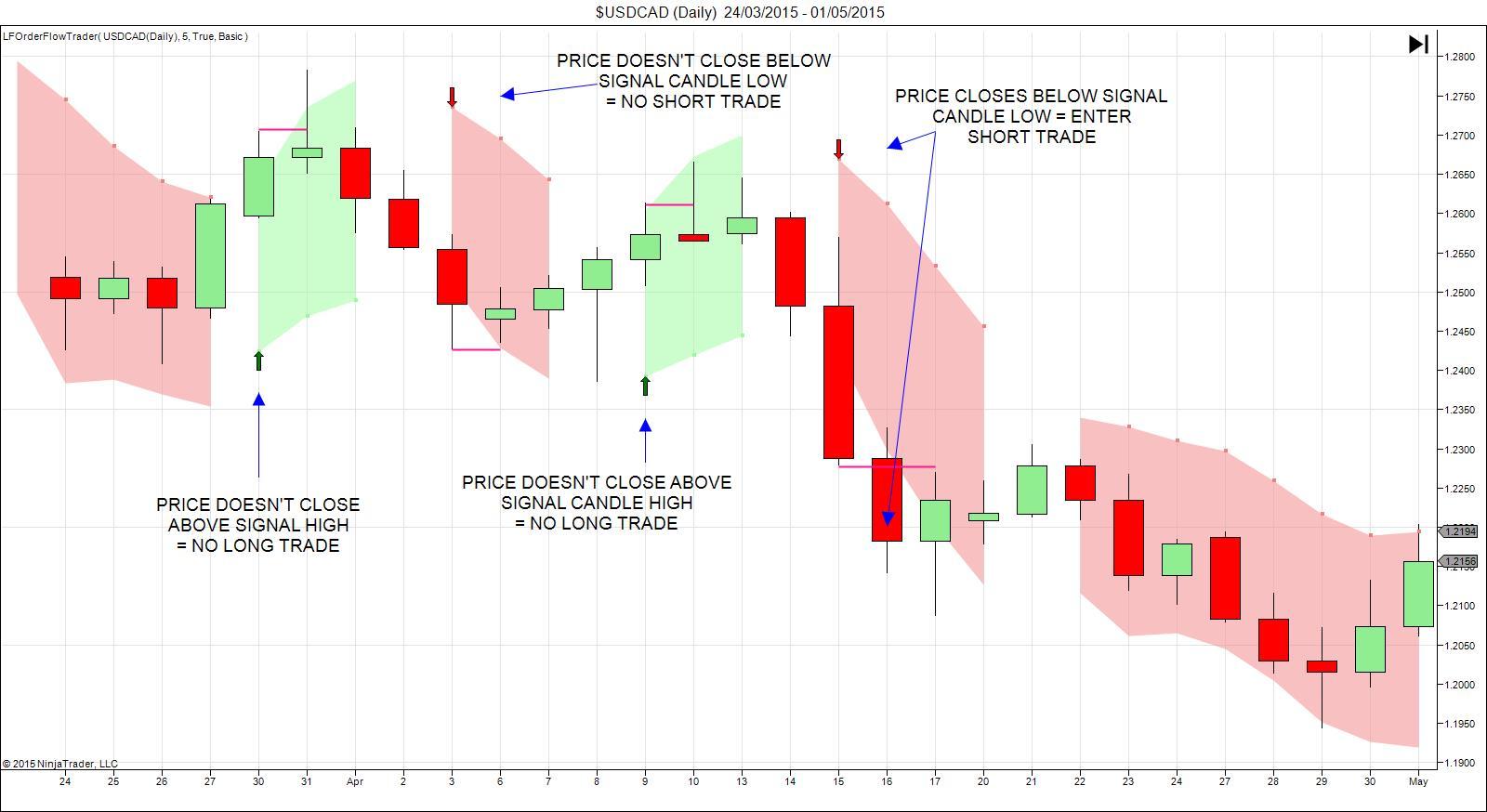
If we see an OFT buy signal on a candle I then want to see the second candle close above the high of the signal candle to execute my long trade and vice-versa for sell signals. So not only does price need to break the high of the candle, it also needs to close above it.
Look at the example below. We can see that by waiting for the second candle to close above the high of the signal candle (for buy signals) and below the low of the signal candle (for sell signals) we were able to avoid three weak signals and catch a nice winner.
One of the best ways to filter out weaker signals is simply to stop and think about the price action on your chart at the time of the signal. Now there are all sorts of different candlesticks we could examine here but I want to share with you just one, that through alot of time spent researching, trading and teaching the use of the indicator I feel is most important.
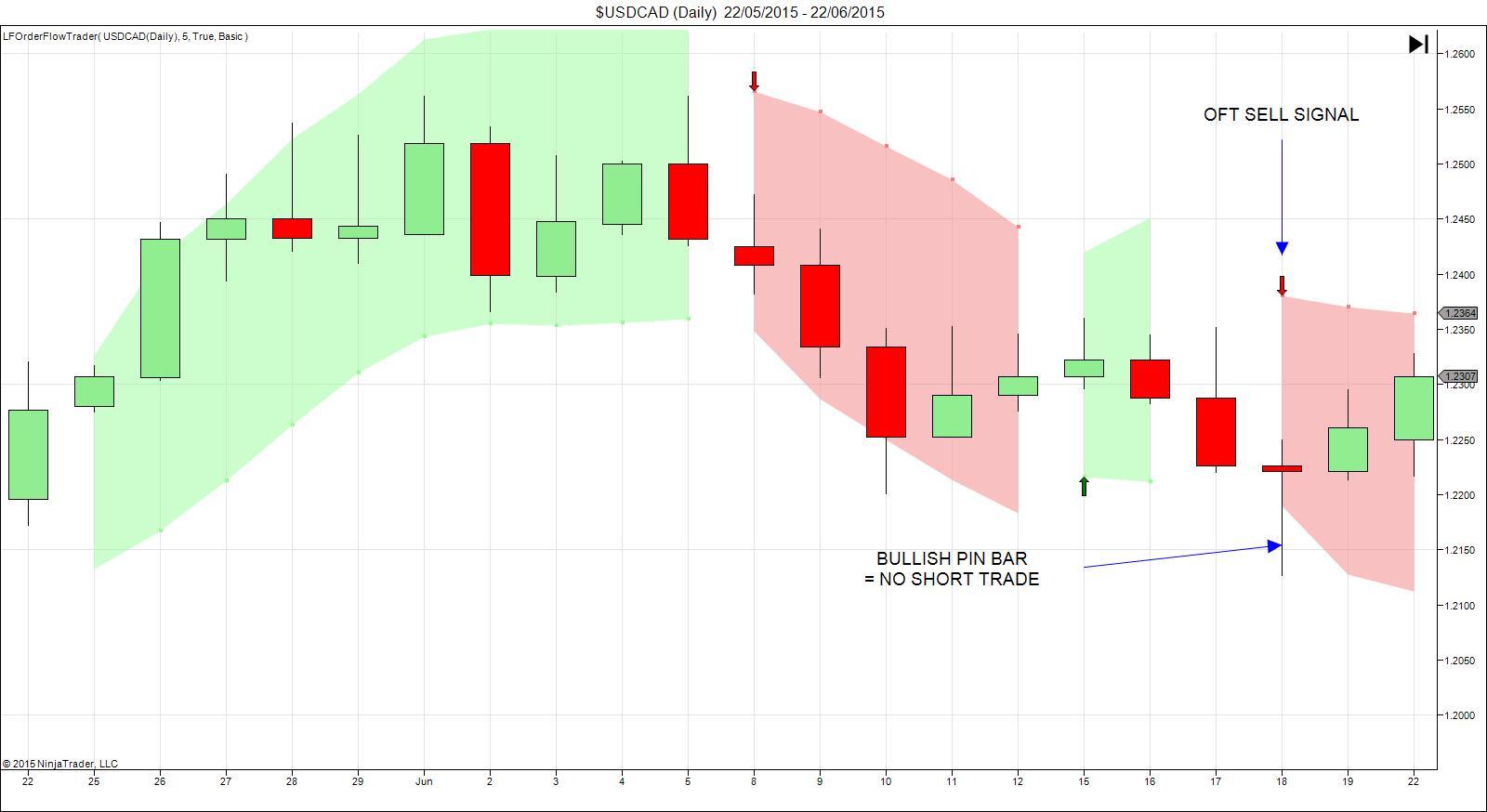
If we see an OFT buy signal on a bearish pin bar, avoid the signal. If we see an OFT sell signal on a bullish pin bar, avoid the signal.
Now this is my own personal preference for using OFT. There are occasions when we see an OFT buy signal and a bearish pin bar and price trades higher in line with the signal. This is fine, I accept that I can’t always be right, but what I always try to do is refine my methods and refine my trading to improve my success, so this is a method I choose to use.
Look at the example below. We can see that we get an OFT sell signal and a bullish pin bar, and price trades higher.
As I said, this isn’t always the case but I have found more often than not, this is a reliable way of filtering signals.
So hopefully this article has got you thinking a bit more strategically about how to trade the OFT signals. There are of course a vast amount of different period setting you can use to change signal frequency and to some extent strength, but hopefully these methods will help you no matter which time-frame or signal period setting you use.
However there are some ways that we can increase the success of Order Flow Trader by filtering out some of the weaker signals. Here are a few tips & tricks to bare in mind when trading using Order Flow Trader.
1. Trade the Signal Bar Break
You will probably have heard this quite a lot if you’re familiar with my posts & videos as this is a favourite method of mine. Simply put, instead of just executing the trade once the signal bar has closed I look to see some continuation in price before entering.How do we identify continuation?
If we see an OFT buy signal on a candle, I then want to see price break the high of the signal candle before executing my long trade and vice-versa for sell signals. This simple adjustment to how you use OFT can filter out a lot of weaker signals.
Look at the example below, we can see two great winning trades and one losing trade. Using the “bar break” method however, we avoid the losing trade.
2. Second candle close
If we think of executing on the signal candle close as being aggressive and entering on the signal candle break as being more conservative, then this approach is more conservative still. The idea here is not only to look for continuation in price but also confirmation.How do we identify confirmation?
If we see an OFT buy signal on a candle I then want to see the second candle close above the high of the signal candle to execute my long trade and vice-versa for sell signals. So not only does price need to break the high of the candle, it also needs to close above it.
Look at the example below. We can see that by waiting for the second candle to close above the high of the signal candle (for buy signals) and below the low of the signal candle (for sell signals) we were able to avoid three weak signals and catch a nice winner.
3. Think About The Signal Candle
Some traders don’t have the time to spend in front of the charts to implement some of the other methods we’ve looked at, so here is a really quick method for identifying the signal as strong or weak.One of the best ways to filter out weaker signals is simply to stop and think about the price action on your chart at the time of the signal. Now there are all sorts of different candlesticks we could examine here but I want to share with you just one, that through alot of time spent researching, trading and teaching the use of the indicator I feel is most important.
If we see an OFT buy signal on a bearish pin bar, avoid the signal. If we see an OFT sell signal on a bullish pin bar, avoid the signal.
Now this is my own personal preference for using OFT. There are occasions when we see an OFT buy signal and a bearish pin bar and price trades higher in line with the signal. This is fine, I accept that I can’t always be right, but what I always try to do is refine my methods and refine my trading to improve my success, so this is a method I choose to use.
Look at the example below. We can see that we get an OFT sell signal and a bullish pin bar, and price trades higher.
As I said, this isn’t always the case but I have found more often than not, this is a reliable way of filtering signals.
So hopefully this article has got you thinking a bit more strategically about how to trade the OFT signals. There are of course a vast amount of different period setting you can use to change signal frequency and to some extent strength, but hopefully these methods will help you no matter which time-frame or signal period setting you use.
Editors’ Picks

EUR/USD tests nine-day EMA support near 1.1850
EUR/USD remains in the negative territory for the fourth successive session, trading around 1.1870 during the Asian hours on Friday. The 14-day Relative Strength Index momentum indicator at 56 stays above the midline, confirming steady momentum. RSI has eased but remains above 50, indicating momentum remains constructive for the bulls.

GBP/USD consolidates around 1.3600 vs. USD; looks to US CPI for fresh impetus
The GBP/USD pair remains on the defensive through the Asian session on Friday, though it lacks bearish conviction and holds above the 1.3600 mark as traders await the release of the US consumer inflation figures before placing directional bets.

USD/JPY rebounds above 153.00 ahead of US inflation data
USD/JPY stages a comeback and regains 153.00 in the Asian session, snapping a four-day losing streak amid some repositioning ahead of the US CPI report. However, expectations that Japan's PM Sanae Takaichi could be more fiscally responsible, along with bets that the BoJ will stick to its policy normalization path and the risk-off mood, could support the safe-haven Japanese Yen, capping the pair's upside.
Editors’ Picks
USD/JPY rebounds above 153.00 ahead of US inflation data
USD/JPY stages a comeback and regains 153.00 in the Asian session, snapping a four-day losing streak amid some repositioning ahead of the US CPI report. However, expectations that Japan's PM Sanae Takaichi could be more fiscally responsible, along with bets that the BoJ will stick to its policy normalization path and the risk-off mood, could support the safe-haven Japanese Yen, capping the pair's upside.

Gold: Will US CPI data trigger a range breakout?
Gold retakes $5,000 early Friday amid a turnaround from weekly lows as US CPI data loom. The US Dollar consolidates weekly losses as AI concerns-driven risk-off mood stalls downside. Technically, Gold appears primed for a big range breakout, with risks skewed toward a bullish break.

AUD/USD consolidates below 0.7100 as traders await US CPI report
AUD/USD consolidates the previous day's retracement slide from the vicinity of mid-0.7100s, or a three-year high, holding below 0.7100 as traders move to the sidelines ahead of Friday's release of the US consumer inflation figures. In the meantime, the divergent RBA-Fed outlooks might continue to support spot prices amid subdued US Dollar demand, though the risk-off impulse could act as a headwind for the Aussie.

Bitcoin, Ethereum and Ripple stay weak as bearish momentum persists
Bitcoin, Ethereum and Ripple remain under pressure, extending losses of over 5%, 6% and 4%, respectively, so far this week. BTC trades below $67,000 while ETH and XRP correct after facing rejection around key levels. With bearish momentum persisting and prices staying weak, the top three cryptocurrencies continue to show no clear signs of a sustained recovery.

A tale of two labour markets: Headline strength masks underlying weakness
Undoubtedly, yesterday’s delayed US January jobs report delivered a strong headline – one that surpassed most estimates. However, optimism quickly faded amid sobering benchmark revisions.
RECOMMENDED LESSONS
Making money in forex is easy if you know how the bankers trade!

I’m often mystified in my educational forex articles why so many traders struggle to make consistent money out of forex trading. The answer has more to do with what they don’t know than what they do know. After working in investment banks for 20 years many of which were as a Chief trader its second knowledge how to extract cash out of the market.
5 Forex News Events You Need To Know

In the fast moving world of currency markets where huge moves can seemingly come from nowhere, it is extremely important for new traders to learn about the various economic indicators and forex news events and releases that shape the markets. Indeed, quickly getting a handle on which data to look out for, what it means, and how to trade it can see new traders quickly become far more profitable and sets up the road to long term success.
Top 10 Chart Patterns Every Trader Should Know

Chart patterns are one of the most effective trading tools for a trader. They are pure price-action, and form on the basis of underlying buying and selling pressure. Chart patterns have a proven track-record, and traders use them to identify continuation or reversal signals, to open positions and identify price targets.
7 Ways to Avoid Forex Scams

The forex industry is recently seeing more and more scams. Here are 7 ways to avoid losing your money in such scams: Forex scams are becoming frequent. Michael Greenberg reports on luxurious expenses, including a submarine bought from the money taken from forex traders. Here’s another report of a forex fraud. So, how can we avoid falling in such forex scams?
What Are the 10 Fatal Mistakes Traders Make
Trading is exciting. Trading is hard. Trading is extremely hard. Some say that it takes more than 10,000 hours to master. Others believe that trading is the way to quick riches. They might be both wrong. What is important to know that no matter how experienced you are, mistakes will be part of the trading process.
The challenge: Timing the market and trader psychology

Successful trading often comes down to timing – entering and exiting trades at the right moments. Yet timing the market is notoriously difficult, largely because human psychology can derail even the best plans. Two powerful emotions in particular – fear and greed – tend to drive trading decisions off course.