In traditional investing, risk is viewed as volatility or standard deviation of the asset’s marked to market value. Standard deviation tells you how much an investment’s value will fluctuate from the average return. The more volatile the investment is likely to swing (both positively and negatively) around it’s own historical average, the more risky an investment or asset class is.
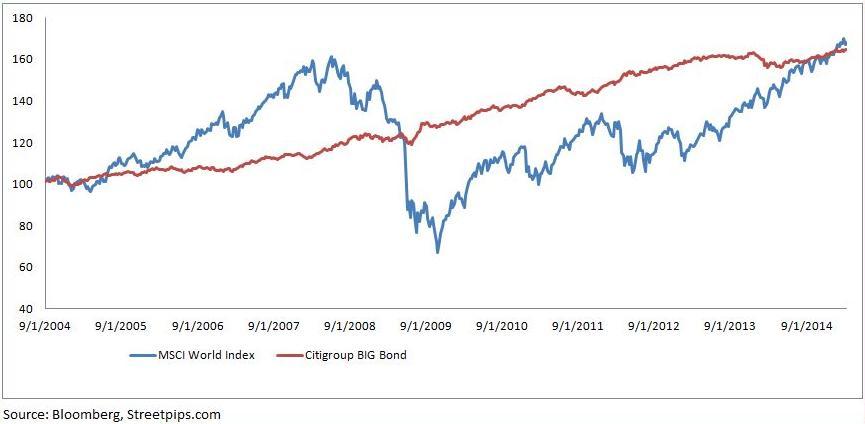
For example, Chart 1 below shows the normalised returns of Global Equities, as represented by MSCI World Index, versus Global Bonds, as represented by Citigroup Broad Investment Grade Bonds Index.
If you had invested $100 in both Global Equities and Global Bonds for the past 10 years, your portfolio value of either would be fairly similar, which is $168 for Global Equities and $165 for Global Bonds. (pretty dismal annualised returns per unit risk for Global Equities but that’s another story altogether) However, Global Equities is more volatile than Global Bonds and hence more risky by definition. The standard deviation of a time series of daily returns for Global Equities is 2.53% versus 0.50% for Global Bonds.
There are many more traditional measures of risk such as Value-at-Risk or Conditional-Value-at-Risk, which is an extension of VAR. These measures are widely used by the vast majority of investors for many years now.
However the most important and relevant risk to me when I trade is the Risk of Ruin. There were many sources of inspiration and influences (the “Market Wizards†type of traders and successful fund managers) through the years in shaping my thoughts on trading and this concept of looking at risk as the “risk of losses of trading capital†has been one of the most important.
So how do we quantify the risk of ruin? I came across these 2 methods as described below. They were referenced from D.R. Cox and H.D Miller in “The Theory of Stochastic Processesâ€.
For fixed trade size without dynamic position sizing (i.e. fixed trade size regardless of trading capital changes)
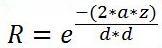
R= Risk of losing z fraction of the trading capital in percentage terms (probability)
e = Base of natural logarithm, 2.71828
z = If we want to calculate the risk of losing half the account, input 0.5
a = mean return of the trades, must be same time frame as d. For example if daily mean returns are used, then use standard deviation of daily returns. If weekly mean returns are used, then use standard deviation of weekly returns.
d = standard deviation of returns, must be same time frame as mean returns mentioned earlier.
For fixed trade percentage (e.g. 2% of capital per trade)
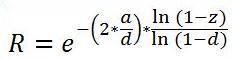
R= Risk of losing z fraction of the trading capital in percentage terms (probability)
e = Base of natural logarithm, 2.71828
ln(1-z) = natural logarithm of (1-z)
z = If we want to calculate the risk of losing half the account, input 0.5
a = mean return of the trades, must be same time frame as d. For example if daily mean returns are used, then use standard deviation of daily returns. If weekly mean returns are used, then use standard deviation of weekly returns.
d = standard deviation of returns, must be same time frame as mean returns mentioned earlier.
You may wish to incorporate these calculations in your money management tools to give you an idea of the risk of ruin which is so important in trading. Live to trade another day. It is all about survival in this game!
For example, Chart 1 below shows the normalised returns of Global Equities, as represented by MSCI World Index, versus Global Bonds, as represented by Citigroup Broad Investment Grade Bonds Index.
If you had invested $100 in both Global Equities and Global Bonds for the past 10 years, your portfolio value of either would be fairly similar, which is $168 for Global Equities and $165 for Global Bonds. (pretty dismal annualised returns per unit risk for Global Equities but that’s another story altogether) However, Global Equities is more volatile than Global Bonds and hence more risky by definition. The standard deviation of a time series of daily returns for Global Equities is 2.53% versus 0.50% for Global Bonds.
Chart 1: Normalised Returns For Past 10 Years For Global Equities & Global Bonds
There are many more traditional measures of risk such as Value-at-Risk or Conditional-Value-at-Risk, which is an extension of VAR. These measures are widely used by the vast majority of investors for many years now.
However the most important and relevant risk to me when I trade is the Risk of Ruin. There were many sources of inspiration and influences (the “Market Wizards†type of traders and successful fund managers) through the years in shaping my thoughts on trading and this concept of looking at risk as the “risk of losses of trading capital†has been one of the most important.
So how do we quantify the risk of ruin? I came across these 2 methods as described below. They were referenced from D.R. Cox and H.D Miller in “The Theory of Stochastic Processesâ€.
For fixed trade size without dynamic position sizing (i.e. fixed trade size regardless of trading capital changes)
R= Risk of losing z fraction of the trading capital in percentage terms (probability)
e = Base of natural logarithm, 2.71828
z = If we want to calculate the risk of losing half the account, input 0.5
a = mean return of the trades, must be same time frame as d. For example if daily mean returns are used, then use standard deviation of daily returns. If weekly mean returns are used, then use standard deviation of weekly returns.
d = standard deviation of returns, must be same time frame as mean returns mentioned earlier.
For fixed trade percentage (e.g. 2% of capital per trade)
R= Risk of losing z fraction of the trading capital in percentage terms (probability)
e = Base of natural logarithm, 2.71828
ln(1-z) = natural logarithm of (1-z)
z = If we want to calculate the risk of losing half the account, input 0.5
a = mean return of the trades, must be same time frame as d. For example if daily mean returns are used, then use standard deviation of daily returns. If weekly mean returns are used, then use standard deviation of weekly returns.
d = standard deviation of returns, must be same time frame as mean returns mentioned earlier.
You may wish to incorporate these calculations in your money management tools to give you an idea of the risk of ruin which is so important in trading. Live to trade another day. It is all about survival in this game!
Editors’ Picks

EUR/USD trims losses, back to 1.1830
EUR/USD manages to regain some composure, leaving behind part of the earlier losses and reclaim the 1.1830 region on Tuesday. In the meantime, the US Dollar’s upside impulse loses some momentum while investors remain cautious ahead of upcoming US data releases, including the FOMC Minutes.

GBP/USD bounces off lows, retargets 1.3550
After bottoming out just below the 1.3500 yardstick, GBP/USD now gathers some fresh bids and advances to the 1.3530-1.3540 band in the latter part of Tuesday’s session. Cable’s recovery comes as the Greenback surrenders part of its advance, although it keeps the bullish bias well in place for the day.

USD/JPY is looking for direction around 153.00 with key US data in focus
USD/JPY reversal from 153.70 has been contained above 152.70 on Tuesday. Major currencies are trading within narrow ranges amid thin trading volumes. Investors await the release of the US GDP and PCE Inflation figures to make decisions.
Editors’ Picks
EUR/USD trims losses, back to 1.1830
EUR/USD manages to regain some composure, leaving behind part of the earlier losses and reclaim the 1.1830 region on Tuesday. In the meantime, the US Dollar’s upside impulse loses some momentum while investors remain cautious ahead of upcoming US data releases, including the FOMC Minutes.
GBP/USD bounces off lows, retargets 1.3550
After bottoming out just below the 1.3500 yardstick, GBP/USD now gathers some fresh bids and advances to the 1.3530-1.3540 band in the latter part of Tuesday’s session. Cable’s recovery comes as the Greenback surrenders part of its advance, although it keeps the bullish bias well in place for the day.

Gold remains offered below $5,000
Gold stays on the defensive on Tuesday, receding to the sub-$5,000 region per troy ounce on the back of the persistent move higher in the Greenback. The precious metal’s decline is also underpinned by the modest uptick in US Treasury yields across the spectrum.

Crypto Today: Bitcoin, Ethereum, XRP upside looks limited amid deteriorating retail demand
The cryptocurrency market extends weakness with major coins including Bitcoin (BTC), Ethereum (ETH) and Ripple (XRP) trading in sideways price action at the time of writing on Tuesday.
UK jobs market weakens, bolstering rate cut hopes
In the UK, the latest jobs report made for difficult reading. Nonetheless, this represents yet another reminder for the Bank of England that they need to act swiftly given the collapse in inflation expected over the coming months.
RECOMMENDED LESSONS
Making money in forex is easy if you know how the bankers trade!

I’m often mystified in my educational forex articles why so many traders struggle to make consistent money out of forex trading. The answer has more to do with what they don’t know than what they do know. After working in investment banks for 20 years many of which were as a Chief trader its second knowledge how to extract cash out of the market.
5 Forex News Events You Need To Know

In the fast moving world of currency markets where huge moves can seemingly come from nowhere, it is extremely important for new traders to learn about the various economic indicators and forex news events and releases that shape the markets. Indeed, quickly getting a handle on which data to look out for, what it means, and how to trade it can see new traders quickly become far more profitable and sets up the road to long term success.
Top 10 Chart Patterns Every Trader Should Know

Chart patterns are one of the most effective trading tools for a trader. They are pure price-action, and form on the basis of underlying buying and selling pressure. Chart patterns have a proven track-record, and traders use them to identify continuation or reversal signals, to open positions and identify price targets.
7 Ways to Avoid Forex Scams

The forex industry is recently seeing more and more scams. Here are 7 ways to avoid losing your money in such scams: Forex scams are becoming frequent. Michael Greenberg reports on luxurious expenses, including a submarine bought from the money taken from forex traders. Here’s another report of a forex fraud. So, how can we avoid falling in such forex scams?
What Are the 10 Fatal Mistakes Traders Make
Trading is exciting. Trading is hard. Trading is extremely hard. Some say that it takes more than 10,000 hours to master. Others believe that trading is the way to quick riches. They might be both wrong. What is important to know that no matter how experienced you are, mistakes will be part of the trading process.
The challenge: Timing the market and trader psychology

Successful trading often comes down to timing – entering and exiting trades at the right moments. Yet timing the market is notoriously difficult, largely because human psychology can derail even the best plans. Two powerful emotions in particular – fear and greed – tend to drive trading decisions off course.