
Here at Littlefish FX, our whole trading ethos is centered around trying to trade in the same direction as the big fish: the Banks and major financial institutions. Whilst in the past, trading aspirations such as this would have been relatively impossible due to lack of information available to traders outside of these institutions, we now find ourselves at an incredibly interesting and exciting point, with market data, information and analytics creating opportunities for retail traders that have never before been seen.
With that in mind, we have designed what we believe to be some of the most consistent and profitable trading strategies available built around this central theme of using the available market data to trade in line with the big players instead of against them, a trap which many retail traders fall foul of.
These strategies comprise of using the Order Flow Indicators available on the Reuters Eikon trading software platform and our very own COT indicator (to be used on NinjaTrader 7) which automatically displays the information from the weekly Commitment of Traders report in a really effective visual format on your charts.
We have also developed an Order Flow Indicator package which can be used on Metastock Pro which is a professional market data & charting package, the LFX Order Flow Trader, which automatically generates trading signals for you based on a confluent crossover of the Psychology & Order Book Regression indicators.
Here is a quick look at a strategy combining both the COT indicators we built for NinjaTrader and the Order Flow Indicators we use on Eikon.
So first of all we look to our NinjaTrader charts to see if the COT Indicator is giving any clues as to potential moves. As many of you will now be aware, the green lines on the indicator signal the Non-Commercial market participants (the Banks & institutions) and these are the guys we want to be trading in line with.
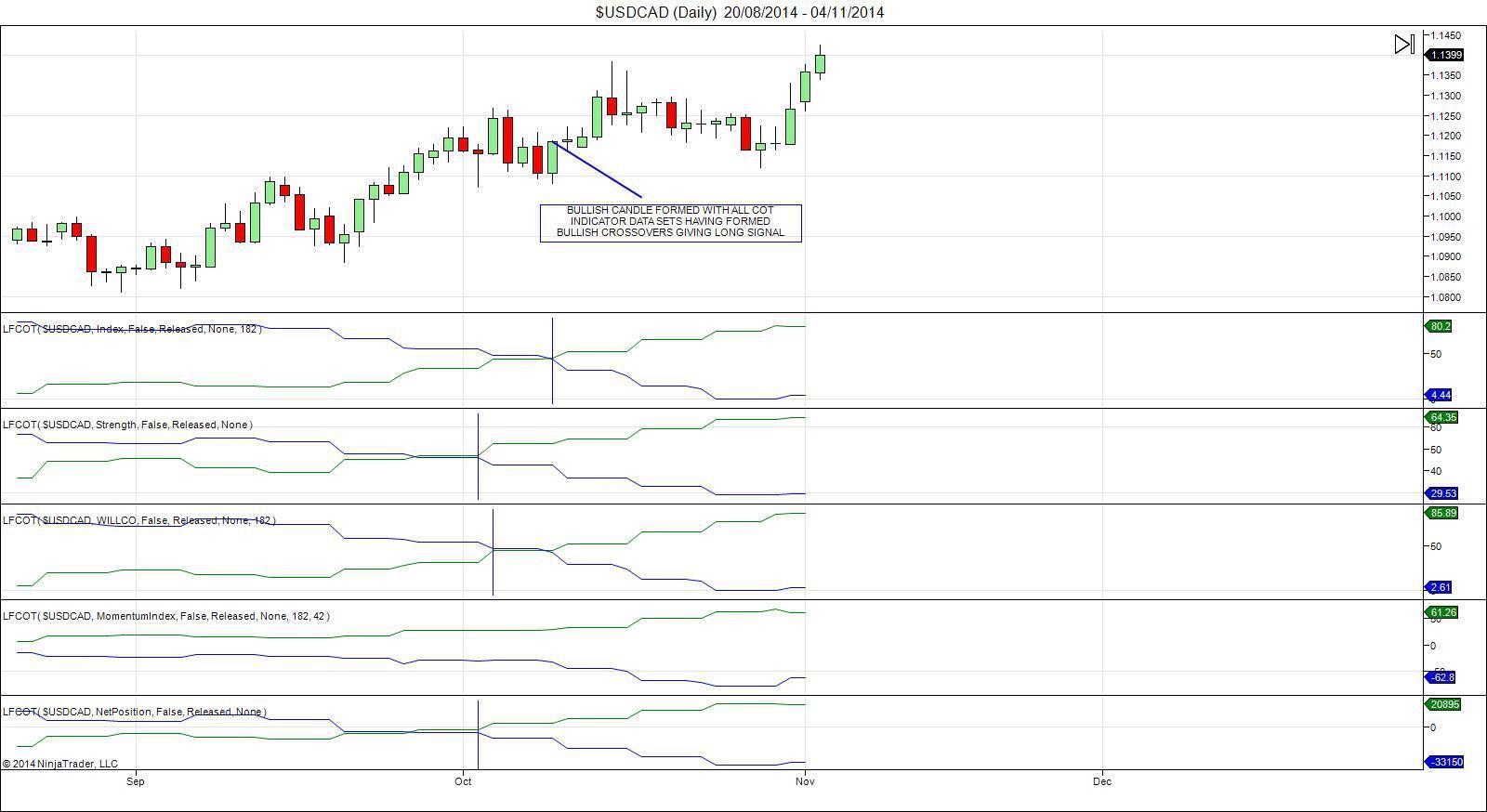
Looking at this USDCAD Daily chart we can see price beginning to trend higher from the September lows, whilst COT indicators remain to the downside (Green lines below blue). However, as price continues higher through early October, indicators begin to move to the upside and we then see bullish crossovers on Index, Strength, WILLCO & Net Positioning with Momentum moving steadily higher. With these crossovers in place we now have our Bullish trade signal, at which point we move across to our Eikon charts to look for entries using the Order Flow indicators.
_20160324083717-637973707808724631.png "COT&OrderFlow")
We can see that on the Bullish candle formed (which marked the final COT crossover on the Index indicator) both Psychology and Order Book Regression indicators crossed to the upside giving us our long trade entry.
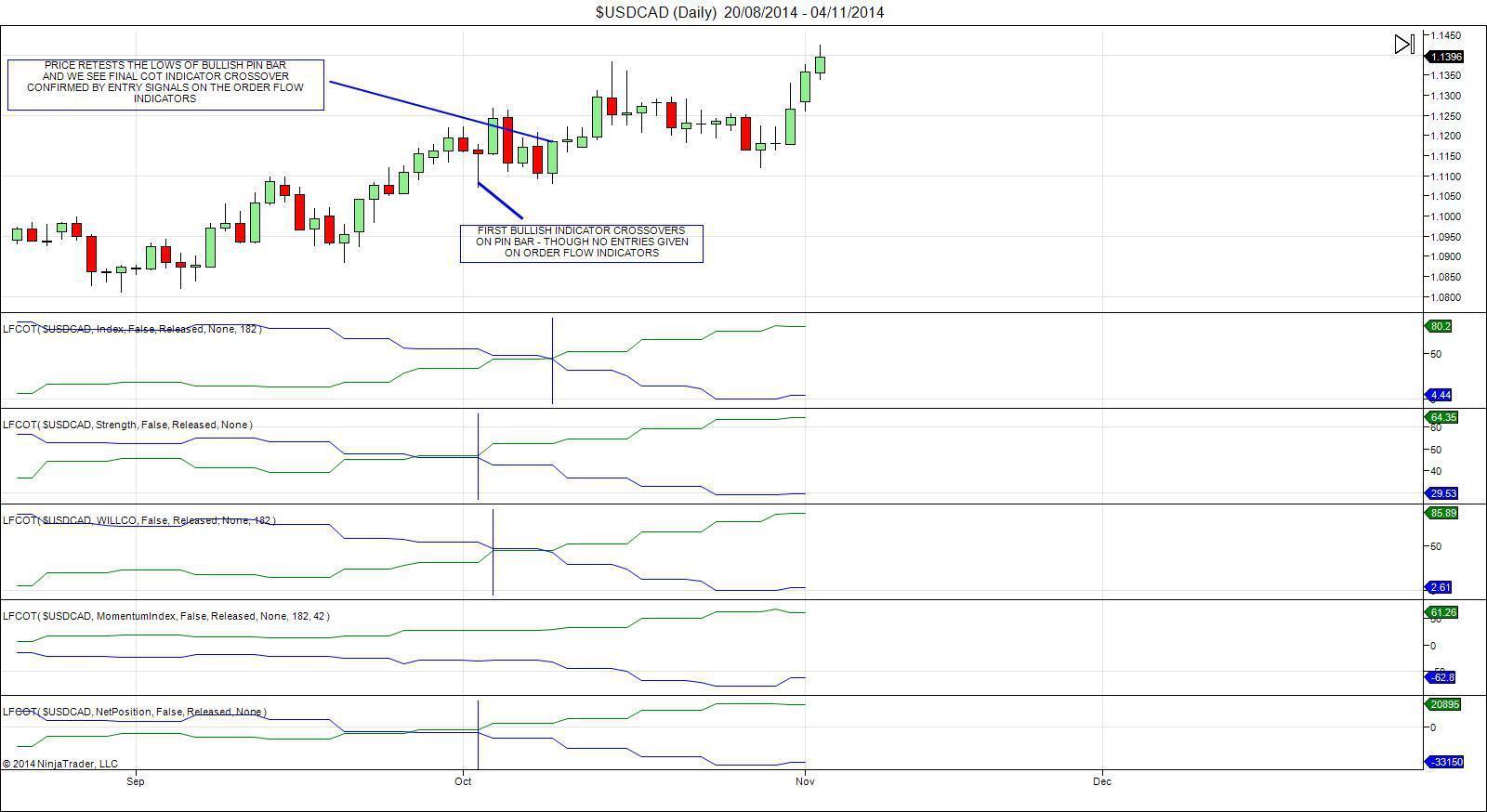
Whilst we did see initial bullish crossovers on the COT indicator confirmed by a bullish Pin Bar, we didn’t get the confluent Bullish crossovers on the Order Flow indicators, and as you can see, price moved lower from that Pin Bar before we finally got the entry signals on the Order Flow indicators. This really highlights the value of combining the two indicator sets to clarify entry points once a directional bias has been established.
With COT indicators remaining at highs, keeping the bullish bias intact we can use the order flow indicators on lower timeframes to add to bullish positions.
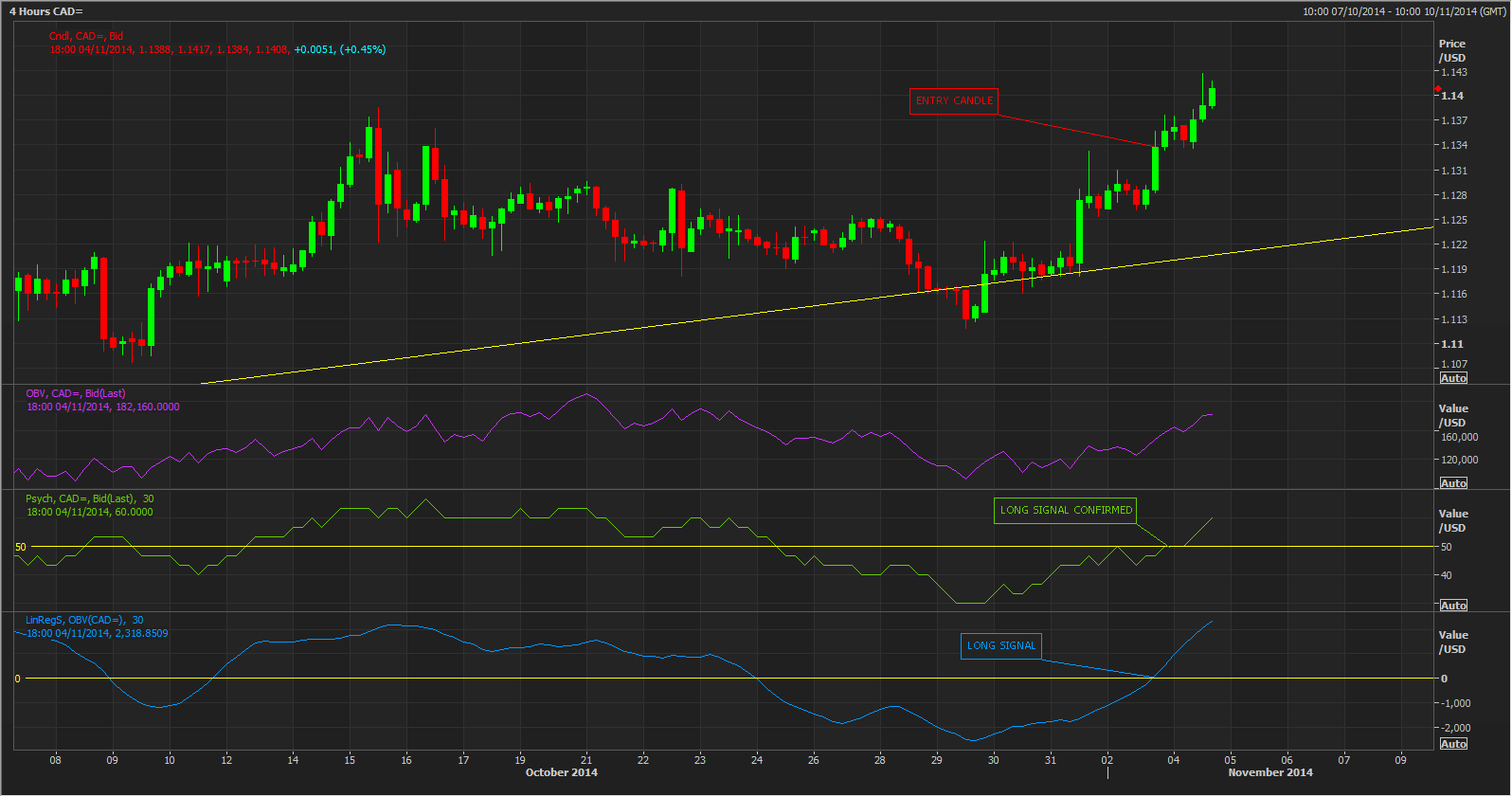
We can see here on the H4 chart that after price consolidated for a period shorty after our initial long position was established we then saw price breaking out to the upside. As this continued bullishness occurred we can see that Psychology & Order Book Regression indicators crossed to the upside giving us a signal to add to our core long position.
This is a very quick look at this combined strategy using both the COT indicators on NinjaTrade7 and the Order Flow indicators on Eikon, but the profitability of combining these tow indicators is evidently clear.
This market forecast is for general information only. It is not an investment advice or a solution to buy or sell securities.
Authors' opinions do not represent the ones of Orbex and its associates. Terms and Conditions and the Privacy Policy apply.
Trading foreign exchange on margin carries a high level of risk, and may not be suitable for all investors. Before deciding to trade foreign exchange, you should carefully consider your investment objectives, level of experience, and risk appetite. There is a possibility that you may sustain a loss of some or all of your investment and therefore you should not invest money that you cannot afford to lose. You should be aware of all the risks associated with foreign exchange trading, and seek advice from an independent financial advisor if you have any doubts.
Editors’ Picks

EUR/USD loses traction, breaks below 1.1900
EUR/USD comes under extra downside pressure, breaching below the 1.1900 support once again on Tuesday. The improved tone in the US Dollar keeps the pair on the back foot after two consecutive daily advances. In the meantime, prudence is expected to kick in ahead of the release of the key US Nonfarm Payrolls on Wednesday.

GBP/USD slips back to daily lows near 1.3640
GBP/USD drops to daily lows near 1.3640 as sellers push harder and the Greenback extends its rebound in the latter part of Tuesday’s session. Looking ahead, the combination of key US releases, including NFP and CPI, alongside important UK data, should keep the pound firmly in focus over the coming days.

USD/JPY drops toward 155.00 as focus shifts to US data
USD/JPY meets fresh supply and inches closer toward 155.00 in the Asian session on Tuesday. The Japanese Yen holds the upper hand over the US Dollar after Japanese Prime Minister Sanae Takaichi led the ruling Liberal Democratic Party to a historic landslide win and on intervention talks. Traders brace for key US economic data that could offer more clues on the Federal Reserve's monetary policy.
Editors’ Picks
EUR/USD loses traction, breaks below 1.1900
EUR/USD comes under extra downside pressure, breaching below the 1.1900 support once again on Tuesday. The improved tone in the US Dollar keeps the pair on the back foot after two consecutive daily advances. In the meantime, prudence is expected to kick in ahead of the release of the key US Nonfarm Payrolls on Wednesday.
GBP/USD slips back to daily lows near 1.3640
GBP/USD drops to daily lows near 1.3640 as sellers push harder and the Greenback extends its rebound in the latter part of Tuesday’s session. Looking ahead, the combination of key US releases, including NFP and CPI, alongside important UK data, should keep the pound firmly in focus over the coming days.

Gold the battle of wills continues with bulls not ready to give up
Gold remains on the defensive and approaches the key $5,000 region per troy ounce on Tuesday, giving back part of its recent two day. The precious metal’s pullback unfolds against a firmer tone in the US Dollar, declining US Treasury yields and steady caution ahead of upcoming key US data releases.

Bitcoin's downtrend caused by ETF redemptions and AI rotation: Wintermute
Bitcoin's (BTC) fall from grace since the October 10 leverage flush has been spearheaded by sustained ETF outflows and a rotation into the AI narrative, according to Wintermute.

Dollar drops and stocks rally: The week of reckoning for US economic data
Following a sizeable move lower in US technology Stocks last week, we have witnessed a meaningful recovery unfold. The USD Index is in a concerning position; the monthly price continues to hold the south channel support.
RECOMMENDED LESSONS
Making money in forex is easy if you know how the bankers trade!

I’m often mystified in my educational forex articles why so many traders struggle to make consistent money out of forex trading. The answer has more to do with what they don’t know than what they do know. After working in investment banks for 20 years many of which were as a Chief trader its second knowledge how to extract cash out of the market.
5 Forex News Events You Need To Know

In the fast moving world of currency markets where huge moves can seemingly come from nowhere, it is extremely important for new traders to learn about the various economic indicators and forex news events and releases that shape the markets. Indeed, quickly getting a handle on which data to look out for, what it means, and how to trade it can see new traders quickly become far more profitable and sets up the road to long term success.
Top 10 Chart Patterns Every Trader Should Know

Chart patterns are one of the most effective trading tools for a trader. They are pure price-action, and form on the basis of underlying buying and selling pressure. Chart patterns have a proven track-record, and traders use them to identify continuation or reversal signals, to open positions and identify price targets.
7 Ways to Avoid Forex Scams

The forex industry is recently seeing more and more scams. Here are 7 ways to avoid losing your money in such scams: Forex scams are becoming frequent. Michael Greenberg reports on luxurious expenses, including a submarine bought from the money taken from forex traders. Here’s another report of a forex fraud. So, how can we avoid falling in such forex scams?
What Are the 10 Fatal Mistakes Traders Make
Trading is exciting. Trading is hard. Trading is extremely hard. Some say that it takes more than 10,000 hours to master. Others believe that trading is the way to quick riches. They might be both wrong. What is important to know that no matter how experienced you are, mistakes will be part of the trading process.
The challenge: Timing the market and trader psychology

Successful trading often comes down to timing – entering and exiting trades at the right moments. Yet timing the market is notoriously difficult, largely because human psychology can derail even the best plans. Two powerful emotions in particular – fear and greed – tend to drive trading decisions off course.