 Gabe Velázquez
Online Trading Academy
If you were contemplating starting your own business, would it be wise to do so if you had little idea about what type of profit margins you would have in the business? Moreover, would you embark on this endeavor without a sound business plan? You all know the answer to these questions, and yet, why is it that when it comes to trading (which should be treated like a business) not many traders consider profit margins when putting on trades.
In any operation that engages in buying and selling merchandise, it’s simple math that dictates whether a business is profitable or not. A basic example of this concept would be that of a grocer. He will buy tomatoes directly from a vendor, in this case a farmer at let’s say $1.25 a pound. If he charges $2.50 a pound he has a profit of $1.25 per pound which is a 100% markup. The markup (the difference between the price he pays and what he sells the tomatoes for) is the profit margin. For the most part, the grocer is not in the business of predicting the future price of tomatoes, he just needs to manage his inventory and sell as many tomatoes at a good margin as he can while staying competitive with other grocers. There is however, a scenario where the grocer will lose money on a batch of tomatoes. That is, if increasing supply causes the price of tomatoes to suddenly drop to fifty cents a pound. If he’s caught with a bunch of inventory which he paid much higher prices for some of his competitors will buy the cheaper tomatoes and sell them at lower prices. This in turn will cut into his profits because he will have to lower his prices to stay competitive. If the price he sells them is below cost he will lose money. If he manages his inventory properly through all the inevitable price fluctuations, in the long run, he’ll stay profitable.
It’s not any different in trading. Buying low and selling high is the only way to stay profitable. As simple as that sounds, why is it so challenging for traders to stay profitable? Think about the last time you went long an S&P E-mini futures contract. Before you placed the trade did you have a mechanical process to project a profit target? Did the potential profit warrant the risk you were putting on? Do you understand the concept of probabilities, and that it takes a larger sample size to ascertain the viability of any method? If you answered no to any of these questions then I would venture to guess you’re trading is not profitable.
Here at Online Trading Academy, we teach a method based on the immutable laws of Supply and demand. We use this not only to find low risk entry points but also as a way to measure profit potential. The details are beyond the scope of this article but here is an example of what we did in one of the XLT classes I conducted last week.
This was a short setup in the EC (Euro currency futures) that students participated in. We found a high quality area where institutions had shown us that they had sold a large number of futures contracts (supply). We placed a limit order at the bottom of the zone (before price returned to the level) and a stop above the upper end of the zone in case we were wrong. Now, the profit target (the blue line) was done by measuring the distance between the entry and where prices were likely to turn higher. This is accomplished by using various factors that give us a specific target price. You’ll notice in the chart below that price fell much further than our projected target. We’re perfectly fine with that as long as the rules of engagement are applied.
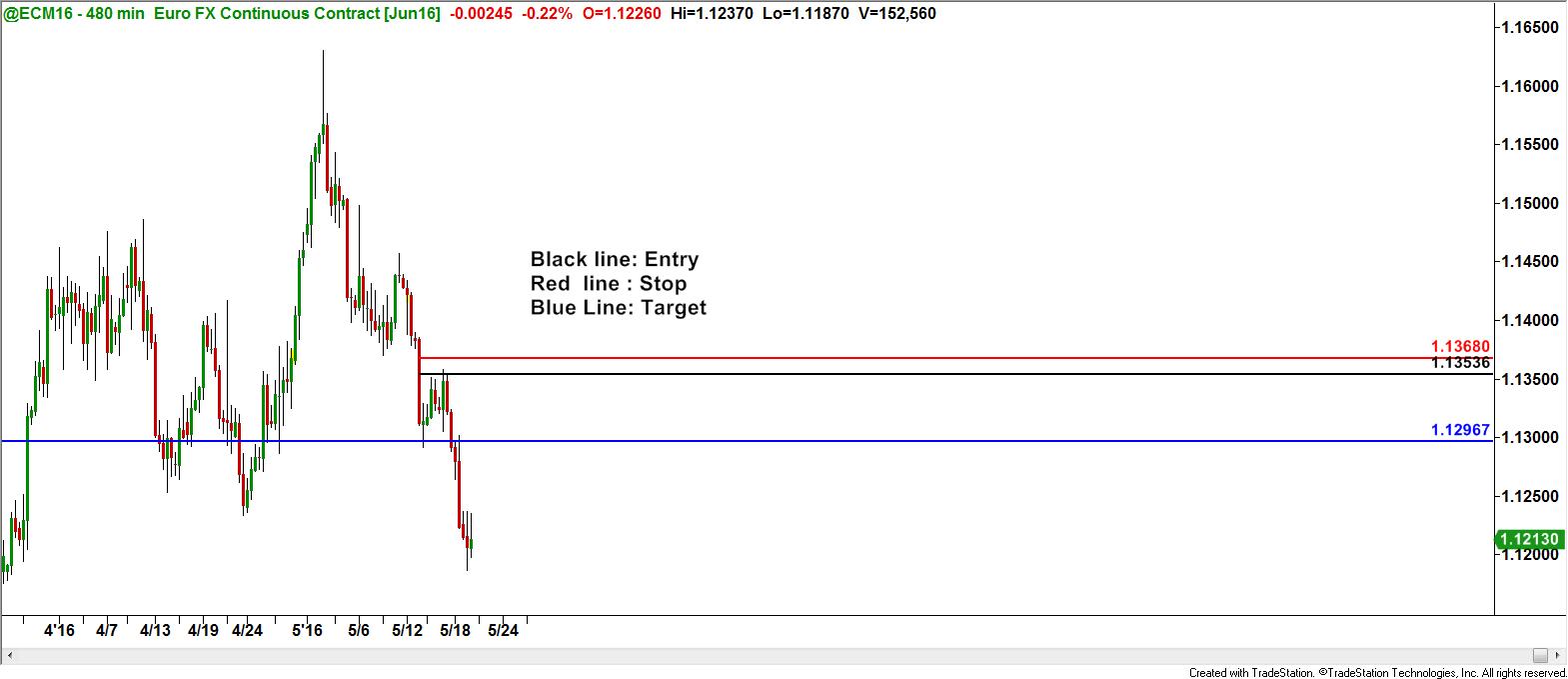
In conclusion, trading has to be treated like a business and there must be a system in place to measure the profitability of all the trades that are taken. And similar to a business, which incurs costs, and won’t make money on all transactions, a trader must keep losses small and profit margins wide so in the long run profits will be more probable.
Until next time , I hope everyone has a profitable week.
This content is intended to provide educational information only. This information should not be construed as individual or customized legal, tax, financial or investment services. As each individual's situation is unique, a qualified professional should be consulted before making legal, tax, financial and investment decisions. The educational information provided in this article does not comprise any course or a part of any course that may be used as an educational credit for any certification purpose and will not prepare any User to be accredited for any licenses in any industry and will not prepare any User to get a job. Reproduced by permission from OTAcademy.com click here for Terms of Use: https://www.otacademy.com/about/terms
Editors’ Picks

EUR/USD remains offered below 1.1800, looks at US data
EUR/USD is still trading on the defensive in the latter part of Thursday’s session, while the US Dollar maintains its bid bias as investors now gear up for Friday’s key release of the PCE data, advanced Q4 GDP prints and flash PMIs.

GBP/USD bounces off monthly lows near 1.3430
GBP/USD is sliding in tandem with its risk-sensitive peers, drifting back towards the 1.3430 area, its lowest levels in the month. The move reflects a firmer Greenback, supported by another round of solid US data and a somewhat divided FOMC Minutes.

USD/JPY sticks to gains near one-week top, above 155.00 on softer Japanese CPI
USD/JPY attracts some dip-buying following the release of Japan's soft consumer inflation figures, which tempers bets for an immediate BoJ rate hike and weighs on the Japanese Yen amid fiscal concerns. Apart from this, a bullish US Dollar keeps spot prices close to over a one-week top. However, a slight deterioration in the global risk sentiment might cap gains. Traders now look to the US Q4 GDP report and the crucial PCE Price Index for cues about Fed policy outlook amid rising bets for more rate cuts, which will drive the US Dollar and provide a fresh impetus to the currency pair.
Editors’ Picks

AUD/USD hangs near two-week low vs. firmer USD ahead of key US macro releases
The AUD/USD pair meets with a fresh supply during the Asian session on Friday and remains well within striking distance of a nearly two-week low, touched the previous day. Spot prices currently trade around the 0.7035 area as traders look to the key US macro releases before placing fresh directional bets.
USD/JPY sticks to gains near one-week top, above 155.00 on softer Japanese CPI
USD/JPY attracts some dip-buying following the release of Japan's soft consumer inflation figures, which tempers bets for an immediate BoJ rate hike and weighs on the Japanese Yen amid fiscal concerns. Apart from this, a bullish US Dollar keeps spot prices close to over a one-week top. However, a slight deterioration in the global risk sentiment might cap gains. Traders now look to the US Q4 GDP report and the crucial PCE Price Index for cues about Fed policy outlook amid rising bets for more rate cuts, which will drive the US Dollar and provide a fresh impetus to the currency pair.

Gold drifts higher to near $5,000 on heightened US-Iran tensions
Gold price holds positive ground near $5,000 during the early Asian session on Friday. The precious metal edges higher as escalating tensions between the United States and Iran boost safe-haven demand. Traders brace for the preliminary reading of US Gross Domestic Product for the fourth quarter, the Personal Consumption Expenditures and the S&P Global Purchasing Managers Index data, which are due later on Friday.

Ethereum: Active addresses halt growth as US selling pressure eases
Ethereum network growth has declined after two months of explosive increase. US selling pressure has eased following an improvement in the Coinbase Premium Index. ETH extends its range-bound move below the $2,107 resistance and above $1,740 .

Hawkish Fed minutes and a market finding its footing
It was green across the board for US Stock market indexes at the close on Wednesday, with most S&P 500 names ending higher, adding 38 points (0.6%) to 6,881 overall. At the GICS sector level, energy led gains, followed by technology and consumer discretionary, while utilities and real estate posted the largest losses.
RECOMMENDED LESSONS
Making money in forex is easy if you know how the bankers trade!

I’m often mystified in my educational forex articles why so many traders struggle to make consistent money out of forex trading. The answer has more to do with what they don’t know than what they do know. After working in investment banks for 20 years many of which were as a Chief trader its second knowledge how to extract cash out of the market.
5 Forex News Events You Need To Know

In the fast moving world of currency markets where huge moves can seemingly come from nowhere, it is extremely important for new traders to learn about the various economic indicators and forex news events and releases that shape the markets. Indeed, quickly getting a handle on which data to look out for, what it means, and how to trade it can see new traders quickly become far more profitable and sets up the road to long term success.
Top 10 Chart Patterns Every Trader Should Know

Chart patterns are one of the most effective trading tools for a trader. They are pure price-action, and form on the basis of underlying buying and selling pressure. Chart patterns have a proven track-record, and traders use them to identify continuation or reversal signals, to open positions and identify price targets.
7 Ways to Avoid Forex Scams

The forex industry is recently seeing more and more scams. Here are 7 ways to avoid losing your money in such scams: Forex scams are becoming frequent. Michael Greenberg reports on luxurious expenses, including a submarine bought from the money taken from forex traders. Here’s another report of a forex fraud. So, how can we avoid falling in such forex scams?
What Are the 10 Fatal Mistakes Traders Make
Trading is exciting. Trading is hard. Trading is extremely hard. Some say that it takes more than 10,000 hours to master. Others believe that trading is the way to quick riches. They might be both wrong. What is important to know that no matter how experienced you are, mistakes will be part of the trading process.
The challenge: Timing the market and trader psychology

Successful trading often comes down to timing – entering and exiting trades at the right moments. Yet timing the market is notoriously difficult, largely because human psychology can derail even the best plans. Two powerful emotions in particular – fear and greed – tend to drive trading decisions off course.