 Gabe Velázquez
Online Trading Academy
Over the last 20 years, it seems that about every six to eight years the financial markets experience severe bouts of turbulence. These episodes of trading volatility, in my estimation, are probably going to become even more frequent as the global economy becomes more intertwined and information is disseminated at light speed.
For the average investor, these spikes in trading volatility can be harrowing as they see their stocks and mutual funds going through wild fluctuations while prices go mostly lower. The average trader also finds this type of environment challenging because the rate of change can be so dramatic that reacting to such price movement usually results in several losses.
In addressing these changes in market volatility, the first question I get asked is if there is a different strategy that should be implemented for such extreme conditions. The simple answer is no. The core strategy of supply and demand never changes regardless of market conditions. The only aspect that changes is the velocity of price movement; and the levels do become a bit wider.
On Monday August 24, the E-mini S&P futures contract was down a whopping 100 points as we were nearing the open of the New York Stock Exchange. Conventional thinking was telling us that it was a crash or just to hang on despite the fact that fear was rampant, and it was difficult not to get caught up in the group thinking. If, however, you have a simple, objective, rules based strategy that you are following, you would have noticed that the ES (E-mini S&P) futures contract was approaching a 240 min demand zone (shown in the chart below). This indicates that there was a high probability that the ES would bounce from there.
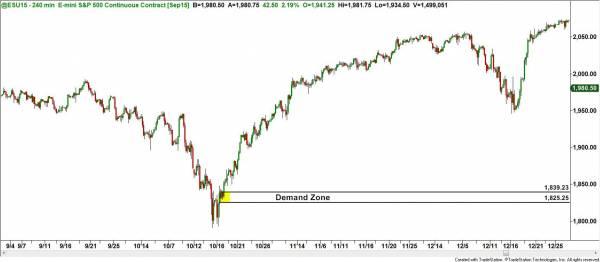
Notice I say probability; I always have to address this with potential traders. You must remember that this game is all about measuring odds and that there are never any guarantees. Also, that if it doesn’t hold we take small losses. Lastly, the fact is that nobody knows for sure what will happen next so that’s where a sound, proven strategy comes into play. The reason I bring this up is because many will be asked, “How do you know which level to choose when there are so many I see?” The answer goes back to the specifics in the core strategy we teach here at Online trading Academy. In the next image we can see that the market did indeed bounce from this level. Please understand that there’s no silver bullet here, just a picture that represented true supply and demand.
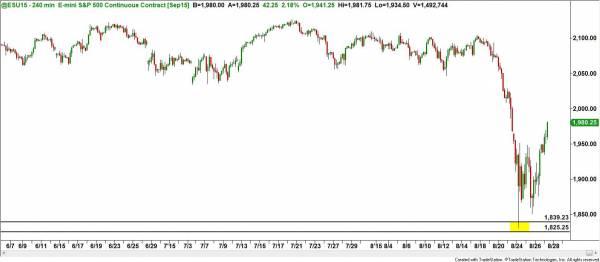
Because the supply and demand levels do become wider in this environment, the only adjustment to be made for the short-term trader is to reduce their contract size and take entries on smaller time frames.
As I noted earlier, it is unfortunate that so many people suffer in markets with high trading volatility because, quite honestly, they don’t truly understand the dynamics of supply and demand or how the institutions manipulate the markets to suit their needs. The simple fact is, that in order to change one’s results one must change their perception and how they think about trading and investing. Otherwise, the high volatility will continue to wreak havoc in a trader’s psyche and account balance.
This content is intended to provide educational information only. This information should not be construed as individual or customized legal, tax, financial or investment services. As each individual's situation is unique, a qualified professional should be consulted before making legal, tax, financial and investment decisions. The educational information provided in this article does not comprise any course or a part of any course that may be used as an educational credit for any certification purpose and will not prepare any User to be accredited for any licenses in any industry and will not prepare any User to get a job. Reproduced by permission from OTAcademy.com click here for Terms of Use: https://www.otacademy.com/about/terms
Editors’ Picks

EUR/USD struggles to regain momentum in the low1.1600s
EUR/USD is giving some signs of life in the aftermath of two severe days of losses on Wednesday, reclaiming the 1.1600 hurdle and above on the back of the resurgence of a mild selling bias around the US Dollar. Moving forward, the usual US weekly Claims will take centre stage on Thursday ahead of Friday’s crucial NFP data.

GBP/USD tests key moving averages as growth downgrade weighs
GBP/USD was nearly flat on Wednesday, edging up 0.08% to settle around 1.3370 in a quiet session. The pair has fallen sharply from its late-January high near 1.3870 and is now testing the 200-day Exponential Moving Average, with this week's one-week forex heatmap showing Pound Sterling as one of the worst performers against the US Dollar, down about 1.4% on the week.

USD/JPY retreats further from YTD peak amid intervention fears, softer USD
The USD/JPY drifts lower for the second consecutive day, moving further away from its highest level since January 23, around the 158.00 area, set earlier this week. Fears of intervention, along with expectations that the BoJ will stick to its policy normalization path, support the Japanese Yen and weigh on spot prices amid a softer US Dollar. However, geopolitical tensions could benefit the USD's reserve currency status amid reduced bets for more aggressive easing by the Fed and cap the currency pair.
Editors’ Picks

AUD/USD holds steady below 0.7100 after Australian trade data
AUD/USD moves little following the release of Australian Trade Balance data and consolidates below 0.7100 on Thursday. A goodish recovery in the risk sentiment acts as a tailwind for the Aussie amid bets for another RBA rate hike in May, bolstered by the upbeat GDP print on Wednesday. However, rising geopolitical tensions help limit the safe-haven US Dollar's overnight corrective pullback and cap the currency pair.
USD/JPY retreats further from YTD peak amid intervention fears, softer USD
The USD/JPY drifts lower for the second consecutive day, moving further away from its highest level since January 23, around the 158.00 area, set earlier this week. Fears of intervention, along with expectations that the BoJ will stick to its policy normalization path, support the Japanese Yen and weigh on spot prices amid a softer US Dollar. However, geopolitical tensions could benefit the USD's reserve currency status amid reduced bets for more aggressive easing by the Fed and cap the currency pair.

Gold benefits from a retreating USD; reduced Fed rate cut bets cap gains
Gold attracts some buyers for the second consecutive day on Thursday amid a modest US Dollar pullback from an over three-month high, though it remains below the $5,200 mark. Wednesday's upbeat US macro data further tempered hopes for three rate cuts by the Fed in 2026. Furthermore, escalating Middle East tensions might continue to benefit the USD's status as the global reserve currency and contribute to capping the bullion.

Morgan Stanley files amended S-1 for spot Bitcoin ETF
Morgan Stanley submitted an amended S-1 filing to the US Securities and Exchange Commission on Wednesday, providing additional details on its proposed Bitcoin exchange-traded fund.

First Venezuela, now Iran: The US-China energy war escalates Premium
At first glance, the latest escalation involving the United States with both Iran and Venezuela looks like another chapter in a long-running geopolitical story. But viewed through a broader strategic lens, something else may be unfolding: Energy.
RECOMMENDED LESSONS
Making money in forex is easy if you know how the bankers trade!

I’m often mystified in my educational forex articles why so many traders struggle to make consistent money out of forex trading. The answer has more to do with what they don’t know than what they do know. After working in investment banks for 20 years many of which were as a Chief trader its second knowledge how to extract cash out of the market.
5 Forex News Events You Need To Know

In the fast moving world of currency markets where huge moves can seemingly come from nowhere, it is extremely important for new traders to learn about the various economic indicators and forex news events and releases that shape the markets. Indeed, quickly getting a handle on which data to look out for, what it means, and how to trade it can see new traders quickly become far more profitable and sets up the road to long term success.
Top 10 Chart Patterns Every Trader Should Know

Chart patterns are one of the most effective trading tools for a trader. They are pure price-action, and form on the basis of underlying buying and selling pressure. Chart patterns have a proven track-record, and traders use them to identify continuation or reversal signals, to open positions and identify price targets.
7 Ways to Avoid Forex Scams

The forex industry is recently seeing more and more scams. Here are 7 ways to avoid losing your money in such scams: Forex scams are becoming frequent. Michael Greenberg reports on luxurious expenses, including a submarine bought from the money taken from forex traders. Here’s another report of a forex fraud. So, how can we avoid falling in such forex scams?
What Are the 10 Fatal Mistakes Traders Make
Trading is exciting. Trading is hard. Trading is extremely hard. Some say that it takes more than 10,000 hours to master. Others believe that trading is the way to quick riches. They might be both wrong. What is important to know that no matter how experienced you are, mistakes will be part of the trading process.
The challenge: Timing the market and trader psychology

Successful trading often comes down to timing – entering and exiting trades at the right moments. Yet timing the market is notoriously difficult, largely because human psychology can derail even the best plans. Two powerful emotions in particular – fear and greed – tend to drive trading decisions off course.