
Many students email me wanting to know how to tell if a supply or demand zone is likely to hold or break. Understanding this is critical for trading, for if we buy or sell at the wrong time we give up the opportunity to make greater profits or worse, we lose money.
In the Online Trading Academy’s Professional Trader Course as well as the Extended Learning Track, we stress the importance of our Odds Enhancers as a way to filter out weak opportunities and find the best trades that we should take. Although the strategy of using Supply and Demand is relatively simple, traders and investors must know that not every turning point in the market is a high quality trading opportunity. There are many Odds Enhancers, but with knowledge and practice using them becomes second nature and your consistency in the markets generally improves.
An Odds Enhancer that we look at when determining the strength of a zone is how price left that zone. Think of a glass of water sitting on a table. If you were to grab the glass only to find it filled with scalding hot water, you are likely to release your grip very quickly. But if the glass was filled with room temperature water you could hold the glass as long as you would like or even take a sip.
Price works the same way. Traders need to focus on the strength at which price left the origin of the supply or demand zone. If price leaves quickly, it shows a large imbalance of supply and demand and, therefore, a stronger zone.
Looking at the following chart we can see that we left the demand zone with large green candles when demand was formed. This means that this is an area where buyers are much stronger than the sellers. The glass is hot! When price returns to that level we would have a high probability buying opportunity since the sellers are weak there and price is likely to rise again.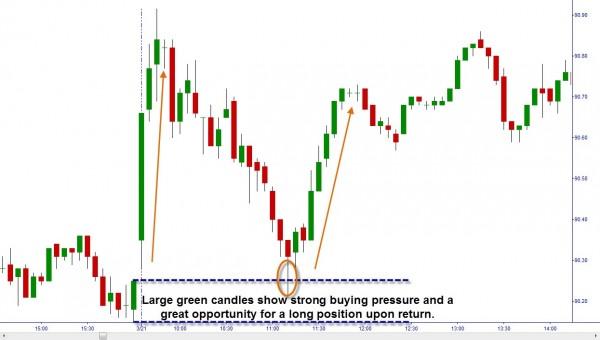
What happens if we leave the area slowly? We would likely see smaller candles and/or a mix or red and green candles. The battle between buyers and sellers is pretty even and no one side has the major advantage. Without clear direction in this zone, prices are less likely to bounce fast.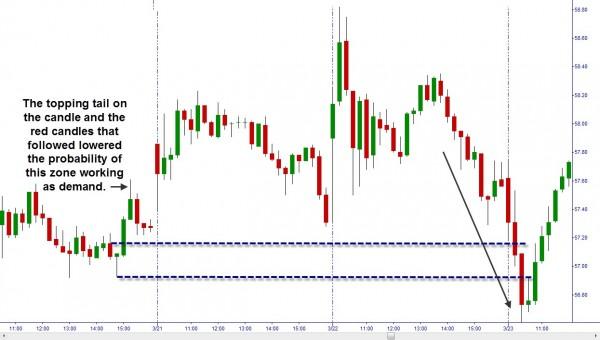
The same can be said for supply zones. For the zone to offer us a higher probability selling opportunity we would want to see a fast drop from that level. On the charts this would be characterized by large red candles, gaps down and/or topping tails on the candles.
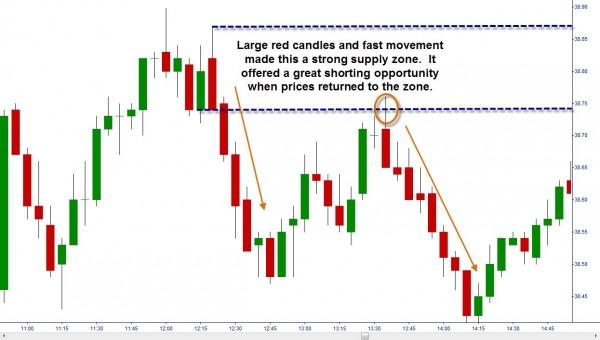
If you do not see that occurring you would have a lower probability of success in selling at those levels.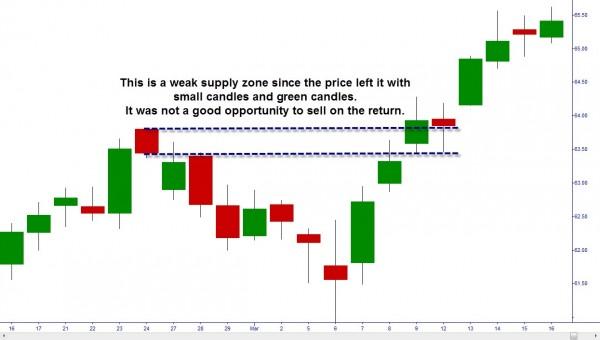
So, now you are aware of one of the Odds Enhancers we can use to increase our chances for success in trading any market and any time frame. To learn the others join us at one of our worldwide education centers and increase your knowledge.
Editors’ Picks

EUR/USD edges lower below 1.1650 as Middle East tensions fuel US Dollar strength
The EUR/USD pair trades in negative territory around 1.1635 during the early Asian session on Thursday. The US Dollar strengthens against the Euro as escalating Middle East conflict boosts safe-haven flows. Traders brace for the Eurozone Retail Sales and US weekly Initial Jobless Claims reports, which will be released later on Thursday.

GBP/USD tests key moving averages as growth downgrade weighs
GBP/USD was nearly flat on Wednesday, edging up 0.08% to settle around 1.3370 in a quiet session. The pair has fallen sharply from its late-January high near 1.3870 and is now testing the 200-day Exponential Moving Average, with this week's one-week forex heatmap showing Pound Sterling as one of the worst performers against the US Dollar, down about 1.4% on the week.

USD/JPY holds pullback below 157.00 amid Japanese intervention risks
USD/JPY holds the pullback from the year-to-date high in the Asian session on Thursday, keeping the red below 157.00. Fears of intervention, along with expectations that the BoJ will stick to its policy normalization path, support the Japanese Yen and weigh on the pair amid a subdued US Dollar. However, geopolitical tensions could benefit the USD's reserve currency status amid reduced bets for more aggressive easing by the Fed and cushion the currency pair.
Editors’ Picks

AUD/USD eases below 0.7100 after Aussie trade data, China growth woes
AUD/USD meets fresh supply and eases below 0.7100 following the release of dismal Australian Trade Balance data on Thursday. A record-low growth target set by China for 2026 also weighs on the Chinese proxy, the Australian Dollar, while the US Dollar finds fresh bids amid the ongoing geopolitical tensions in the Middle East.
USD/JPY holds pullback below 157.00 amid Japanese intervention risks
USD/JPY holds the pullback from the year-to-date high in the Asian session on Thursday, keeping the red below 157.00. Fears of intervention, along with expectations that the BoJ will stick to its policy normalization path, support the Japanese Yen and weigh on the pair amid a subdued US Dollar. However, geopolitical tensions could benefit the USD's reserve currency status amid reduced bets for more aggressive easing by the Fed and cushion the currency pair.

Gold re-attempts $5,200 amid a softer USD; reduced Fed rate cut bets cap gains
Gold bounces toward $5,200 for the second consecutive day on Thursday amid a modest US Dollar weakness. Wednesday's upbeat US macro data further tempered hopes for three rate cuts by the Fed in 2026. Furthermore, escalating Middle East tensions might continue to benefit the USD's status as the global reserve currency and contribute to capping the bullion.

Ethereum jumps alongside a spike in open interest, realized price could limit upside
Ethereum has jumped above $2,100 on Wednesday, following a general recovery across the crypto market. The move was accompanied by a spike in Ethereum's open interest, which has increased to 13.43M ETH — its highest level since January 31.

First Venezuela, now Iran: The US-China energy war escalates Premium
At first glance, the latest escalation involving the United States with both Iran and Venezuela looks like another chapter in a long-running geopolitical story. But viewed through a broader strategic lens, something else may be unfolding: Energy.
RECOMMENDED LESSONS
Making money in forex is easy if you know how the bankers trade!

I’m often mystified in my educational forex articles why so many traders struggle to make consistent money out of forex trading. The answer has more to do with what they don’t know than what they do know. After working in investment banks for 20 years many of which were as a Chief trader its second knowledge how to extract cash out of the market.
5 Forex News Events You Need To Know

In the fast moving world of currency markets where huge moves can seemingly come from nowhere, it is extremely important for new traders to learn about the various economic indicators and forex news events and releases that shape the markets. Indeed, quickly getting a handle on which data to look out for, what it means, and how to trade it can see new traders quickly become far more profitable and sets up the road to long term success.
Top 10 Chart Patterns Every Trader Should Know

Chart patterns are one of the most effective trading tools for a trader. They are pure price-action, and form on the basis of underlying buying and selling pressure. Chart patterns have a proven track-record, and traders use them to identify continuation or reversal signals, to open positions and identify price targets.
7 Ways to Avoid Forex Scams

The forex industry is recently seeing more and more scams. Here are 7 ways to avoid losing your money in such scams: Forex scams are becoming frequent. Michael Greenberg reports on luxurious expenses, including a submarine bought from the money taken from forex traders. Here’s another report of a forex fraud. So, how can we avoid falling in such forex scams?
What Are the 10 Fatal Mistakes Traders Make
Trading is exciting. Trading is hard. Trading is extremely hard. Some say that it takes more than 10,000 hours to master. Others believe that trading is the way to quick riches. They might be both wrong. What is important to know that no matter how experienced you are, mistakes will be part of the trading process.
The challenge: Timing the market and trader psychology

Successful trading often comes down to timing – entering and exiting trades at the right moments. Yet timing the market is notoriously difficult, largely because human psychology can derail even the best plans. Two powerful emotions in particular – fear and greed – tend to drive trading decisions off course.