 Brandon Wendell, CMT
Brandon Wendell
In last week’s article, we discussed one of the areas that novice traders mistakenly enter trades only to get stopped out by the professionals. This week, I will revisit an older topic that is related. In that article, I answered an email from a student:
“I want you to tell me the importance of how a price comes back to a level? What is the significance of how it arrives, if it comes in like a glider plane or a lead balloon? I think what is important is how it leaves but the arrival is an odd’s enhancer. I am a ‘why’ guy. So why is arrival so important?”
This is a great question and the answer highlights the true market forces behind price movement, fear and greed. I want you to think about a flagpole. If I climbed to the top of that pole it would hold my weight. However, as more and more people climbed up to the top of that same pole, eventually it would bend and break from the added weight. Prices are similar.
Stock prices rise because of demand. The demand being greater than the supply causes buyers to outbid each other and climb the pole. At some point, the buyers have exhausted themselves and everyone who wanted to buy has already done so or is prevented from buying due to the high cost.
Prices start to fall as fear takes hold. Most investors and traders will start to panic when the price starts moving against them or their stops will be triggered. If there was a lot of buying pressure and large green candles going into the supply level, there will be few buyers to stop the collapse and catch the supply being dumped onto the markets from stop orders being triggered.
Compare this with a gradual climb that features smaller green candles and some small pullbacks to shake out weak traders. As prices fall away from a supply level in this scenario, they will be met with less stop orders and more buying pressure as the demand was not exhausted on the way up.
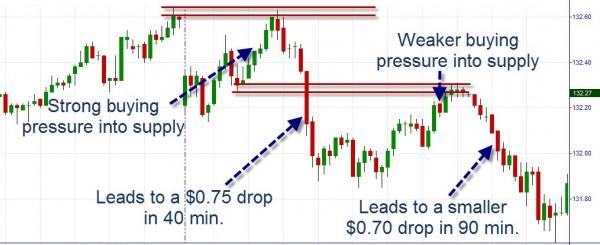
Arrival to demand zones are also important. If you arrive to the demand with large red candles signaling panic and fear, you are likely to have a bigger and better bounce. The large red candles signal that everyone who wanted to sell has now exited the stock. When buyers step in they must raise their bids quickly to attract a seller who may still be around.
If the arrival to the demand zone is quiet, there are still many worried holders of the stock who are looking to sell at a smaller loss when the bounce occurs. This added supply will mute the bounce of price from the demand level.
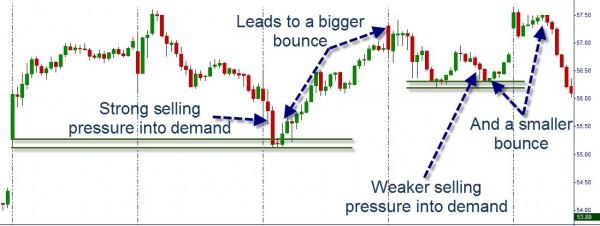
Most novice traders are taught to buy AFTER prices have rallied. This is where we see them climbing to the top of the flagpole. As professionals, we want to be buying wholesale prices.
We buy when prices are cheap, not expensive. The same is true for selling. Selling after a drop in price is silly. You should sell before the drop and at a supply zone. Knowing where these zones lie is critical to being successful in trading and is part of Online trading Academy’s core strategy.
Neither Freedom Management Partners nor any of its personnel are registered broker-dealers or investment advisers. I will mention that I consider certain securities or positions to be good candidates for the types of strategies we are discussing or illustrating. Because I consider the securities or positions appropriate to the discussion or for illustration purposes does not mean that I am telling you to trade the strategies or securities. Keep in mind that we are not providing you with recommendations or personalized advice about your trading activities. The information we are providing is not tailored to any individual. Any mention of a particular security is not a recommendation to buy, sell, or hold that or any other security or a suggestion that it is suitable for any specific person. Keep in mind that all trading involves a risk of loss, and this will always be the situation, regardless of whether we are discussing strategies that are intended to limit risk. Also, Freedom Management Partners’ personnel are not subject to trading restrictions. I and others at Freedom Management Partners could have a position in a security or initiate a position in a security at any time.
Editors’ Picks

EUR/USD keeps the offered stance just above 1.1700
EUR/USD is coming under heavy selling pressure in what has been a rather grim start to the new trading week, with the pair now trading close to the 1.1700 support area as the US Dollar stages a solid rebound. The prevailing flight to safety mood continues to favour the Greenback, as investors react to the escalating conflict in the Middle East and trim risk exposure across the board.

GBP/USD hits new yearly lows near 1.3300
GBP/USD adds to the recent bearish tone, approaching to the key 1.3300 support to reach fresh YTD troughs against the backdrop of the robust performance of the US Dollar. Indeed, Cable’s decline comes amid the firm demand for the safe-haven space in the wake of the US and Israel attacks to Iran.

USD/JPY: Japanese Yen remains depressed vs. USD amid Middle East tensions; lacks follow-through
The USD/JPY pair catches fresh bids at the start of a new week and climbs back closer to last week's swing high, though it lacks follow-through and remains below the 157.00 mark through the Asian session. A coordinated US-Israel military strike on Iran marks a dramatic escalation of geopolitical tensions and unsettles global markets.
Editors’ Picks

Gold trims losses, back below $5,400
Gold now surrenders part of the earlier advance past the $5,400 mark per troy ounce at the beginning of the week. Indeed, the precious metal’s strong uptick remains fuelled by increasing geopolitical tensions in the Middle East amid the intense demand for safer assets.

Oil eases from tops, back to around $71.00/bbl
Crude oil prices are now giving away some gains after the initial 12% advance, with WTI hovering just above the $71.00 mark per barrel, its strongest levels since June. The jump in prices comes as markets continue to react to heightened geopolitical risk after US and Israeli military strikes on Iran and the effective shutdown of shipping through the Strait of Hormuz.
EUR/USD keeps the offered stance just above 1.1700
EUR/USD is coming under heavy selling pressure in what has been a rather grim start to the new trading week, with the pair now trading close to the 1.1700 support area as the US Dollar stages a solid rebound. The prevailing flight to safety mood continues to favour the Greenback, as investors react to the escalating conflict in the Middle East and trim risk exposure across the board.

Bitcoin on brink of breakdown amid US-Iran war
Bitcoin (BTC) remains under pressure near the key support level of $65,700. Trading at $66,400 at the time of writing on Monday, a breakdown below this critical level would suggest a deeper correction ahead.

The Fed is finally talking about AI – Here's why it matters for the US Dollar Premium
AI is moving from earnings calls into the heart of monetary policy discussions, forcing Federal Reserve officials to confront a new question: How to act if AI reshapes inflation, employment and interest rates at the same time?
RECOMMENDED LESSONS
Making money in forex is easy if you know how the bankers trade!

I’m often mystified in my educational forex articles why so many traders struggle to make consistent money out of forex trading. The answer has more to do with what they don’t know than what they do know. After working in investment banks for 20 years many of which were as a Chief trader its second knowledge how to extract cash out of the market.
5 Forex News Events You Need To Know

In the fast moving world of currency markets where huge moves can seemingly come from nowhere, it is extremely important for new traders to learn about the various economic indicators and forex news events and releases that shape the markets. Indeed, quickly getting a handle on which data to look out for, what it means, and how to trade it can see new traders quickly become far more profitable and sets up the road to long term success.
Top 10 Chart Patterns Every Trader Should Know

Chart patterns are one of the most effective trading tools for a trader. They are pure price-action, and form on the basis of underlying buying and selling pressure. Chart patterns have a proven track-record, and traders use them to identify continuation or reversal signals, to open positions and identify price targets.
7 Ways to Avoid Forex Scams

The forex industry is recently seeing more and more scams. Here are 7 ways to avoid losing your money in such scams: Forex scams are becoming frequent. Michael Greenberg reports on luxurious expenses, including a submarine bought from the money taken from forex traders. Here’s another report of a forex fraud. So, how can we avoid falling in such forex scams?
What Are the 10 Fatal Mistakes Traders Make
Trading is exciting. Trading is hard. Trading is extremely hard. Some say that it takes more than 10,000 hours to master. Others believe that trading is the way to quick riches. They might be both wrong. What is important to know that no matter how experienced you are, mistakes will be part of the trading process.
The challenge: Timing the market and trader psychology

Successful trading often comes down to timing – entering and exiting trades at the right moments. Yet timing the market is notoriously difficult, largely because human psychology can derail even the best plans. Two powerful emotions in particular – fear and greed – tend to drive trading decisions off course.