
Now that you are comfortable calculating “Profit/Loss at expiry” to buy options, I would like to show you how changing the strike of the option affects the overall value of it. The strike of an option will always be in one of three states: In-the-money (ITM), at-the-money (ATM), or out-of-the-money (OTM).
Since there are several news events for both the euro and the greenback on Monday, EUR/USD will be potentially more volatile. When buying options, increasing volatility in the future is good. So let’s evaluate whether you would want to buy your options at-the-money, in-the-money, or out-of-the-money (terms you will frequently hear when trading options).
• An option is at-the-money (ATM) when the strike rate equals the underlying market rate. For example, if EUR/USD is trading at 1.1200 and you buy a Call option with strike 1.1200 the option is ATM.
• An option is in-the-money (ITM) when the strike rate is better than the underlying market rate. For example, if EUR/USD is trading at 1.1200 and you buy a Call with strike 1.1100 the option would be considered ITM because 1.1100 is a better buy rate than 1.1200.
• An option is out-of-the-money (OTM) when the strike rate is worse than the underlying market rate. For example, if EUR/USD is trading at 1.1200 and you buy a Call with strike 1.1300 the option would be considered OTM because 1.1300 is a worse buy rate than 1.1200.
These states are known as an option’s ‘moneyness’.
When an option is in-the-money (ITM), it is more valuable, i.e. its premium is higher. Hence, ITM options are the most expensive to buy, whereas out-of-the-money (OTM) options are cheaper. Paying more for an option means you are risking more, however an ITM option has a higher probability of returning a profit. Buying an OTM option is a smaller risk, but the probability of profit is lower. In each trade, you enter a strike rate depending on your market outlook and risk appetite.
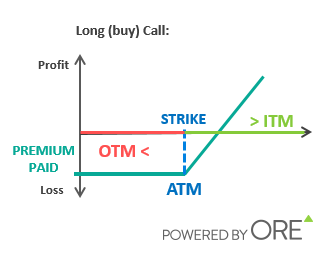
When you buy a Call option with a strike equal to the market rate, it is at-the-money (ATM). If the market rises, the option will become ITM since the buy price of the strike is cheaper than the market. But if the market falls, the option will become OTM. The diagram below demonstrates this concept.
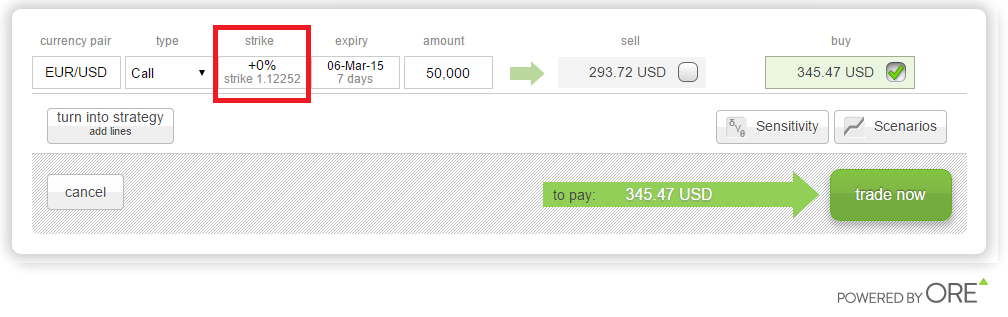
In the ATM buy call option image above, the underlying EUR/USD rate was trading at 1.12252 and valued at 345.47 USD.
Setting an option with a strike of 0% means the strike will also be 1.12252.
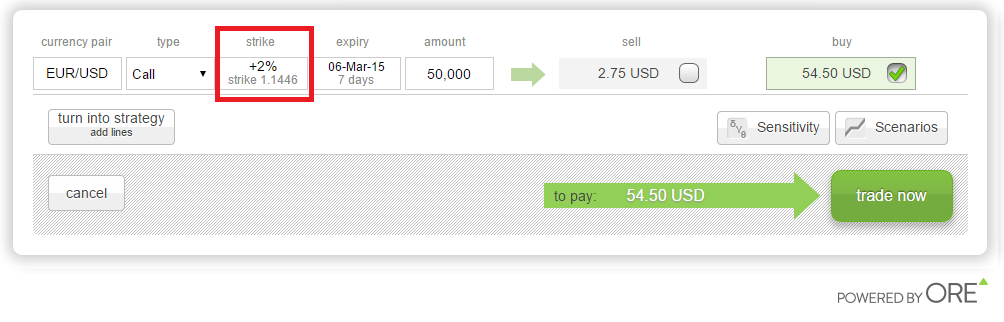
In the OTM buy call option above, a strike price +2% above market has been selected. This means the trader is reserving a worse rate than what is currently available in the market and the following happens – the value of the option decreases to 54.50 USD.
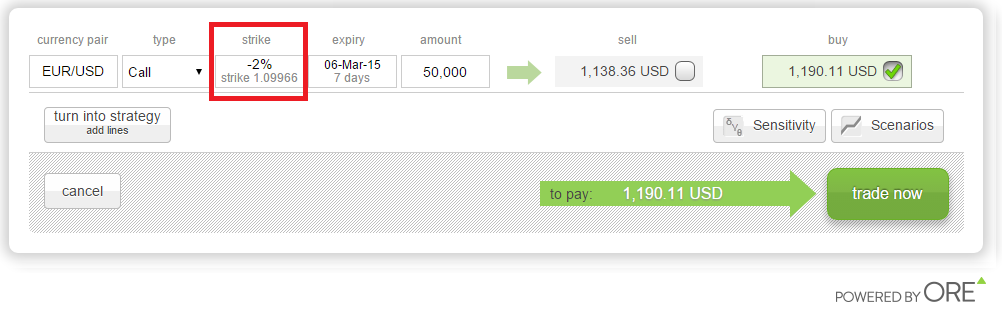
In the ITM buy call option above, a strike price -2% below market has been selected. This means the trader is reserving a better rate than the market and the following happens – the value of the option increases to 1,190.11 USD.
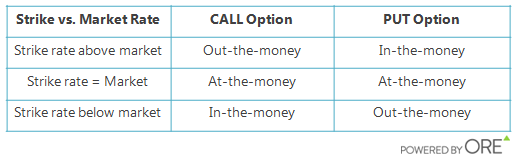
Note: A Put option, with the same strike rate, will always be in a different state to the Call option unless the strike rate equals the market, then both the Put and Call will be at-the-money (ATM). The table below shows the different states of a Put and Call as the strike level in relation to market level changes.
Since there are several news events for both the euro and the greenback on Monday, EUR/USD will be potentially more volatile. When buying options, increasing volatility in the future is good. So let’s evaluate whether you would want to buy your options at-the-money, in-the-money, or out-of-the-money (terms you will frequently hear when trading options).
• An option is at-the-money (ATM) when the strike rate equals the underlying market rate. For example, if EUR/USD is trading at 1.1200 and you buy a Call option with strike 1.1200 the option is ATM.
• An option is in-the-money (ITM) when the strike rate is better than the underlying market rate. For example, if EUR/USD is trading at 1.1200 and you buy a Call with strike 1.1100 the option would be considered ITM because 1.1100 is a better buy rate than 1.1200.
• An option is out-of-the-money (OTM) when the strike rate is worse than the underlying market rate. For example, if EUR/USD is trading at 1.1200 and you buy a Call with strike 1.1300 the option would be considered OTM because 1.1300 is a worse buy rate than 1.1200.
These states are known as an option’s ‘moneyness’.
When an option is in-the-money (ITM), it is more valuable, i.e. its premium is higher. Hence, ITM options are the most expensive to buy, whereas out-of-the-money (OTM) options are cheaper. Paying more for an option means you are risking more, however an ITM option has a higher probability of returning a profit. Buying an OTM option is a smaller risk, but the probability of profit is lower. In each trade, you enter a strike rate depending on your market outlook and risk appetite.
Buying an at-the-money (ATM) Call option
When you buy a Call option with a strike equal to the market rate, it is at-the-money (ATM). If the market rises, the option will become ITM since the buy price of the strike is cheaper than the market. But if the market falls, the option will become OTM. The diagram below demonstrates this concept.
Example of buying Long Call option – ATM, OTM, ITM
The following three images depict EUR/USD buy call options ATM, OTM, and ITM.In the ATM buy call option image above, the underlying EUR/USD rate was trading at 1.12252 and valued at 345.47 USD.
Setting an option with a strike of 0% means the strike will also be 1.12252.
In the OTM buy call option above, a strike price +2% above market has been selected. This means the trader is reserving a worse rate than what is currently available in the market and the following happens – the value of the option decreases to 54.50 USD.
In the ITM buy call option above, a strike price -2% below market has been selected. This means the trader is reserving a better rate than the market and the following happens – the value of the option increases to 1,190.11 USD.
Note: A Put option, with the same strike rate, will always be in a different state to the Call option unless the strike rate equals the market, then both the Put and Call will be at-the-money (ATM). The table below shows the different states of a Put and Call as the strike level in relation to market level changes.
Editors’ Picks

EUR/USD holds steady above 1.1850 as markets eye Eurozone GDP, US CPI inflation releases
The EUR/USD pair trades on a flat note near 1.1870 during the early Asian session on Friday. The major pair steadies amid mixed signals from the latest release of US economic indicators. Traders await the preliminary reading of the Eurozone Gross Domestic Product for the fourth quarter and US inflation data, which are published later on Friday.

GBP/USD consolidates around 1.3600 vs. USD; looks to US CPI for fresh impetus
The GBP/USD pair remains on the defensive through the Asian session on Friday, though it lacks bearish conviction and holds above the 1.3600 mark as traders await the release of the US consumer inflation figures before placing directional bets.

USD/JPY rebounds above 153.00 ahead of US inflation data
USD/JPY stages a comeback and regains 153.00 in the Asian session, snapping a four-day losing streak amid some repositioning ahead of the US CPI report. However, expectations that Japan's PM Sanae Takaichi could be more fiscally responsible, along with bets that the BoJ will stick to its policy normalization path and the risk-off mood, could support the safe-haven Japanese Yen, capping the pair's upside.
Editors’ Picks
USD/JPY rebounds above 153.00 ahead of US inflation data
USD/JPY stages a comeback and regains 153.00 in the Asian session, snapping a four-day losing streak amid some repositioning ahead of the US CPI report. However, expectations that Japan's PM Sanae Takaichi could be more fiscally responsible, along with bets that the BoJ will stick to its policy normalization path and the risk-off mood, could support the safe-haven Japanese Yen, capping the pair's upside.

Gold recovers toward $5,000 as focus shifts to US CPI
Gold price is recovering ground toward $5,000 in the Asian session on Friday. The yellow metal tumbled roughly 3.50% on Thursday, with algorithmic traders appearing to amplify the precious metal’s sudden drop. Traders will closely monitor the release of the US Consumer Price Index inflation report for January, which will be released later on Friday.

AUD/USD consolidates below 0.7100 as traders await US CPI report
AUD/USD consolidates the previous day's retracement slide from the vicinity of mid-0.7100s, or a three-year high, holding below 0.7100 as traders move to the sidelines ahead of Friday's release of the US consumer inflation figures. In the meantime, the divergent RBA-Fed outlooks might continue to support spot prices amid subdued US Dollar demand, though the risk-off impulse could act as a headwind for the Aussie.

Ethereum investors face huge unrealized losses following price slump
US spot Ethereum exchange-traded funds flipped negative again on Wednesday after recording net outflows of $129.1 million, reversing mild inflows seen at the beginning of the week, per SoSoValue data. Fidelity's FETH was responsible for more than half of withdrawals, posting outflows of $67 million.

A tale of two labour markets: Headline strength masks underlying weakness
Undoubtedly, yesterday’s delayed US January jobs report delivered a strong headline – one that surpassed most estimates. However, optimism quickly faded amid sobering benchmark revisions.
RECOMMENDED LESSONS
Making money in forex is easy if you know how the bankers trade!

I’m often mystified in my educational forex articles why so many traders struggle to make consistent money out of forex trading. The answer has more to do with what they don’t know than what they do know. After working in investment banks for 20 years many of which were as a Chief trader its second knowledge how to extract cash out of the market.
5 Forex News Events You Need To Know

In the fast moving world of currency markets where huge moves can seemingly come from nowhere, it is extremely important for new traders to learn about the various economic indicators and forex news events and releases that shape the markets. Indeed, quickly getting a handle on which data to look out for, what it means, and how to trade it can see new traders quickly become far more profitable and sets up the road to long term success.
Top 10 Chart Patterns Every Trader Should Know

Chart patterns are one of the most effective trading tools for a trader. They are pure price-action, and form on the basis of underlying buying and selling pressure. Chart patterns have a proven track-record, and traders use them to identify continuation or reversal signals, to open positions and identify price targets.
7 Ways to Avoid Forex Scams

The forex industry is recently seeing more and more scams. Here are 7 ways to avoid losing your money in such scams: Forex scams are becoming frequent. Michael Greenberg reports on luxurious expenses, including a submarine bought from the money taken from forex traders. Here’s another report of a forex fraud. So, how can we avoid falling in such forex scams?
What Are the 10 Fatal Mistakes Traders Make
Trading is exciting. Trading is hard. Trading is extremely hard. Some say that it takes more than 10,000 hours to master. Others believe that trading is the way to quick riches. They might be both wrong. What is important to know that no matter how experienced you are, mistakes will be part of the trading process.
The challenge: Timing the market and trader psychology

Successful trading often comes down to timing – entering and exiting trades at the right moments. Yet timing the market is notoriously difficult, largely because human psychology can derail even the best plans. Two powerful emotions in particular – fear and greed – tend to drive trading decisions off course.