 Sam Seiden
Independent Analyst

Much of the time the trading articles I write are focused on where to enter a position more than any other topic. This is because it’s the most important part of the trade. If you can’t get your entry correct, meaning low risk, high reward and high probability, the other components to your trades such as the exit and management will not work. Today I want to focus on a simple yet powerful technique related to how you exit positions that should help you increase your winning percentage. To explain this, let’s look at a recent trade from the Mastermind Community Supply/Demand grid.
Profit Zone
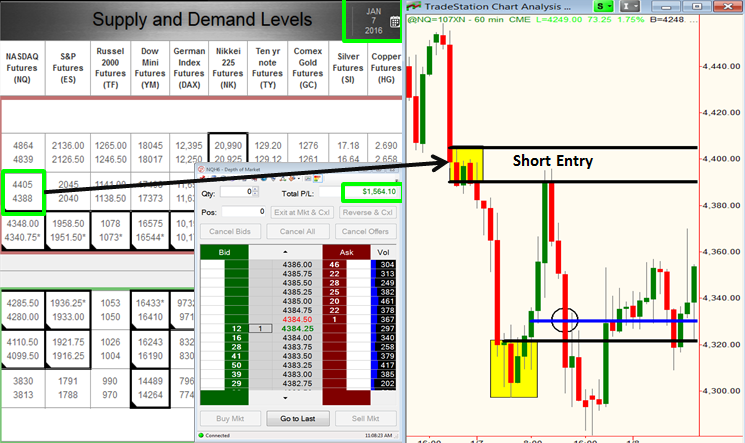
In short, your profit zone is the distance from your entry to your target. So in the example below, the profit zone is the distance from the short entry (supply) to the demand level below, which would be our target. The black line on the bottom of the chart is the origin of the rally (demand) that brought price up to supply for our short entry. Many would take that demand area as their target, thinking, sell short at supply and buy back for a profit at demand.
NASDAQ 1/07/16
Profitable Thinking
Demand, as we know, is a price level where there is competition to buy. So, if we buy where others are looking to buy we are going to have to compete with them at that level which makes getting filled difficult. So, if we know there is competition to buy at demand that is the last place we want to buy. If we want a much easier time getting our buy order filled, we need to buy before price reaches the area of demand. Instead of buying back our position at the black line (demand area); buying back at the blue line (circled area) will give us a much easier and better chance at getting filled. Another way to say this… Instead of buying when there is competition to buy, buy back for your profit when there is still competition to sell. While you will often miss out on a little profit, that’s ok. You are giving that up for trading opportunities with a stronger probability of success.
The Tip
If you have been reading my articles for a while, nothing I have said so far is brand new information. Let’s get to some of that now. For all our short term and long term trading opportunities, one component that must be present is an ideal/risk reward. No matter how many Odds Enhancers are present, the risk/reward must be there. To help define this for the purposes of this article, when we say 3:1, we mean risking 1 to potentially make 3. Furthermore, the “1” is the distance from entry to your protective stop and the “3” is the distance from your supply/demand level to the nearest opposing supply/demand level. However, given the information we discussed above on competition and how it relates to the probability of getting filled, we have an opportunity to increase our odds of a profitable trade.
If you are looking for trading opportunities that offer you 3:1, make sure the chart is offering you at least 4:1. If you are looking for 4:1, make sure the chart is offering you at least 5:1 and so on. If you want to increase your winning percentage even more, try this… If you are looking for 3:1, make sure the chart is offering 5:1.
I employ this concept on most trading opportunities I find and take. Most people who find 3:1 on a chart set their trade up to take action at 3:1, I don’t. Instead, I would make sure the chart was offering at least 4:1 and then take profit at 3:1 or pass on the opportunity.
Of course, to do this objectively you must be able to qualify and quantify real demand and supply in any and all markets with a very high degree of accuracy. All the information you need to do this is clearly seen on a price chart if you know what you’re looking for.
Hope this was helpful, have a great day.
Note: All information on this page is subject to change. The use of this website constitutes acceptance of our user agreement. Please read our privacy policy and legal disclaimer. Opinions expressed at FXstreet.com are those of the individual authors and do not necessarily represent the opinion of FXstreet.com or its management. Risk Disclosure: Trading foreign exchange on margin carries a high level of risk, and may not be suitable for all investors. The high degree of leverage can work against you as well as for you. Before deciding to invest in foreign exchange you should carefully consider your investment objectives, level of experience, and risk appetite. The possibility exists that you could sustain a loss of some or all of your initial investment and therefore you should not invest money that you cannot afford to lose. You should be aware of all the risks associated with foreign exchange trading, and seek advice from an independent financial advisor if you have any doubts.
Editors’ Picks

EUR/USD hovers around 1.1850 ahead of FOMC Minutes
EUR/USD stays on the back foot around 1.1850 in the European session on Wednesday, pressured by renewed US Dollar demand. Traders now look forward to the Minutes of the Fed's January monetary policy meeting for fresh signals on future rate cuts.

GBP/USD defends 1.3550 after UK inflation data
GBP/USD is holding above 1.3550 in Wednesday's European morning, little changed following the UK Consumer Price Index (CPI) data release. The UK inflation eased as expected in January, reaffirming bets for a March BoE interest rate cut, especially after Tuesday's weak employment report.

USD/JPY is looking for direction around 153.00 with key US data in focus
USD/JPY reversal from 153.70 has been contained above 152.70 on Tuesday. Major currencies are trading within narrow ranges amid thin trading volumes. Investors await the release of the US GDP and PCE Inflation figures to make decisions.
Editors’ Picks
GBP/USD defends 1.3550 after UK inflation data
GBP/USD is holding above 1.3550 in Wednesday's European morning, little changed following the UK Consumer Price Index (CPI) data release. The UK inflation eased as expected in January, reaffirming bets for a March BoE interest rate cut, especially after Tuesday's weak employment report.
EUR/USD hovers around 1.1850 ahead of FOMC Minutes
EUR/USD stays on the back foot around 1.1850 in the European session on Wednesday, pressured by renewed US Dollar demand. Traders now look forward to the Minutes of the Fed's January monetary policy meeting for fresh signals on future rate cuts.

Gold: Is the $5,000 level back in sight?
Gold snaps a two-day downtrend, as recovery gathers traction toward $5,000 on Wednesday. The US Dollar recovers from the overnight sell-off as rebalancing trades resume ahead of Fed Minutes. The 38.2% Fib support holds on the daily chart for now. What does that mean for Gold?

Pi Network rally defies market pressure ahead of its first anniversary
Pi Network is trading above $0.1900 at press time on Wednesday, extending the weekly gains by nearly 8% so far. The steady recovery is supported by a short-term pause in mainnet migration, which reduces pressure on the PI token supply for Centralized Exchanges. The technical outlook focuses on the $0.1919 resistance as bullish momentum increases.

UK jobs market weakens, bolstering rate cut hopes
In the UK, the latest jobs report made for difficult reading. Nonetheless, this represents yet another reminder for the Bank of England that they need to act swiftly given the collapse in inflation expected over the coming months.
RECOMMENDED LESSONS
Making money in forex is easy if you know how the bankers trade!

I’m often mystified in my educational forex articles why so many traders struggle to make consistent money out of forex trading. The answer has more to do with what they don’t know than what they do know. After working in investment banks for 20 years many of which were as a Chief trader its second knowledge how to extract cash out of the market.
5 Forex News Events You Need To Know

In the fast moving world of currency markets where huge moves can seemingly come from nowhere, it is extremely important for new traders to learn about the various economic indicators and forex news events and releases that shape the markets. Indeed, quickly getting a handle on which data to look out for, what it means, and how to trade it can see new traders quickly become far more profitable and sets up the road to long term success.
Top 10 Chart Patterns Every Trader Should Know

Chart patterns are one of the most effective trading tools for a trader. They are pure price-action, and form on the basis of underlying buying and selling pressure. Chart patterns have a proven track-record, and traders use them to identify continuation or reversal signals, to open positions and identify price targets.
7 Ways to Avoid Forex Scams

The forex industry is recently seeing more and more scams. Here are 7 ways to avoid losing your money in such scams: Forex scams are becoming frequent. Michael Greenberg reports on luxurious expenses, including a submarine bought from the money taken from forex traders. Here’s another report of a forex fraud. So, how can we avoid falling in such forex scams?
What Are the 10 Fatal Mistakes Traders Make
Trading is exciting. Trading is hard. Trading is extremely hard. Some say that it takes more than 10,000 hours to master. Others believe that trading is the way to quick riches. They might be both wrong. What is important to know that no matter how experienced you are, mistakes will be part of the trading process.
The challenge: Timing the market and trader psychology

Successful trading often comes down to timing – entering and exiting trades at the right moments. Yet timing the market is notoriously difficult, largely because human psychology can derail even the best plans. Two powerful emotions in particular – fear and greed – tend to drive trading decisions off course.