
By Bramesh Bhandari
Price moves in trends. Trends can be extremely short-term, down to the tick level, or month-long steady climbs (or falls) in a stock’s value. The tools we use to predict or detect these trends are as varied as the time frames on which they appear. As you would expect, some tools are more appropriate for certain time frames than others.
Trendlines are one of the simpler tools. These basic lines, drawn roughly along price lows to indicate support in uptrends or along price highs to indicate resistance in downtrends, identify general market price direction. They provide excellent guidance during clean and persistent price trends.
However, such qualities are not always in place. Often, trends play out in fits and starts, surging ahead only to give back several points before resuming the move in the predominant direction. For these moves, it is more difficult to see where price is headed. We need to turn to a tool that is more sensitive to price changes that are inconsistent over time.
The commodity channel index (CCI) is an oscillator designed to be effective in these environments. Don’t be confused by the use of the word “commodity” in the name. This oscillator, popularized by Donald Lambert, works perfectly well on stocks. It measures the variation of a security’s price from its statistical mean. This variation can hold clues to a change in price trend.
Lambert’s basic assumption is that tradable assets, such as stocks and commodities, move in cycles. CCI helps by indicating when an asset has moved too far above its mean for the trend to sustain (overbought condition), or has become too cheap for sellers to maintain necessary selling pressure (oversold condition). These levels can, in turn, be used to generate buy and sell signals against the recent move.
1. Calculate the typical price (TP). Add each period’s high, low and close and divide by three: TP = (H+L+C)/3
2. Calculate the n-period simple moving average of the typical price (SMATP). Traders generally use a 20-period SMA because on average there are 20 trading days in a month.
3. Calculate the mean deviation (MD). First, calculate the absolute value of the difference between the last period’s SMATP and the typical price for each of the past 20 periods. Add all of these absolute values together and divide by 20 to find the mean deviation.
4. The final step is to apply the TP, the SMATP, the MD and a constant (0.015) to the following formula: CCI = (TP – SMA) / 0.015 x MD
There are three basic applications of the CCI indicator in trading:
We’ll discuss each of the above methods in detail, elaborating with examples.
A word of caution, however. Actively trading on every zero-line crossover can result in numerous whipsaws, particularly if the stock is currently range bound. As long as we are prepared to accept that risk, the following are some basic, unfiltered trade rules for a zero-line crossover:
Buy when the CCI crosses its zero-line from below, setting a stop loss at the previous day’s low. If the market runs higher as expected, profit should be booked once price gives back enough of the new uptrend to break the three-day low.
Sell when the CCI crosses its zero-line from above, setting a stop loss at the previous day’s high. If the market falls as expected, profit should be booked once price gives back enough of the new downtrend to break the three-day high.
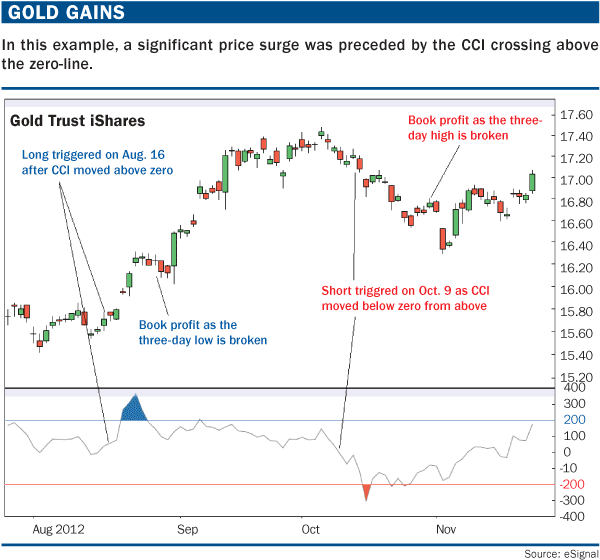
“Gold gains” (below) shows the iShares Gold Trust (IAU) exchange-traded fund (ETF) with a 20-day CCI on the daily time frame. On Aug. 15, 2012, IAU closed at $15.62 after making a low of $15.58 with the CCI at –2.72. On Aug. 16, the ETF opened at $15.65 and the CCI moved into positive territory, giving us a signal to initiate the trade with a stop loss of $15.58. The ETF rallied, made a high of $16.31, and the CCI kept moving until it reached 369. As per our exit rule, we took profits on a break of the three-day low, which was triggered Aug. 30 when $16.19 was broken.
The CCI technically has no high or low limit as per the traditional calculation.
Markets can remain overbought or oversold for extended periods of time.
Regarding the level to use, typically +100 and –100 work when trading a stock in a trading range, while higher levels, such as +200 and –200, are necessary during trending moves.
Using overbought/oversold levels effectively also depends on the volatility of the underlying security. For example, the CCI range for ETFs generally is lower when compared to individual stocks such as Apple and Google. Here are some trading rules for overbought/oversold readings during a trending market:
Buy when the CCI turns up from below –200 with a stop loss as the previous day’s low. Profit should be booked on a break of the subsequent three-day low.
Sell when the CCI turns down from above 200 with a stop loss as the previous day’s high. Profit should be booked on a break of the subsequent three-day high.
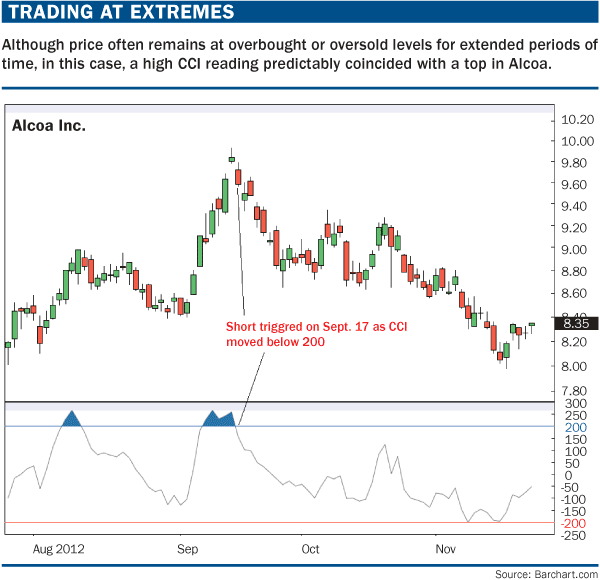
“Trading at extremes” (below) shows Alcoa Inc. (AA) with a 20-day CCI on a daily time frame. On Sept. 14, 2012, Alcoa closed at $9.84 after making a high of $9.93 and a low of $9.78, with the CCI at 259.65. On Sept. 17, the stock opened at $9.72 and the CCI moved below 200, giving us a signal to initiate the trade with a stop loss of $9.93. The stock started its correction and made a low of $8.65. As per our profit-taking rule, we exit the stock on a break of the three-day low, which was triggered on Sept. 26 when $8.81 was broken.
A positive divergence occurs when the CCI begins to advance and the security is still in a downtrend and makes a lower reaction low.
A negative divergence forms when the security advances or moves sideways and the CCI declines. The negative divergence in CCI can take the form of either a lower-high or a straight decline.
Confirmation is necessary for a successful divergence trade. Positive divergence is confirmed with a break above the zero-line or the break of a downtrend line on the price chart. Similarly, negative divergence is confirmed with a break below the zero-line or a break of an uptrend line on the price chart.
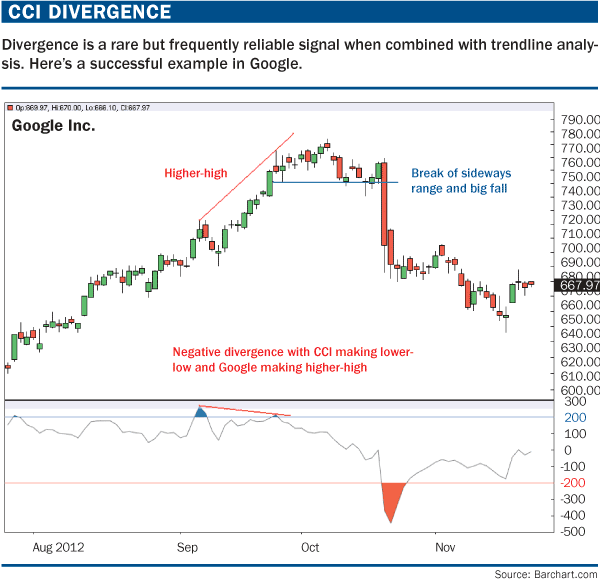
“CCI divergence” (below) shows Google Inc. (GOOG) with a 20-day CCI on the daily time frame. On Sept. 7, 2012, Google closed at $712.25 and the CCI at 265.68. After Sept. 7, Google continued its rise and made a high of $774.68 on Oct. 5, but the CCI was at 107.88, showing a significant negative divergence with price making a higher-high and the CCI indicator making a lower-low. Negative divergence demonstrated its value on Oct. 18 when Google broke the price support of $740 and went into a freefall mode after results were declared that fell short of market expectations.
Price moves in trends, and while traditional price chart tools such as trendlines and moving averages can signal important shifts in sentiment, more sophisticated indicators are useful across varying conditions. The CCI is one such tool. It offers multiple ways to analyze price movements, and it works well with confirming indicators, such as trendlines, to forecast major moves.
Price moves in trends. Trends can be extremely short-term, down to the tick level, or month-long steady climbs (or falls) in a stock’s value. The tools we use to predict or detect these trends are as varied as the time frames on which they appear. As you would expect, some tools are more appropriate for certain time frames than others.
Trendlines are one of the simpler tools. These basic lines, drawn roughly along price lows to indicate support in uptrends or along price highs to indicate resistance in downtrends, identify general market price direction. They provide excellent guidance during clean and persistent price trends.
However, such qualities are not always in place. Often, trends play out in fits and starts, surging ahead only to give back several points before resuming the move in the predominant direction. For these moves, it is more difficult to see where price is headed. We need to turn to a tool that is more sensitive to price changes that are inconsistent over time.
The commodity channel index (CCI) is an oscillator designed to be effective in these environments. Don’t be confused by the use of the word “commodity” in the name. This oscillator, popularized by Donald Lambert, works perfectly well on stocks. It measures the variation of a security’s price from its statistical mean. This variation can hold clues to a change in price trend.
Lambert’s basic assumption is that tradable assets, such as stocks and commodities, move in cycles. CCI helps by indicating when an asset has moved too far above its mean for the trend to sustain (overbought condition), or has become too cheap for sellers to maintain necessary selling pressure (oversold condition). These levels can, in turn, be used to generate buy and sell signals against the recent move.
CCI calculation
There are four steps in the calculation of the CCI:1. Calculate the typical price (TP). Add each period’s high, low and close and divide by three: TP = (H+L+C)/3
2. Calculate the n-period simple moving average of the typical price (SMATP). Traders generally use a 20-period SMA because on average there are 20 trading days in a month.
3. Calculate the mean deviation (MD). First, calculate the absolute value of the difference between the last period’s SMATP and the typical price for each of the past 20 periods. Add all of these absolute values together and divide by 20 to find the mean deviation.
4. The final step is to apply the TP, the SMATP, the MD and a constant (0.015) to the following formula: CCI = (TP – SMA) / 0.015 x MD
There are three basic applications of the CCI indicator in trading:
- Zero-line crossover
- Overbought and oversold levels
- Trading divergence (positive and negative)
We’ll discuss each of the above methods in detail, elaborating with examples.
Trading with the CCI
One of the simplest applications of the CCI is a zero-line crossover. As the CCI generally varies within the +100 to –100 range, any move above +100 or below –100 shows an unexceptional strength or weakness that can extend itself further. The zero-line is precisely in the middle of these extremes. Traders use the zero-line cross as a potential entry point under the assumption that trend bias has shifted from negative to positive, or vice versa, and is headed toward one of the extremes.A word of caution, however. Actively trading on every zero-line crossover can result in numerous whipsaws, particularly if the stock is currently range bound. As long as we are prepared to accept that risk, the following are some basic, unfiltered trade rules for a zero-line crossover:
Buy when the CCI crosses its zero-line from below, setting a stop loss at the previous day’s low. If the market runs higher as expected, profit should be booked once price gives back enough of the new uptrend to break the three-day low.
Sell when the CCI crosses its zero-line from above, setting a stop loss at the previous day’s high. If the market falls as expected, profit should be booked once price gives back enough of the new downtrend to break the three-day high.
“Gold gains” (below) shows the iShares Gold Trust (IAU) exchange-traded fund (ETF) with a 20-day CCI on the daily time frame. On Aug. 15, 2012, IAU closed at $15.62 after making a low of $15.58 with the CCI at –2.72. On Aug. 16, the ETF opened at $15.65 and the CCI moved into positive territory, giving us a signal to initiate the trade with a stop loss of $15.58. The ETF rallied, made a high of $16.31, and the CCI kept moving until it reached 369. As per our exit rule, we took profits on a break of the three-day low, which was triggered Aug. 30 when $16.19 was broken.
Overbought/oversold
The CCI also is effective as an overbought and oversold indicator. It oscillates between two extremes. High readings imply an overbought condition (shorts can be taken) and low readings imply an oversold condition (longs can be taken). However, identifying overbought and oversold levels can be tricky with the CCI because of the following reasons:The CCI technically has no high or low limit as per the traditional calculation.
Markets can remain overbought or oversold for extended periods of time.
Regarding the level to use, typically +100 and –100 work when trading a stock in a trading range, while higher levels, such as +200 and –200, are necessary during trending moves.
Using overbought/oversold levels effectively also depends on the volatility of the underlying security. For example, the CCI range for ETFs generally is lower when compared to individual stocks such as Apple and Google. Here are some trading rules for overbought/oversold readings during a trending market:
Buy when the CCI turns up from below –200 with a stop loss as the previous day’s low. Profit should be booked on a break of the subsequent three-day low.
Sell when the CCI turns down from above 200 with a stop loss as the previous day’s high. Profit should be booked on a break of the subsequent three-day high.
“Trading at extremes” (below) shows Alcoa Inc. (AA) with a 20-day CCI on a daily time frame. On Sept. 14, 2012, Alcoa closed at $9.84 after making a high of $9.93 and a low of $9.78, with the CCI at 259.65. On Sept. 17, the stock opened at $9.72 and the CCI moved below 200, giving us a signal to initiate the trade with a stop loss of $9.93. The stock started its correction and made a low of $8.65. As per our profit-taking rule, we exit the stock on a break of the three-day low, which was triggered on Sept. 26 when $8.81 was broken.
Trading divergences
Divergence occurs when the security’s price makes a new high while the CCI fails to surpass its previous high. Divergences probably are the least common of the three signals, but usually are the most reliable and lead to the biggest moves. There are two types of divergences:A positive divergence occurs when the CCI begins to advance and the security is still in a downtrend and makes a lower reaction low.
A negative divergence forms when the security advances or moves sideways and the CCI declines. The negative divergence in CCI can take the form of either a lower-high or a straight decline.
Confirmation is necessary for a successful divergence trade. Positive divergence is confirmed with a break above the zero-line or the break of a downtrend line on the price chart. Similarly, negative divergence is confirmed with a break below the zero-line or a break of an uptrend line on the price chart.
“CCI divergence” (below) shows Google Inc. (GOOG) with a 20-day CCI on the daily time frame. On Sept. 7, 2012, Google closed at $712.25 and the CCI at 265.68. After Sept. 7, Google continued its rise and made a high of $774.68 on Oct. 5, but the CCI was at 107.88, showing a significant negative divergence with price making a higher-high and the CCI indicator making a lower-low. Negative divergence demonstrated its value on Oct. 18 when Google broke the price support of $740 and went into a freefall mode after results were declared that fell short of market expectations.
Price moves in trends, and while traditional price chart tools such as trendlines and moving averages can signal important shifts in sentiment, more sophisticated indicators are useful across varying conditions. The CCI is one such tool. It offers multiple ways to analyze price movements, and it works well with confirming indicators, such as trendlines, to forecast major moves.
Editors’ Picks

EUR/USD retreats toward 1.1700 on modest USD recovery
EUR/USD stays under mild bearish pressure and trades below 1.1750 on Friday. Although trading conditions remain thin following the New Year holiday and ahead of the weekend, the modest recovery seen in the US Dollar causes the pair to edge lower. The economic calendar will not feature any high-impact data releases.

GBP/USD struggles to gain traction, stabilizes near 1.3450
After testing 1.3400 on the last day of 2025, GBP/USD managed to stage a rebound. Nevertheless, the pair finds it difficult to gather momentum and trades marginally lower on the day at around 1.3450 as market participants remain in holiday mood.

USD/JPY advances to near 157.00 on BoJ's cautious tightening
The USD/JPY pair trades in positive territory for the fourth consecutive day around 157.00 during the early European session on Friday. The cautious pace of the Bank of Japan’s (BoJ) monetary tightening weighs on the Japanese Yen (JPY) against the Greenback. Traders will take more cues from the US Nonfarm Payrolls (NFP) report for December, which is due next week.
Editors’ Picks
EUR/USD retreats toward 1.1700 on modest USD recovery
EUR/USD stays under mild bearish pressure and trades below 1.1750 on Friday. Although trading conditions remain thin following the New Year holiday and ahead of the weekend, the modest recovery seen in the US Dollar causes the pair to edge lower. The economic calendar will not feature any high-impact data releases.
GBP/USD struggles to gain traction, stabilizes near 1.3450
After testing 1.3400 on the last day of 2025, GBP/USD managed to stage a rebound. Nevertheless, the pair finds it difficult to gather momentum and trades marginally lower on the day at around 1.3450 as market participants remain in holiday mood.

Gold climbs toward $4,400 following deep correction
Gold advances toward $4,400 and gains more than 1.5% on the day after suffering heavy losses amid profit-taking heading into the end of the year. Growing expectations for a dovish Fed policy and persistent geopolitical risks seem to be helping XAU/USD stretch higher.

Cardano gains early New Year momentum, bulls target falling wedge breakout
Cardano kicks off the New Year on a positive note and is extending gains, trading above $0.36 at the time of writing on Friday. Improving on-chain and derivatives data point to growing bullish interest, while the technical outlook keeps an upside breakout in focus.

Economic outlook 2026-2027 in advanced countries: Solidity test
After a year marked by global economic resilience and ending on a note of optimism, 2026 looks promising and could be a year of solid economic performance. In our baseline scenario, we expect most of the supportive factors at work in 2025 to continue to play a role in 2026.
RECOMMENDED LESSONS
Making money in forex is easy if you know how the bankers trade!

I’m often mystified in my educational forex articles why so many traders struggle to make consistent money out of forex trading. The answer has more to do with what they don’t know than what they do know. After working in investment banks for 20 years many of which were as a Chief trader its second knowledge how to extract cash out of the market.
5 Forex News Events You Need To Know

In the fast moving world of currency markets where huge moves can seemingly come from nowhere, it is extremely important for new traders to learn about the various economic indicators and forex news events and releases that shape the markets. Indeed, quickly getting a handle on which data to look out for, what it means, and how to trade it can see new traders quickly become far more profitable and sets up the road to long term success.
Top 10 Chart Patterns Every Trader Should Know

Chart patterns are one of the most effective trading tools for a trader. They are pure price-action, and form on the basis of underlying buying and selling pressure. Chart patterns have a proven track-record, and traders use them to identify continuation or reversal signals, to open positions and identify price targets.
7 Ways to Avoid Forex Scams

The forex industry is recently seeing more and more scams. Here are 7 ways to avoid losing your money in such scams: Forex scams are becoming frequent. Michael Greenberg reports on luxurious expenses, including a submarine bought from the money taken from forex traders. Here’s another report of a forex fraud. So, how can we avoid falling in such forex scams?
What Are the 10 Fatal Mistakes Traders Make
Trading is exciting. Trading is hard. Trading is extremely hard. Some say that it takes more than 10,000 hours to master. Others believe that trading is the way to quick riches. They might be both wrong. What is important to know that no matter how experienced you are, mistakes will be part of the trading process.
The challenge: Timing the market and trader psychology

Successful trading often comes down to timing – entering and exiting trades at the right moments. Yet timing the market is notoriously difficult, largely because human psychology can derail even the best plans. Two powerful emotions in particular – fear and greed – tend to drive trading decisions off course.