 Gabe Velázquez
Online Trading Academy
Greetings from Chicago! I’m here this week teaching a great group of students how to navigate the financial markets using Online Trading Academy’s patented core strategy. As I’ve written in previous articles, I believe that successful market speculation requires a sound proven process, the discipline to follow it and, lastly, the mindset to stay focused. The challenge most traders encounter is that they don’t have a proven methodology with clear, concise and consistent trading rules to follow. Moreover, many novice traders are only interested in “making money” with little regard to putting forth a process that will produce consistent results. In other words, in trading, most people are only interested in the end result but have little idea how to get there. Does that make any sense?
Let me draw an analogy. I want to take you to an Automobile manufacturing plant in Detroit Michigan. This plant is where cars are put together in an assembly line. At the start of this assembly line is the bare frame of the car. As it moves down the assembling line, more and more components are added until you end up with a beautiful, high quality American made automobile at the end. Do you think the plant manager comes in every day focused on the end product? Or, is his job to make sure each station on the assembly line runs smoothly? Of course we know the answer. He knows if the assembly line breaks down there will be no end product, or the end product will be faulty.
If this makes sense to you, why do you think it would be any different in trading? As I have stated many times before, trading is not any different than any other risk-taking endeavor. A clear concise set of trading rules adds clarity and resolves many of the conflicts encountered in trading. These rules should be based on producing low-risk high probability outcomes.
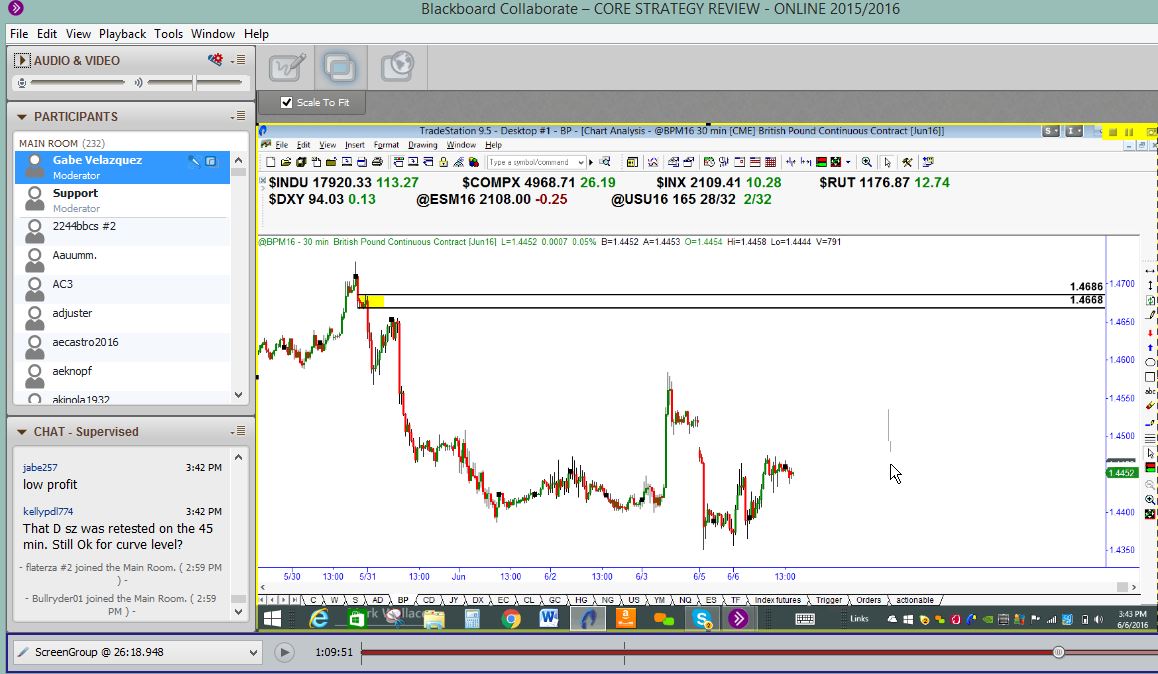
Last Monday I was conducting one of our weekly Core Strategy Review sessions. These webinars are designed to help our students hone their skill in Online Trading Academy’s process of finding supply and demand levels. In it I gave a setup in the British pound futures that was a high quality shorting opportunity (seen in the chart highlighted in yellow). This setup was based on a set of clear, concise trading rules that we teach students. These are meant to be done consistently so that the probabilities work in the traders favor. This is what I call the triple C of strategy building.
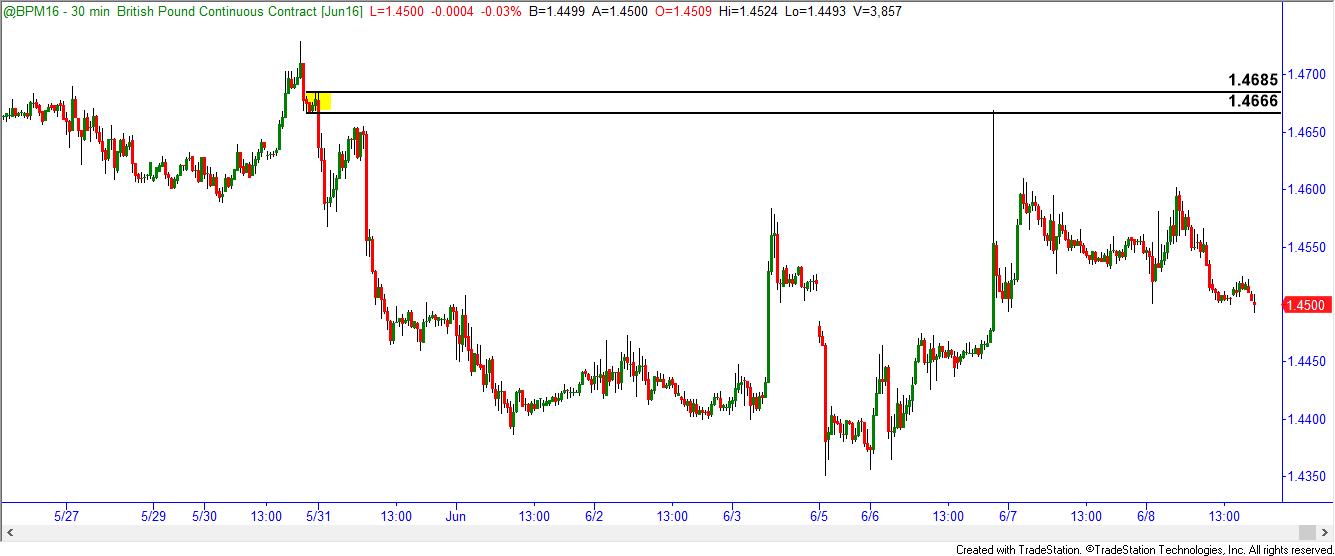
As we can see in the second chart, the trade worked very well as the news out of Britain pushed the price of the British Pound strongly into a zone where supply exceeded demand. A stop was placed slightly above the higher line in case the trade didn’t work. Not all of them do. As I mentioned earlier, a trader must come to every trading day equipped with a strong set of rules so they know exactly what to do to take advantage of the opportunities that may be presented. The lesson for traders here is that all of the energy expended in a trading day should be towards following a clear, concise set of trading rules consistently, with less emphasis placed on the end result. Similar to the auto plant manager in the earlier analogy, if a trader does this the end result should be less losses and more profits. And who doesn’t want that?
Until next time, I hope everyone has a great week.
This content is intended to provide educational information only. This information should not be construed as individual or customized legal, tax, financial or investment services. As each individual's situation is unique, a qualified professional should be consulted before making legal, tax, financial and investment decisions. The educational information provided in this article does not comprise any course or a part of any course that may be used as an educational credit for any certification purpose and will not prepare any User to be accredited for any licenses in any industry and will not prepare any User to get a job. Reproduced by permission from OTAcademy.com click here for Terms of Use: https://www.otacademy.com/about/terms
Editors’ Picks

EUR/USD sticks to positive bias above 1.1800 as trade jitters undermine USD
The EUR/USD pair builds on the previous day's modest gains and attracts some buyers for the second straight day on Thursday amid a softer US Dollar. Spot prices, however, lack bullish conviction and trade around the 1.1815-1.1820 area during the Asian session, up 0.10% for the day.

GBP/USD bounces as soft CPI boosts BoE cut bets
GBP/USD rose 0.42% on Wednesday, recovering toward 1.3600 in a session shaped by softer-than-expected UK inflation data and broad US Dollar weakness. The pair had been consolidating in a tight range between about 1.3450 and 1.3520 for the past few days following the sharp pullback from the late-January high near 1.3870, and Wednesday's move pushed price action back onto the high side of key moving averages.

USD/JPY retreats further from two-week top; downside potential seems limited
USD/JPY extends the previous day's late pullback from a two-week high and drifts lower during the Asian session on Thursday, as intervention fears offer some support to the Japanese Yen. The US Dollar, on the other hand, remains on the back foot amid concerns about the fallout from Trump's trade policies, which weigh on the currency pair. However, the uncertainty over the pace and timing of the next BoJ rate hike could limit JPY gains and cap the currency pair.
Editors’ Picks

AUD/USD holds steady above 0.7100; eyes multi-year top amid RBA rate hike bets
AUD/USD consolidates above 0.7100 during the Asian session on Thursday and remains close to a three-year peak amid bets for another RBA rate hike in 2026, bolstered by the latest Australian consumer inflation figures released the previous day. Moreover, a softer US Dollar and a positive risk tone act as a tailwind for the Aussie, though trade uncertainties seem to act as a headwind for spot prices.
USD/JPY retreats further from two-week top; downside potential seems limited
USD/JPY extends the previous day's late pullback from a two-week high and drifts lower during the Asian session on Thursday, as intervention fears offer some support to the Japanese Yen. The US Dollar, on the other hand, remains on the back foot amid concerns about the fallout from Trump's trade policies, which weigh on the currency pair. However, the uncertainty over the pace and timing of the next BoJ rate hike could limit JPY gains and cap the currency pair.

Gold retains positive bias amid sustained safe-haven demand, softer USD
Gold attracts some buyers for the second straight day as trade jitters and geopolitical tensions ahead of the US-Iran nuclear talks underpin demand for safe-haven assets. Apart from this, a softer US Dollar further supports the bullion, though the underlying bullish sentiment could cap gains. Bulls might also opt to wait for acceptance above the $5,200 mark before positioning for any meaningful appreciating move.

AUD/USD rises toward three-year highs on RBA rate hike bets
AUD/USD remains stronger for the third successive session, trading around 0.7120 during the Asian hours on Thursday. The pair advances toward its three-year high of 0.7147, last touched on February 12, as the Australian Dollar strengthens following hotter-than-expected inflation data from Australia, reinforcing expectations of further interest rate hikes by the Reserve Bank of Australia this year.

Nvidia delivers another monster earnings report, and forecasts big things to come
It was another monster earnings report from Nvidia for fiscal Q4. Revenues were $68.1bn, smashing estimates of $65bn. Gross profit margin was a healthy 75%, up from 73.5% in the prior quarter, and the outlook for this quarter was monstrous.
RECOMMENDED LESSONS
Making money in forex is easy if you know how the bankers trade!

I’m often mystified in my educational forex articles why so many traders struggle to make consistent money out of forex trading. The answer has more to do with what they don’t know than what they do know. After working in investment banks for 20 years many of which were as a Chief trader its second knowledge how to extract cash out of the market.
5 Forex News Events You Need To Know

In the fast moving world of currency markets where huge moves can seemingly come from nowhere, it is extremely important for new traders to learn about the various economic indicators and forex news events and releases that shape the markets. Indeed, quickly getting a handle on which data to look out for, what it means, and how to trade it can see new traders quickly become far more profitable and sets up the road to long term success.
Top 10 Chart Patterns Every Trader Should Know

Chart patterns are one of the most effective trading tools for a trader. They are pure price-action, and form on the basis of underlying buying and selling pressure. Chart patterns have a proven track-record, and traders use them to identify continuation or reversal signals, to open positions and identify price targets.
7 Ways to Avoid Forex Scams

The forex industry is recently seeing more and more scams. Here are 7 ways to avoid losing your money in such scams: Forex scams are becoming frequent. Michael Greenberg reports on luxurious expenses, including a submarine bought from the money taken from forex traders. Here’s another report of a forex fraud. So, how can we avoid falling in such forex scams?
What Are the 10 Fatal Mistakes Traders Make
Trading is exciting. Trading is hard. Trading is extremely hard. Some say that it takes more than 10,000 hours to master. Others believe that trading is the way to quick riches. They might be both wrong. What is important to know that no matter how experienced you are, mistakes will be part of the trading process.
The challenge: Timing the market and trader psychology

Successful trading often comes down to timing – entering and exiting trades at the right moments. Yet timing the market is notoriously difficult, largely because human psychology can derail even the best plans. Two powerful emotions in particular – fear and greed – tend to drive trading decisions off course.