 Russ Allen
Online Trading Academy
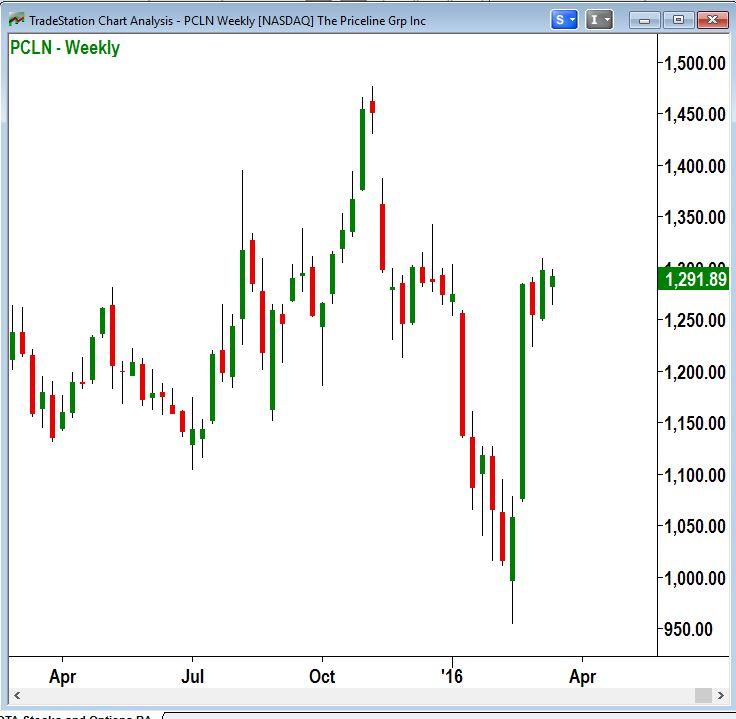
Last week I described a way to use options as a way to trade high-priced stocks, like Google or Priceline, with much less cost and risk than trading the stocks themselves. Below is the chart of Priceline as of our starting point on March 9, 2016.
I compared two alternative trades to implement a bearish outlook:
Sell the stock short at the price at the time around $1292, with a target around $1100 and a stop-loss price at around $1310.
Buying a July put option at the $1300 strike, with orders in place to close out the trade if PCLN hit either our $1310 stop or $1100 target.
That article calculated that of the two trades, the put purchase had a potential to make 62% of the profit that the short stock sale would make if the stock reached the $1100 target; while tying up only 15% as much cash, for a much better cash-on-cash return. Today let’s look at using an additional option to improve the risk-reward possibilities even further.
At the time that we could have bought the $1300 put described before for $90.70 per share, we could have simultaneously sold a put near our $1100 target and received about $20.00 per share. Changing this trade from a simple long option into a vertical spread would do several things:
It would reduce the net cash out of pocket required to enter the trade, from $90.70 to $70.70 per share, since we would be collecting $20 per share for the short 1100-strike put.
If PCLN rallied to the $1310 stop-loss point, the loss would be less by about two dollars per share – about $14 per share instead of about $16 per share with the long put alone. This is because the short put would lose value in that case (good for us), and this would partially offset the loss in value of our long $1300-strike put.
If PCLN did drop down to the $1100 target, the profit on the trade would be about the same with or without the short put, if the decline took a long time. If it took a short time, the spread would not do quite as well as the long put alone.
Options at any moment in time may be cheap or expensive, in terms of the amount that traders are willing to pay per unit of time. This factor is dynamic – when expectations change, the option value per unit of time changes too. We call this factor implied volatility. When we simply own an option, we are fully exposed to those changes in expectations. When we are both short and long options at the same time, then our exposure to these changing expectations is diminished. In this case, options were a little on the cheap side, but not by much. Since they were not extremely cheap they could still get cheaper; so we would want to reduce our exposure to that possibility. Adding the short option to the long option offsets some of our exposure to a change in implied volatility.
Creating this vertical spread was one of a number of ways we could have matched our outlook on the stock’s price to an option strategy. Options can be put together like Lego blocks to create different types of positions for different situations. We can finely tune these positions in ways that are not possible with any other instrument. And, using options can give us entrée to trading in stocks that might otherwise be beyond our reach.
The selection of the right strategy is key to option profits. In our classes, we lay out a simple two-step process for selecting a strategy in any given situation. When you know how the pieces fit together, the puzzle becomes a picture.
This content is intended to provide educational information only. This information should not be construed as individual or customized legal, tax, financial or investment services. As each individual's situation is unique, a qualified professional should be consulted before making legal, tax, financial and investment decisions. The educational information provided in this article does not comprise any course or a part of any course that may be used as an educational credit for any certification purpose and will not prepare any User to be accredited for any licenses in any industry and will not prepare any User to get a job. Reproduced by permission from OTAcademy.com click here for Terms of Use: https://www.otacademy.com/about/terms
Editors’ Picks

EUR/USD eases from around 1.1800 after US GDP figures
The US Dollar is finding some near-term demand after the release of the US Q3 GDP. According to the report, the economy expanded at an annualized rate of 4.3% in the three months to September, well above the 3.3% forecast by market analysts.

GBP/USD retreats below 1.3500 on modest USD recovery
GBP/USD retreats from session highs and trades slightly below 1.3500 in the second half of the day on Tuesday. The US Dollar stages a rebound following the better-than-expected Q3 growth data, limiting the pair's upside ahead of the Christmas break.

USD/JPY plunges to near 155.80 amid fragile US Dollar, Japan’s intervention call
USD/JPY plummets to near 155.80 as the US Dollar outperforms across the board. The Fed is expected to deliver at least two interest rate cuts in 2026. Japan’s FM Katayama warns against one-sided, excessive moves against the Yen.
Editors’ Picks

Gold to challenge fresh record highs
Gold prices soared to $4,497 early on Monday, as persistent US Dollar weakness and thinned holiday trading exacerbated the bullish run. The bright metal eases following the release of an upbeat US Q3 GDP reading, as USD finds near-term demand in the American session.
EUR/USD eases from around 1.1800 after US GDP figures
The US Dollar is finding some near-term demand after the release of the US Q3 GDP. According to the report, the economy expanded at an annualized rate of 4.3% in the three months to September, well above the 3.3% forecast by market analysts.
GBP/USD retreats below 1.3500 on modest USD recovery
GBP/USD retreats from session highs and trades slightly below 1.3500 in the second half of the day on Tuesday. The US Dollar stages a rebound following the better-than-expected Q3 growth data, limiting the pair's upside ahead of the Christmas break.

Crypto Today: Bitcoin, Ethereum, XRP decline as risk-off sentiment escalates
Bitcoin remains under pressure, trading above the $87,000 support at the time of writing on Tuesday. Selling pressure has continued to weigh on the broader cryptocurrency market since Monday, triggering declines across altcoins, including Ethereum and Ripple.

Ten questions that matter going into 2026
2026 may be less about a neat “base case” and more about a regime shift—the market can reprice what matters most (growth, inflation, fiscal, geopolitics, concentration). The biggest trap is false comfort: the same trades can look defensive… right up until they become crowded.
RECOMMENDED LESSONS
Making money in forex is easy if you know how the bankers trade!

I’m often mystified in my educational forex articles why so many traders struggle to make consistent money out of forex trading. The answer has more to do with what they don’t know than what they do know. After working in investment banks for 20 years many of which were as a Chief trader its second knowledge how to extract cash out of the market.
5 Forex News Events You Need To Know

In the fast moving world of currency markets where huge moves can seemingly come from nowhere, it is extremely important for new traders to learn about the various economic indicators and forex news events and releases that shape the markets. Indeed, quickly getting a handle on which data to look out for, what it means, and how to trade it can see new traders quickly become far more profitable and sets up the road to long term success.
Top 10 Chart Patterns Every Trader Should Know

Chart patterns are one of the most effective trading tools for a trader. They are pure price-action, and form on the basis of underlying buying and selling pressure. Chart patterns have a proven track-record, and traders use them to identify continuation or reversal signals, to open positions and identify price targets.
7 Ways to Avoid Forex Scams

The forex industry is recently seeing more and more scams. Here are 7 ways to avoid losing your money in such scams: Forex scams are becoming frequent. Michael Greenberg reports on luxurious expenses, including a submarine bought from the money taken from forex traders. Here’s another report of a forex fraud. So, how can we avoid falling in such forex scams?
What Are the 10 Fatal Mistakes Traders Make
Trading is exciting. Trading is hard. Trading is extremely hard. Some say that it takes more than 10,000 hours to master. Others believe that trading is the way to quick riches. They might be both wrong. What is important to know that no matter how experienced you are, mistakes will be part of the trading process.
The challenge: Timing the market and trader psychology

Successful trading often comes down to timing – entering and exiting trades at the right moments. Yet timing the market is notoriously difficult, largely because human psychology can derail even the best plans. Two powerful emotions in particular – fear and greed – tend to drive trading decisions off course.