 Russ Allen
Online Trading Academy
Last week we looked at an opportunity in the stock of Facebook (FB). We compared buying the stock to buying call options on the stock. This is how the chart looked at that time:
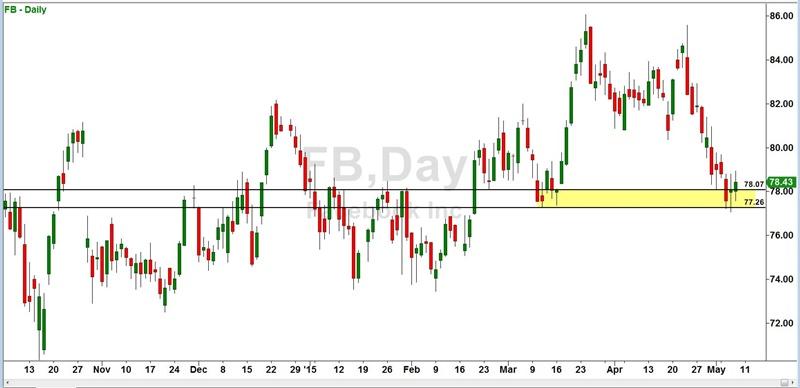
A week later, on May 14, the chart appeared like this:
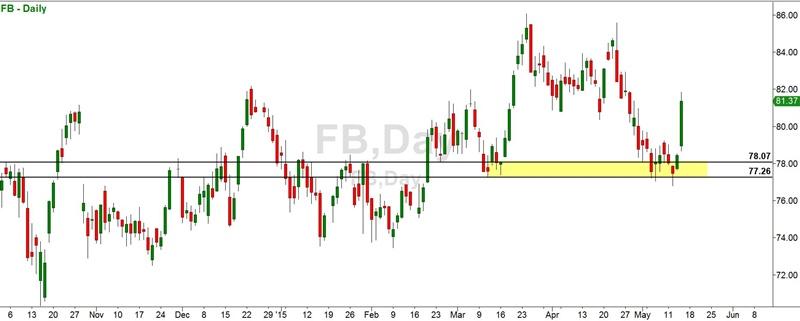
The stock popped on some favorable news and closed on May 14 at 81.37. That was a 3.7% increase. Meanwhile, the July 77.5 calls that we mentioned in the last article closed at $5.44, up from the $3.90 we quoted at that time. This was a 39.5% increase, or more than ten times the percentage increase in the stock itself.
Not bad so far. It looked to be a good start toward the move back to the recent highs around $86 that we thought likely. We’ll look in on this one again later.
For now, let’s look at a variation on this trade that could be even more profitable.
At the same time that the $77.50 calls were available for $3.90, there were call options at the $85.00 strike with a bid price of $1.07. These were too far above the current price of $78.43 to interest us as a buying opportunity, but instead of buying them we could have sold them at the same time that we bought the $77.50 calls. We would then be short those $85.00 calls. Selling a call option short obligates you to deliver the stock and accept the agreed-on price – in this case $85.00 – if the options are exercised by the other party. We did not expect the stock to get much higher than $85.00 by July, but if it did we would have to turn over the stock and accept $85.00 in payment.
Turn over what stock? We didn’t have any. Our only position was the $77.50 calls that we bought.
That’s fine. In any situation where we have to produce shares of stock (remember, somebody has to be willing to pay us $85.00 for that to happen), we could just exercise our own $77.50 calls and thereby buy the stock from someone else at that price. Our ownership of the $77.50 calls covers our obligation on the short $85.00 calls.
But what would be the point of selling the $85.00 calls? The point would be to collect the $1.07 per share that those calls would bring. That would reduce our net cost on the trade from $3.90 to $2.83 per share.
This type of position has a name. It is a vertical spread – one option at a strike price above another option. There are several varieties of it. In this one, the cost of the moneymaking $77.50 call is reduced by the amount received for selling the $85.00 call. If the stock does go up, the amount of profit is greater than with the long call alone in a wide price range.
Here, let’s say that the stock did go up to our $86.00 target at the July expiration. We could exercise our $77.50 calls and buy the stock at that price. Someone who had sold those $77.50 calls short would have to turn the stock over to us in exchange for our $77.50, even though the stock was much higher. That’s what they signed up for when they took our $3.90 originally.
We, in turn, would have to hand over the stock to someone who had bought the $85.00 calls from us and accept their $85.00 in payment (even though the stock was at $86.00). Net result: a gross profit of $7.50 per share ($85.00 in, $77.50 out).
From this $7.50 we have to subtract our net cost, which was $2.83 as described above. Net profit: $4.67 on a $2.83 investment, or 165%.
With the original $77.50 call only, without the short $85.00 call, our gross profit would be a little more at $8.50 ($86.00 less $77.50) but we would have to subtract the entire cost of the call at $3.90. That would leave a profit of $4.60 on a $3.90 investment, or 117%. That’s pretty darned good; but not as good as the 165% that we could make with the vertical spread.
This example highlights some of the unique features of options that make them so versatile. Tune in next time for more. Better yet, call your local center about our Professional Options Trader class.
This content is intended to provide educational information only. This information should not be construed as individual or customized legal, tax, financial or investment services. As each individual's situation is unique, a qualified professional should be consulted before making legal, tax, financial and investment decisions. The educational information provided in this article does not comprise any course or a part of any course that may be used as an educational credit for any certification purpose and will not prepare any User to be accredited for any licenses in any industry and will not prepare any User to get a job. Reproduced by permission from OTAcademy.com click here for Terms of Use: https://www.otacademy.com/about/terms
Editors’ Picks

EUR/USD climbs to daily highs near 1.1820
EUR/USD now picks up pace and advances to the area of daily peaks north of the 1.1800 barrier at the end of the week. The pair’s decent move higher comes against the backdrop of a generalised lack of direction in the FX galaxy and the mild offered stance in the US Dollar.

GBP/USD trims losses, retests 1.3460
After briefly challenging its key 200-day SMA near 1.3440, GBP/USD now manages to regain some balance and revisit the 1.3460 zone on Friday. Cable’s pullback comes as the selling pressure on the Greenback gathers traction, reigniting some recovery in the risk-linked space.

Japanese Yen gives back half of early gains against USD ahead of US PPI data
The Japanese Yen (JPY) surrenders half of its early gains against the US Dollar (USD) during the European trading session on Friday. The USD/JPY pair rebounds to near 155.90 as the JPY falls back, but is still 0.15% down.
Editors’ Picks
EUR/USD climbs to daily highs near 1.1820
EUR/USD now picks up pace and advances to the area of daily peaks north of the 1.1800 barrier at the end of the week. The pair’s decent move higher comes against the backdrop of a generalised lack of direction in the FX galaxy and the mild offered stance in the US Dollar.
GBP/USD trims losses, retests 1.3460
After briefly challenging its key 200-day SMA near 1.3440, GBP/USD now manages to regain some balance and revisit the 1.3460 zone on Friday. Cable’s pullback comes as the selling pressure on the Greenback gathers traction, reigniting some recovery in the risk-linked space.

Gold flirts with four-week highs past $5,200
Gold extends its rebound, climbing for a third consecutive session and pushing back above the $5,200 mark per troy ounce on Friday. The move higher continues to draw support from lingering geopolitical tensions and the ongoing uncertainty surrounding US trade policy, both of which are keeping safe-haven demand firmly in play.

Bitcoin, Ethereum and Ripple consolidate with short-term cautious bullish bias
Bitcoin, Ethereum and Ripple are consolidating near key technical areas on Friday, showing mild signs of stabilization after recent volatility. BTC holds above $67,000 despite mild losses so far this week, while ETH hovers around $2,000 after a rejection near its upper consolidation boundary.

Changing the game: International implications of recent tariff developments
The Supreme Court ruling on International Emergency Economic Powers Act (IEEPA) tariffs provides limited relief for the rest of the world, with weighted average tariff rates modestly lower.
RECOMMENDED LESSONS
Making money in forex is easy if you know how the bankers trade!

I’m often mystified in my educational forex articles why so many traders struggle to make consistent money out of forex trading. The answer has more to do with what they don’t know than what they do know. After working in investment banks for 20 years many of which were as a Chief trader its second knowledge how to extract cash out of the market.
5 Forex News Events You Need To Know

In the fast moving world of currency markets where huge moves can seemingly come from nowhere, it is extremely important for new traders to learn about the various economic indicators and forex news events and releases that shape the markets. Indeed, quickly getting a handle on which data to look out for, what it means, and how to trade it can see new traders quickly become far more profitable and sets up the road to long term success.
Top 10 Chart Patterns Every Trader Should Know

Chart patterns are one of the most effective trading tools for a trader. They are pure price-action, and form on the basis of underlying buying and selling pressure. Chart patterns have a proven track-record, and traders use them to identify continuation or reversal signals, to open positions and identify price targets.
7 Ways to Avoid Forex Scams

The forex industry is recently seeing more and more scams. Here are 7 ways to avoid losing your money in such scams: Forex scams are becoming frequent. Michael Greenberg reports on luxurious expenses, including a submarine bought from the money taken from forex traders. Here’s another report of a forex fraud. So, how can we avoid falling in such forex scams?
What Are the 10 Fatal Mistakes Traders Make
Trading is exciting. Trading is hard. Trading is extremely hard. Some say that it takes more than 10,000 hours to master. Others believe that trading is the way to quick riches. They might be both wrong. What is important to know that no matter how experienced you are, mistakes will be part of the trading process.
The challenge: Timing the market and trader psychology

Successful trading often comes down to timing – entering and exiting trades at the right moments. Yet timing the market is notoriously difficult, largely because human psychology can derail even the best plans. Two powerful emotions in particular – fear and greed – tend to drive trading decisions off course.