 Gabe Velázquez
Online Trading Academy
When looking for low risk opportunities, one situation that’s not as common in the futures market as it is with stocks is the formation of gaps. The reason stocks tend to gap more frequently is simply because they spend more time closed than trading with lots of activity. This exposes stocks to all types of gap risk such as market risk, or news related to the individual company. Alternatively, because futures trade continuously twenty four hours a day, roughly five and a half days a week, most gaps are created on Sunday at the open, and even then gaps are rare. It’s not like there’s a gap open every Sunday throughout the futures markets. Even more unusual are gaps formed in the middle of the week during earnings seasons. More on these later.
Because gaps are so uncommon, when they do occur they can produce high probability opportunities . Since our main focus is finding price levels were the forces of supply and demand are most out of balance what better example of that than a gap opening. Let’s think about how a gap occurs. In the chart below, note that the closing price of the December 2014 Australian Dollar futures contract on Friday was .8769, and on the following chart the opening price for Sunday was .8734. This left a price gap of 34 ticks.
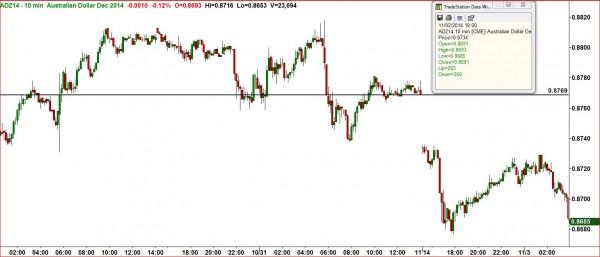
First, the simple fact is that when all the orders started to come in Sunday afternoon there were an abundance of sell orders hitting the tape, and since those orders have to be matched with buy orders the nearest buyer came 34 ticks lower at .8734. The reason that compelled so many to sell is irrelevant, and yes , you can find out why but that won’t assist in finding a high quality trade. What’s most important here is that the creation of this gap represents the best picture of an imbalance of supply and demand. In this case, it is a supply imbalance. This suggests that there might be additional sell orders remaining to be filled.
As I mentioned earlier, the rarest of gaps are formed in the middle of the week. These typically form during reporting season for stocks. They occur because the stock index futures close for a very short period (15 minutes ) every week day between 4:15 and 4:30 EST. This is when the day session ends and the overnight session begins. One such gap occurred on October 28. On that day two major components of the Nasdaq 100 index (Twitter and Facebook) reported disappointing earnings. Commonly, companies that report their earnings after the closing bell usually release their results a few minutes after the close, producing a spike in price in the Futures market. In this instance however, both companies earnings hit the tape during the small window when the stock index futures were closed. The after-hours selling in these two stocks is what created this gap in the Nasdaq futures.
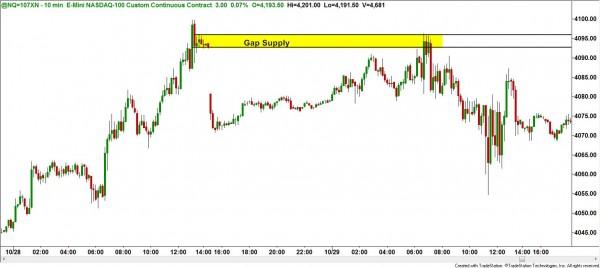
As we can see on the charts, this presented a low risk high probability shorting opportunity.
To trade gaps properly, the odds enhancers, such as structure of the level, first retracement and so on, have to score high in order to enable a high quality opportunity.
All told, gaps represent a big order imbalance, and as such we must always be on high alert when they happen. There is one caveat though, not every gap is tradable. This has to do with where the gap was formed in terms of the location of the move. In other words, was the gap created in the late stages of a move, or near a reversal of the trend? This is key information before taking the trade. This a good starting point in understanding gaps, and I hope this was helpful.
Until next time, good trading.
This content is intended to provide educational information only. This information should not be construed as individual or customized legal, tax, financial or investment services. As each individual's situation is unique, a qualified professional should be consulted before making legal, tax, financial and investment decisions. The educational information provided in this article does not comprise any course or a part of any course that may be used as an educational credit for any certification purpose and will not prepare any User to be accredited for any licenses in any industry and will not prepare any User to get a job. Reproduced by permission from OTAcademy.com click here for Terms of Use: https://www.otacademy.com/about/terms
Editors’ Picks

EUR/USD: Bears retain control below 1.1780-1.1770 confluence breakpoint
The EUR/USD pair remains on the back foot through the Asian session on Friday and currently trades just above mid-1.1700s, well within striking distance of a nearly one-month low set the previous day.

GBP/USD seems vulnerable near one-month low as traders await US data
The GBP/USD pair prolongs its weekly downtrend for the fifth consecutive day on Friday and slides back closer to a nearly one-month low, touched the previous day. Spot prices trade below mid-1.3400s during the Asian session on Friday and seem vulnerable to slide further as traders now look to important US macro data for a fresh impetus.

USD/JPY remains strong after Japan’s National CPI cools down
The Japanese Yen shows weakness against the US Dollar during the Asian trading session on Friday. The USD/JPY pair holds onto gains near its weekly high of 155.20 posted on Thursday. The pair is under pressure as the US Dollar continues to outperform due to signals from Federal Open Market Committee Minutes of the January policy meeting that officials see no rush for interest rate cuts, with inflation remaining persistently above the Federal Reserve’s 2% target.
Editors’ Picks
GBP/USD seems vulnerable near one-month low as traders await US data
The GBP/USD pair prolongs its weekly downtrend for the fifth consecutive day on Friday and slides back closer to a nearly one-month low, touched the previous day. Spot prices trade below mid-1.3400s during the Asian session on Friday and seem vulnerable to slide further as traders now look to important US macro data for a fresh impetus.
EUR/USD: Bears retain control below 1.1780-1.1770 confluence breakpoint
The EUR/USD pair remains on the back foot through the Asian session on Friday and currently trades just above mid-1.1700s, well within striking distance of a nearly one-month low set the previous day.

Gold eyes next breakout on US GDP, PCE inflation data
Gold sticks to recent gains around the $5,000-mark early Friday, biding time before the high-impact US macro events. The focus is now on the US fourth-quarter Gross Domestic Product, core Personal Consumption Expenditures Price Index and the Supreme Court’s ruling on President Donald Trump’s tariffs.

Bitcoin, Ethereum and Ripple remain range-bound as breakdown risks rise
Bitcoin, Ethereum, and Ripple are trading sideways within consolidation ranges on Friday, signaling a lack of directional bias in the broader crypto market. BTC rebounded from key support, and ETH is nearing the lower consolidation boundary, while XRP is holding at its lower trendline boundary.
Hawkish Fed minutes and a market finding its footing
It was green across the board for US Stock market indexes at the close on Wednesday, with most S&P 500 names ending higher, adding 38 points (0.6%) to 6,881 overall. At the GICS sector level, energy led gains, followed by technology and consumer discretionary, while utilities and real estate posted the largest losses.
RECOMMENDED LESSONS
Making money in forex is easy if you know how the bankers trade!

I’m often mystified in my educational forex articles why so many traders struggle to make consistent money out of forex trading. The answer has more to do with what they don’t know than what they do know. After working in investment banks for 20 years many of which were as a Chief trader its second knowledge how to extract cash out of the market.
5 Forex News Events You Need To Know

In the fast moving world of currency markets where huge moves can seemingly come from nowhere, it is extremely important for new traders to learn about the various economic indicators and forex news events and releases that shape the markets. Indeed, quickly getting a handle on which data to look out for, what it means, and how to trade it can see new traders quickly become far more profitable and sets up the road to long term success.
Top 10 Chart Patterns Every Trader Should Know

Chart patterns are one of the most effective trading tools for a trader. They are pure price-action, and form on the basis of underlying buying and selling pressure. Chart patterns have a proven track-record, and traders use them to identify continuation or reversal signals, to open positions and identify price targets.
7 Ways to Avoid Forex Scams

The forex industry is recently seeing more and more scams. Here are 7 ways to avoid losing your money in such scams: Forex scams are becoming frequent. Michael Greenberg reports on luxurious expenses, including a submarine bought from the money taken from forex traders. Here’s another report of a forex fraud. So, how can we avoid falling in such forex scams?
What Are the 10 Fatal Mistakes Traders Make
Trading is exciting. Trading is hard. Trading is extremely hard. Some say that it takes more than 10,000 hours to master. Others believe that trading is the way to quick riches. They might be both wrong. What is important to know that no matter how experienced you are, mistakes will be part of the trading process.
The challenge: Timing the market and trader psychology

Successful trading often comes down to timing – entering and exiting trades at the right moments. Yet timing the market is notoriously difficult, largely because human psychology can derail even the best plans. Two powerful emotions in particular – fear and greed – tend to drive trading decisions off course.