 Gabe Velázquez
Online Trading Academy
Each day the global financial markets are impacted by events that cause traders to react in dramatic fashion. These responses quite often will have a ripple effect that can stretch across all types of markets and asset classes. In other words, what happens in one market will in turn move another related market. For newer traders it’s important to understand this relationship. In this missive I’ll go over some of the strongest inverse correlations, and their uses to help traders gain an edge.
But before we get started, there is one major caveat about this topic: correlations usually hold, however, there are times when what seemed to be a strong correlation between two markets breaks and it longer works. This is often a temporary phenomenon as strong correlations always revert back. An astute trader must be attune to these changes and be flexible enough to make the adjustments necessary to keep his edge.
The first inverse correlation we’ll go over is the one between stocks and bonds. For stocks we’ll use the ES (S&P 500 mini) against the (US) 30 year treasury bond futures contract to do the analysis. This is a simple risk-on versus risk-off correlation. What is meant by this is that theoretically, stocks are inherently riskier than bonds and therefore when stocks are moving higher investors generally have a bigger appetite for risk and would sell the lower yielding bond market. This changes however when things get rough in the stock market. Investors seek the safe harbor of treasuries, and in order to raise the cash necessary to purchase these fixed yielding instruments,they sell their stock holdings. The two annotated charts below illustrate these inverse correlations
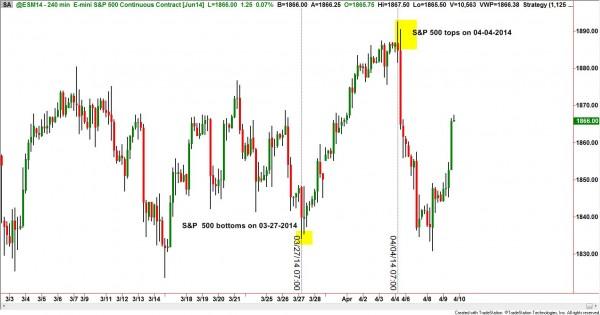
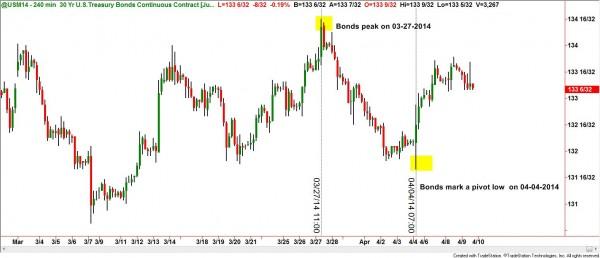
We can see that major inverse moves happened pretty regularly in these two asset classes. The key for traders is to find both markets enter opposing levels simultaneously, thus increasing the probabilities of timing the turning points. This correlation is important for traders who engage the markets on an intermediate -term time frame as it can be a major odds enhancers. Identifying the quality supply and demand levels is the most important element of this equation.
The last inverse correlation we’ll look at is that of the US Dollar index against the Euro Currency. This is a very strong inverse correlation because of how the Dollar Index is comprised, and the way the currency futures contracts are traded. First, the Dollar index is a basket of currencies traded against the US Dollar. The biggest component of this index is the Euro currency constituting over 57% of the index. In addition, currencies futures are only the major global currencies relative to the US dollar. Because of this, the moves in the Euro currency greatly impacts the Dollar index. Similar to the Stock -Bond inverse correlation we can see on the charts below that all the major moves happened on the same day.
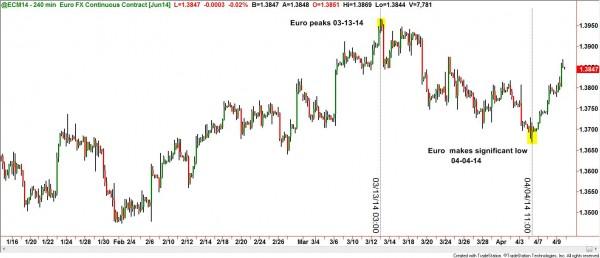
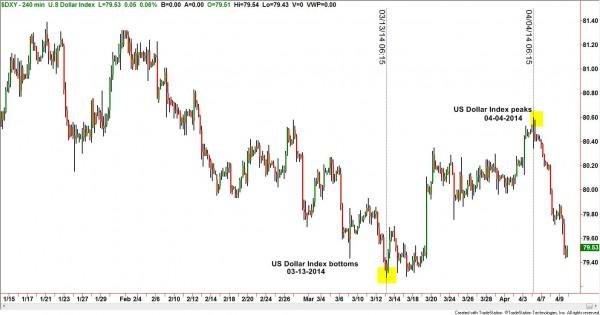
For traders trying to gain an edge, learning how different markets impact each other is a must. Not knowing how the US Dollar can change the trajectory of commodities such as oil, copper, or gold is a big disadvantage, especially when you’re competing with large banks and institutions who wouldn’t think of putting their traders on the front lines if they didn’t understand how these markets impact one another. If you want to have a chance to compete successfully you need to start thinking and acting like them, and part of this, is gaining an understanding of the interrelationships between markets. My hope is that at least this is a good starting point.
Until next time, hope everyone has a great week.
This content is intended to provide educational information only. This information should not be construed as individual or customized legal, tax, financial or investment services. As each individual's situation is unique, a qualified professional should be consulted before making legal, tax, financial and investment decisions. The educational information provided in this article does not comprise any course or a part of any course that may be used as an educational credit for any certification purpose and will not prepare any User to be accredited for any licenses in any industry and will not prepare any User to get a job. Reproduced by permission from OTAcademy.com click here for Terms of Use: https://www.otacademy.com/about/terms
Editors’ Picks

EUR/USD weakens to four-week lows near 1.1750
EUR/USD’s selling pressure is gathering pace now, approaching the area of multi-week troughs in the mid-1.1700s on Thursday. The pair’s intense decline comes on the back of another day of solid gains in the US Dollar, particulalry exacerbated following firm prints from the weekly US labour market.

GBP/USD drops further, hovers around 1.3460
In line with the rest of its risk-linked peers, GBP/USD faces increasing selling pressure and recedes toward the 1.3460 region, or four-week lows, on Thursday. Cable’s persistent pullback comes in response to the continuation of the recovery in the Greenback amid a solid US data and a divided FOMC when it comes to the Fed’s rate path.

Japanese Yen hangs near one-week low vs. USD amid worries about Japan’s fiscal health
The USD/JPY pair gains positive traction for the second straight day – also marking the third day of a move up in the previous four – and climbs to over a one-week high, around the 155.35 area, on Thursday. Spot prices, however, retreat a few pips during the early European session and currently trade just above the 155.00 psychological mark, up nearly 0.20% for the day.
Editors’ Picks
EUR/USD weakens to four-week lows near 1.1750
EUR/USD’s selling pressure is gathering pace now, approaching the area of multi-week troughs in the mid-1.1700s on Thursday. The pair’s intense decline comes on the back of another day of solid gains in the US Dollar, particulalry exacerbated following firm prints from the weekly US labour market.
GBP/USD drops further, hovers around 1.3460
In line with the rest of its risk-linked peers, GBP/USD faces increasing selling pressure and recedes toward the 1.3460 region, or four-week lows, on Thursday. Cable’s persistent pullback comes in response to the continuation of the recovery in the Greenback amid a solid US data and a divided FOMC when it comes to the Fed’s rate path.

Gold clings to daily gains near $5,000
Gold struggles for direction and clings to its daily gains around the key $5,000 mark per troy ounce on Thursday. The precious metal sticks to the bid bias amid reignited geopolitical tensions in the Middle East and despite marked gains in the US Dollar and rising US Treasury yields across the curve.

Ripple slips toward $1.40 despite SG-FORGE tapping protocol for EUR CoinVertible
XRP extends its decline, nearing $1.40 support, as risk appetite fades in the broader market. SG-FORGE’s EUR CoinVertible launches on the XRP Ledger, leveraging the blockchain’s scalability, speed, security, and decentralization.

Hawkish Fed minutes and a market finding its footing
It was green across the board for US Stock market indexes at the close on Wednesday, with most S&P 500 names ending higher, adding 38 points (0.6%) to 6,881 overall. At the GICS sector level, energy led gains, followed by technology and consumer discretionary, while utilities and real estate posted the largest losses.
RECOMMENDED LESSONS
Making money in forex is easy if you know how the bankers trade!

I’m often mystified in my educational forex articles why so many traders struggle to make consistent money out of forex trading. The answer has more to do with what they don’t know than what they do know. After working in investment banks for 20 years many of which were as a Chief trader its second knowledge how to extract cash out of the market.
5 Forex News Events You Need To Know

In the fast moving world of currency markets where huge moves can seemingly come from nowhere, it is extremely important for new traders to learn about the various economic indicators and forex news events and releases that shape the markets. Indeed, quickly getting a handle on which data to look out for, what it means, and how to trade it can see new traders quickly become far more profitable and sets up the road to long term success.
Top 10 Chart Patterns Every Trader Should Know

Chart patterns are one of the most effective trading tools for a trader. They are pure price-action, and form on the basis of underlying buying and selling pressure. Chart patterns have a proven track-record, and traders use them to identify continuation or reversal signals, to open positions and identify price targets.
7 Ways to Avoid Forex Scams

The forex industry is recently seeing more and more scams. Here are 7 ways to avoid losing your money in such scams: Forex scams are becoming frequent. Michael Greenberg reports on luxurious expenses, including a submarine bought from the money taken from forex traders. Here’s another report of a forex fraud. So, how can we avoid falling in such forex scams?
What Are the 10 Fatal Mistakes Traders Make
Trading is exciting. Trading is hard. Trading is extremely hard. Some say that it takes more than 10,000 hours to master. Others believe that trading is the way to quick riches. They might be both wrong. What is important to know that no matter how experienced you are, mistakes will be part of the trading process.
The challenge: Timing the market and trader psychology

Successful trading often comes down to timing – entering and exiting trades at the right moments. Yet timing the market is notoriously difficult, largely because human psychology can derail even the best plans. Two powerful emotions in particular – fear and greed – tend to drive trading decisions off course.