 Brandon Wendell, CMT
Brandon Wendell
A few weeks ago I made some bold stock market observations and predictions about the US Equity markets as well as some of the commodity markets. It is time to review those stock market predictions and see where the markets may be headed in the next few weeks to months.
There has been much speculation and talk about whether the United States economy will endure another recession. I cannot answer that for sure, that’s why they are called stock market predictions, but I do know that the S&P 500 index is definitely in a bearish trend on the weekly charts. We have not entered into a bear market as of yet, but are showing all of the classic signs for the start of one.
The S&P 500 did make the lower low after the lower highs and last week bounced just shy of the 1797 demand zone. This is not necessarily a good sign as it may mean that price is building momentum to break that zone.
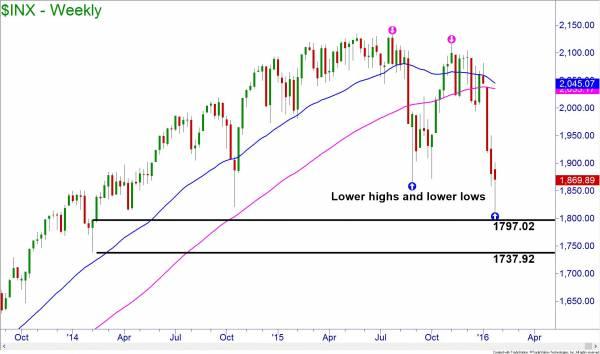
Even if prices rebound for the next couple of weeks as they will likely do, it will not be enough to stop the 40-week simple moving average from crossing below the 80-week simple moving average which usually marks the start of a bear market.
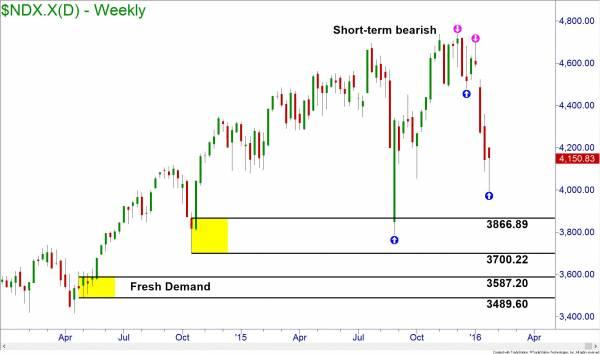
The NASDAQ has been the stronger index but is also weakening. Even though the larger trend has not made lower lows to confirm a bearish trend, in the short-run there have been. Additionally, the August 2015 drop already weakened the demand at 3866 so prices could seek out the 3587 level on the next push down.
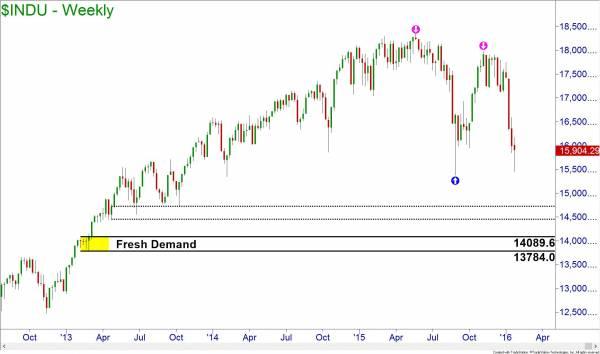
At the big board, the Dow Jones Industrial Average has yet to make lower lows after its lower highs. The bad news is that there is no fresh demand on the weekly charts until 14089.
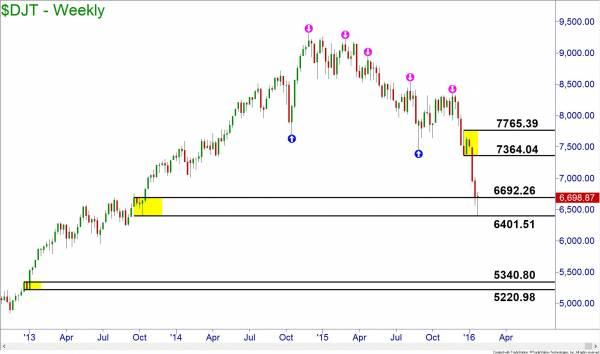
A popular leading index for Dow followers is the Dow Jones Transportation Index. This index has been bearish since late 2014 and has been forecasting price drops for some time. This week, the index tested the 6400 demand zone and has tried to bounce. I expect a retracement to test the supply near 7300 before another drop to the fresh demand at 5340.
One more helpful indicator that can be used to determine the strength or weakness of the overall equity market is comparing the prices of consumer discretionary stocks to those of consumer staples. The discretionary stocks represent companies that produce goods that are sought after when consumers have extra spending money and are feeling good about the economy. The staples are companies that make things we as consumers need to buy no matter what the shape of the economy. After all, we still use toilet paper in a market crash don’t we?
The Exchange Traded Fund, (ETF), XLY symbolizes the consumer discretionary sector. Its holdings include many of the largest companies in that sector. XLP is the consumer staples ETF. By using a technical analysis tool called Spread Ratio, which is available on TradeStation, I can view the strength and weakness of these two ETF’s against each other.
When the spread ratio line is rising, it means the discretionary stocks are outperforming the staples. This usually occurs when investors and traders are bullish about the market and the economy. When the line is dropping, investors are seeking safety in the staples as they feel the economy and markets are likely to start falling or they are already in a bearish mode.
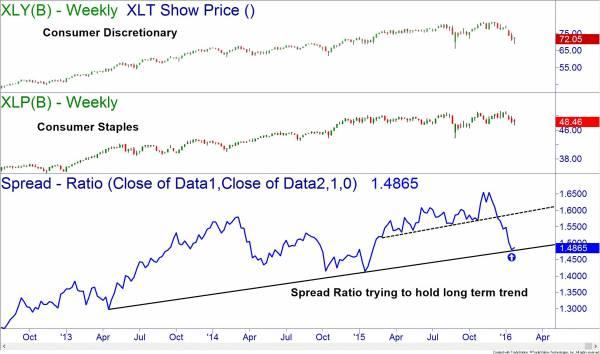
The ratio held the trend in 2015 even during the August price drop. This did not completely rattle the bulls. However, at the end of the year the ratio broke the trend line. This week it is bouncing from the longer term trend line set in 2013. Should that break, it would be a very ominous sign for the markets.
It appears that the bears are getting settled in but not before one last bull trap is set to spring. Be careful on the rallies in the markets and use them as an opportunity to set up protection for your accounts or look to enter shorts for the new bear.
If you do not know how to do all of this, get educated at your local Online Trading Academy office today!
Neither Freedom Management Partners nor any of its personnel are registered broker-dealers or investment advisers. I will mention that I consider certain securities or positions to be good candidates for the types of strategies we are discussing or illustrating. Because I consider the securities or positions appropriate to the discussion or for illustration purposes does not mean that I am telling you to trade the strategies or securities. Keep in mind that we are not providing you with recommendations or personalized advice about your trading activities. The information we are providing is not tailored to any individual. Any mention of a particular security is not a recommendation to buy, sell, or hold that or any other security or a suggestion that it is suitable for any specific person. Keep in mind that all trading involves a risk of loss, and this will always be the situation, regardless of whether we are discussing strategies that are intended to limit risk. Also, Freedom Management Partners’ personnel are not subject to trading restrictions. I and others at Freedom Management Partners could have a position in a security or initiate a position in a security at any time.
Editors’ Picks

EUR/USD meets initial support around 1.1800
EUR/USD remains on the back foot, although it has managed to reverse the initial strong pullback toward the 1.1800 region and regain some balance, hovering around the 1.1850 zone as the NA session draws to a close on Tuesday. Moving forward, market participants will now shift their attention to the release of the FOMC Minutes and US hard data on Wednesday.

GBP/USD bounces off lows, retargets 1.3550
After bottoming out just below the 1.3500 yardstick, GBP/USD now gathers some fresh bids and advances to the 1.3530-1.3540 band in the latter part of Tuesday’s session. Cable’s recovery comes as the Greenback surrenders part of its advance, although it keeps the bullish bias well in place for the day.

USD/JPY is looking for direction around 153.00 with key US data in focus
USD/JPY reversal from 153.70 has been contained above 152.70 on Tuesday. Major currencies are trading within narrow ranges amid thin trading volumes. Investors await the release of the US GDP and PCE Inflation figures to make decisions.
Editors’ Picks

NZD/USD: All eyes on RBNZ guidance and new Governor Breman's debut
NZD/USD opened Tuesday at 0.60344, reached a high of 0.60520 and a low of 0.60044, and closed at 0.60480, down 0.22%. The pair is holding well above the 50-day Exponential Moving Average at 0.59041 and the 200-day EMA at 0.58545, with both averages rising and spaced roughly 50 pips apart, confirming the underlying bullish trend that began from the January low of 0.57110.

AUD/USD extends the bounce, focus back to 0.7100
AUD/USD adds to Monday’s optimism and approaches the key 0.7100 barrier ahead of the opening bell in Asia. The pair’s positive performance comes as investors keep assessing the hawkish tilt from the RBA Minutes and despite humble gains in the Greenback. Next in Oz will be the Westpac Leading Index and the Wage Price Index.

Gold remains offered below $5,000
Gold stays on the defensive on Tuesday, receding to the sub-$5,000 region per troy ounce on the back of the persistent move higher in the Greenback. The precious metal’s decline is also underpinned by the modest uptick in US Treasury yields across the spectrum.

RBNZ set to pause interest-rate easing cycle as new Governor Breman faces firm inflation
The Reserve Bank of New Zealand remains on track to maintain the Official Cash Rate at 2.25% after concluding its first monetary policy meeting of this year on Wednesday.

UK jobs market weakens, bolstering rate cut hopes
In the UK, the latest jobs report made for difficult reading. Nonetheless, this represents yet another reminder for the Bank of England that they need to act swiftly given the collapse in inflation expected over the coming months.
RECOMMENDED LESSONS
Making money in forex is easy if you know how the bankers trade!

I’m often mystified in my educational forex articles why so many traders struggle to make consistent money out of forex trading. The answer has more to do with what they don’t know than what they do know. After working in investment banks for 20 years many of which were as a Chief trader its second knowledge how to extract cash out of the market.
5 Forex News Events You Need To Know

In the fast moving world of currency markets where huge moves can seemingly come from nowhere, it is extremely important for new traders to learn about the various economic indicators and forex news events and releases that shape the markets. Indeed, quickly getting a handle on which data to look out for, what it means, and how to trade it can see new traders quickly become far more profitable and sets up the road to long term success.
Top 10 Chart Patterns Every Trader Should Know

Chart patterns are one of the most effective trading tools for a trader. They are pure price-action, and form on the basis of underlying buying and selling pressure. Chart patterns have a proven track-record, and traders use them to identify continuation or reversal signals, to open positions and identify price targets.
7 Ways to Avoid Forex Scams

The forex industry is recently seeing more and more scams. Here are 7 ways to avoid losing your money in such scams: Forex scams are becoming frequent. Michael Greenberg reports on luxurious expenses, including a submarine bought from the money taken from forex traders. Here’s another report of a forex fraud. So, how can we avoid falling in such forex scams?
What Are the 10 Fatal Mistakes Traders Make
Trading is exciting. Trading is hard. Trading is extremely hard. Some say that it takes more than 10,000 hours to master. Others believe that trading is the way to quick riches. They might be both wrong. What is important to know that no matter how experienced you are, mistakes will be part of the trading process.
The challenge: Timing the market and trader psychology

Successful trading often comes down to timing – entering and exiting trades at the right moments. Yet timing the market is notoriously difficult, largely because human psychology can derail even the best plans. Two powerful emotions in particular – fear and greed – tend to drive trading decisions off course.