 Brandon Wendell, CMT
Brandon Wendell
Those of you who have been in my live classes or XLT sessions know that I like to trade the morning gaps. This is a period of high volatility and price movement that can offer great opportunities when traded properly. Of course, with the increased volatility comes greater risk and you should not trade this time unless you have a detailed plan on how to trade it that also includes risk management rules.
When I used to work as a trader for a retail brokerage, I learned first-hand that gaps were caused from a large imbalance between buyers and sellers. This imbalance could be the result of news on the company or sector or an economic data release that changes investor sentiment. The retail traders either place orders in the after-hours markets or they have them stack up for the brokers to fill on the open.
The broker’s traders and market makers generate income for their companies and themselves by filling customer orders. When there is a large imbalance between buyers and sellers due to an influx of one stack of orders from retail customers reacting to news, they cannot fill those orders until they find enough pending orders on the opposite side, (i.e., sell orders to match their customers’ buy orders). Prior to the open of the markets at 9:30am EST, the market makers will push prices higher or lower so that when price gaps open, it will open into an opposing supply or demand zone with orders to fill their customers’ ones.
As a trader, we can locate stocks that are likely to gap up into supply or down into demand so that we can take advantage of this novice trading. The key is to know where to look. One thing to remember is that even though the pre-market information may be showing a potential gap, it doesn’t mean it will happen. There have been several times where the gap failed to materialize even after the data showed it should.
A free source for gapping information is the NASDAQ itself. On the home page of the NASDAQ website, www.nasdaq.com, there is a section for the pre-market. By looking at the leaders in the pre-market, we can identify which stocks may gap up or down. Based on where the broad market is opening, this information can be used for excellent trades in the morning.
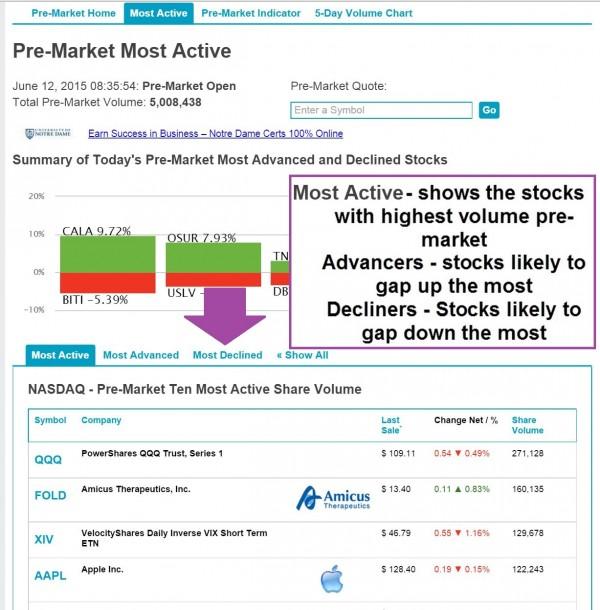
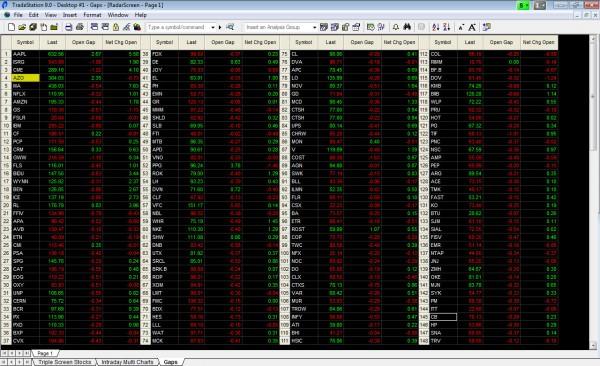
If you are looking for more options other than just the NASDAQ, then you can rely on your trading platform. I use TradeStation which allows me to screen for gapping stocks on their radar screen. When the market opens, the column heading “Open Gap” shows me how much a stock gapped up or down. When I compare this to the “Net Change Open” column, I can see if that stock is trying to fill the gap. You can populate this scanner with any list of stocks you would like; and by clicking on the header you can sort by gaps up or down.
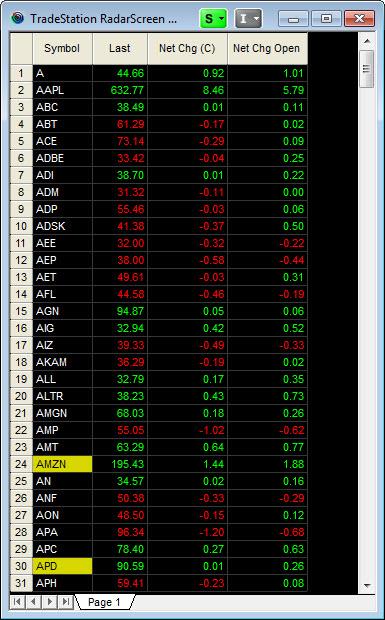
Using another analysis technique called “Net Chg (C)” can also be useful. This will show you the change in price from the prior day’s close and can help you to identify stocks likely to gap before they open.
Whichever method you choose to identify the stocks likely to gap, exercise caution in trading them. Gap trading and even trading in general in the first 15 minutes of the trading day can be dangerous and should only be undertaken by experienced traders who also have a solid plan for doing so. Once mastered, this type of trading has good potential for quick profits.
Neither Freedom Management Partners nor any of its personnel are registered broker-dealers or investment advisers. I will mention that I consider certain securities or positions to be good candidates for the types of strategies we are discussing or illustrating. Because I consider the securities or positions appropriate to the discussion or for illustration purposes does not mean that I am telling you to trade the strategies or securities. Keep in mind that we are not providing you with recommendations or personalized advice about your trading activities. The information we are providing is not tailored to any individual. Any mention of a particular security is not a recommendation to buy, sell, or hold that or any other security or a suggestion that it is suitable for any specific person. Keep in mind that all trading involves a risk of loss, and this will always be the situation, regardless of whether we are discussing strategies that are intended to limit risk. Also, Freedom Management Partners’ personnel are not subject to trading restrictions. I and others at Freedom Management Partners could have a position in a security or initiate a position in a security at any time.
Editors’ Picks

EUR/USD extends losses toward 1.1600 ahead of EU inflation data
EUR/USD extends the decline toward 1.1600 in the European session on Tuesday. The pair remains under pressure as surging energy prices amid the US-Iran war have increased the risks of higher inflation for the Old Continent. The focus is now on the Eurozone preliminary inflation reading for February.

GBP/USD attacks 1.3300, refreshing three-month lows
GBP/USD is deep in the red near 1.3300, accelerating its downside to renew three-month lows in European trading on Tuesday. The ongoing escalation in the Iran war, combined with rising Oil prices, weighs negatively on the higher-yielding Pound Sterling as the US Dollar capitalizes on increased haven demand.

Japanese Yen flat lines vs. rallying USD; bearish bias remains amid BoJ rate hike delay
The USD/JPY pair extends its sideways consolidative price move through the early European session. Spot prices remain below the highest level in over five weeks, touched the precious day, and currently trade below mid-157.00s, nearly unchanged for the day.
Editors’ Picks
EUR/USD extends losses toward 1.1600 ahead of EU inflation data
EUR/USD extends the decline toward 1.1600 in the European session on Tuesday. The pair remains under pressure as surging energy prices amid the US-Iran war have increased the risks of higher inflation for the Old Continent. The focus is now on the Eurozone preliminary inflation reading for February.
GBP/USD attacks 1.3300, refreshing three-month lows
GBP/USD is deep in the red near 1.3300, accelerating its downside to renew three-month lows in European trading on Tuesday. The ongoing escalation in the Iran war, combined with rising Oil prices, weighs negatively on the higher-yielding Pound Sterling as the US Dollar capitalizes on increased haven demand.

Gold falls below $5,300 as stronger USD counter Middle East woes
Gold attracts some intraday selling and falls below $5,300 on Tuesday. The US Dollar climbs to a fresh high since January 20 and turns out to be a key factor exerting downward pressure on the commodity. However, concerns about a broader regional conflict in the Middle East continue to weigh on investors' sentiment and underpin demand for the traditional safe-haven bullion.

Stellar risks deeper losses as derivatives metrics turn negative
Stellar is trading red below $0.16 at the time of writing on Tuesday, after a slight recovery the previous day. Weakening derivatives data caps the recovery, while an unfavorable technical outlook projects a deeper correction for the XLM token in the upcoming days.

The market is not panicking it is repricing the probability distribution of Oil and time
At the end of the day, markets do not trade morality or geopolitics. They trade transmission channels. And the only channel that truly matters in this maelstrom runs through the price of energy and the time value of money.
RECOMMENDED LESSONS
Making money in forex is easy if you know how the bankers trade!

I’m often mystified in my educational forex articles why so many traders struggle to make consistent money out of forex trading. The answer has more to do with what they don’t know than what they do know. After working in investment banks for 20 years many of which were as a Chief trader its second knowledge how to extract cash out of the market.
5 Forex News Events You Need To Know

In the fast moving world of currency markets where huge moves can seemingly come from nowhere, it is extremely important for new traders to learn about the various economic indicators and forex news events and releases that shape the markets. Indeed, quickly getting a handle on which data to look out for, what it means, and how to trade it can see new traders quickly become far more profitable and sets up the road to long term success.
Top 10 Chart Patterns Every Trader Should Know

Chart patterns are one of the most effective trading tools for a trader. They are pure price-action, and form on the basis of underlying buying and selling pressure. Chart patterns have a proven track-record, and traders use them to identify continuation or reversal signals, to open positions and identify price targets.
7 Ways to Avoid Forex Scams

The forex industry is recently seeing more and more scams. Here are 7 ways to avoid losing your money in such scams: Forex scams are becoming frequent. Michael Greenberg reports on luxurious expenses, including a submarine bought from the money taken from forex traders. Here’s another report of a forex fraud. So, how can we avoid falling in such forex scams?
What Are the 10 Fatal Mistakes Traders Make
Trading is exciting. Trading is hard. Trading is extremely hard. Some say that it takes more than 10,000 hours to master. Others believe that trading is the way to quick riches. They might be both wrong. What is important to know that no matter how experienced you are, mistakes will be part of the trading process.
The challenge: Timing the market and trader psychology

Successful trading often comes down to timing – entering and exiting trades at the right moments. Yet timing the market is notoriously difficult, largely because human psychology can derail even the best plans. Two powerful emotions in particular – fear and greed – tend to drive trading decisions off course.