 Brandon Wendell, CMT
Brandon Wendell
Whenever I happen to watch business television, I can’t help but notice how the pundits keep mentioning the stocks or other securities that have moved the most for the day or week. They seem to get more excited the higher prices have already moved. I have also noticed that most novice traders and investors seem to share that same enthusiasm and buy these same securities at elevated levels.
I have read many books on trading and investing for both professional advancement as well as an attempt to improve my personal skills. In the majority of these books, they expound on the virtue of buying breakouts to new highs.
This is silly and completely contrary to what we do in our day to day lives. Could you imagine going to an electronics store, (ok, I know we buy things online now) and not buying a TV because it was on sale. Instead, you wait until the price not only goes back to regular price, but actually rises! I’m sure you are shaking your head at this point because you know that you wouldn’t do this. But you probably have in the markets.
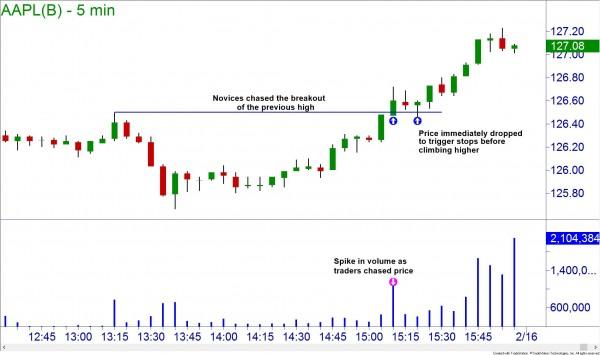
Professionals know that novice traders do this and they love to separate them from their money. Look at the following chart of Apple. Novice traders bought the breakout of the intraday high. The high volume confirms this. Immediately after the novice buying pressure was absorbed by the market, prices dropped to the open of the breakout candle to trigger the novices’ fear and stop loss orders. Once those novices are out, price begins to rise with the professionals having bought the pullback. The novices who were stopped out are likely to jump back in again and help the pro’s long positions.
Sometimes the climb will occur the following day instead of the same day. On the chart of SPY, the ETF that tracks the S&P 500, you see the novices again with their signature high volume accompanying their chasing the breakout of the day’s high. The end of the day was profitable for the professionals as they sold short to the novice traders.
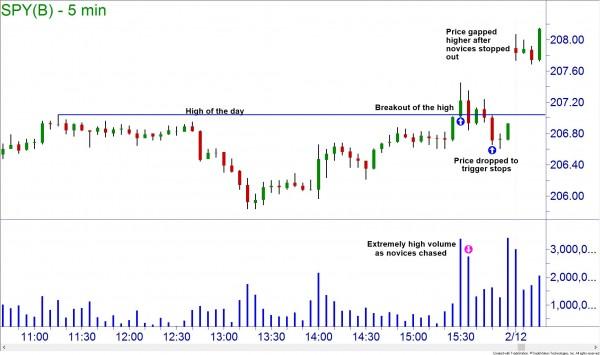
Those novices who were stopped out likely lamented the move as price gapped up the next day without them.
Investors are not immune to chasing price and may even be more susceptible. Many investors will jump into fast rising stocks for fear of missing out. They will even buy in front of an earnings release expecting to make a quick fortune on a favourable release.
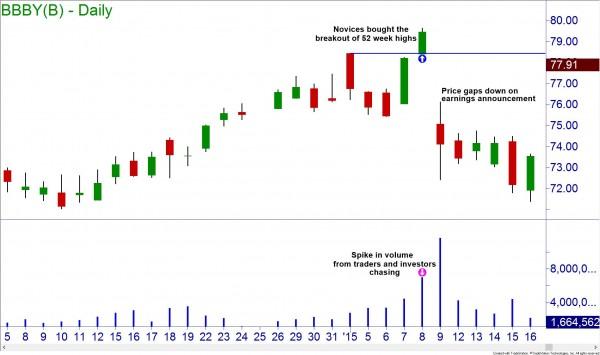
Recently, the retailer Bed Bath and Beyond (BBBY) released their fourth quarter earnings report. On the day of the release investors and traders bought the stock as it climbed and broke above its 52 week high. Once more you can see the increase in volume as their buying frenzy reached a climax. Unfortunately, the report was not what they would have liked and prices gapped down about five percent the next day.
This could have easily been avoided. An educated trader or investor knows to look back in price to find quality demand zones in which to buy and quality supply zones where they sell or short. One year prior to this earning release, there was another earnings release that caused a large gap down and a supply zone. This would have told you not to buy BBBY. You may have even wanted to have shorted the stock instead.
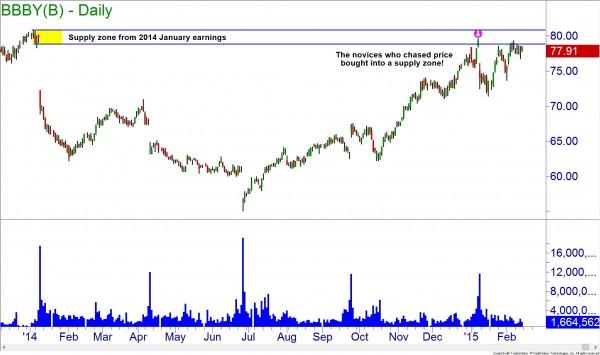
You must remember that trading a stock into an earnings release is incredibly risky and is more akin to gambling than trading. In this case the supply is a warning sign not to buy or to exit a long position, not to short. But it highlights some key mistakes that novices make in the markets. They often buy in front of a supply zone and they sell in front of a demand zone.
In Online Trading Academy’s courses we teach our students to look back in time on their charts before entering a position for this very reason. I have been writing a book on trading called, “Look Left and Be Right,” that addresses this very concept. Without looking left on our charts, we will not see the signs that tell us where prices will turn and will be doomed to repeat the same novice mistakes.
Neither Freedom Management Partners nor any of its personnel are registered broker-dealers or investment advisers. I will mention that I consider certain securities or positions to be good candidates for the types of strategies we are discussing or illustrating. Because I consider the securities or positions appropriate to the discussion or for illustration purposes does not mean that I am telling you to trade the strategies or securities. Keep in mind that we are not providing you with recommendations or personalized advice about your trading activities. The information we are providing is not tailored to any individual. Any mention of a particular security is not a recommendation to buy, sell, or hold that or any other security or a suggestion that it is suitable for any specific person. Keep in mind that all trading involves a risk of loss, and this will always be the situation, regardless of whether we are discussing strategies that are intended to limit risk. Also, Freedom Management Partners’ personnel are not subject to trading restrictions. I and others at Freedom Management Partners could have a position in a security or initiate a position in a security at any time.
Editors’ Picks

EUR/USD seems fragile below 1.1700 as Middle East war boosts energy prices
The EUR/USD pair trades flat at around 1.1680 during the Asian trading session on Tuesday, but broadly seems vulnerable, being close to its five-week low. The major currency pair is under pressure as surging oil prices due to the United States-Israel war with Iran have increased the risks of higher inflation for the Old Continent.

GBP/USD hovers around 1.3400 with bearish pressure intact
GBP/USD edges higher after three days of losses, trading around 1.3400 during the Asian hours on Tuesday. The technical analysis of the daily chart indicates an ongoing bearish bias, as the pair trades within a descending channel pattern.

USD/JPY struggles below 157.50 amid intervention fears, risk aversion
USD/JPY stays defensive below the 157.50 and over a five-week high set on Monday as a dramatic escalation of geopolitical tensions in the Middle East continues to benefit the US Dollar's status as the global reserve currency. The Japanese Yen also benefits from a risk-off market scenario amid looming FX intervention fears, acting as a drag on the major.
Editors’ Picks
EUR/USD seems fragile below 1.1700 as Middle East war boosts energy prices
The EUR/USD pair trades flat at around 1.1680 during the Asian trading session on Tuesday, but broadly seems vulnerable, being close to its five-week low. The major currency pair is under pressure as surging oil prices due to the United States-Israel war with Iran have increased the risks of higher inflation for the Old Continent.

Gold sticks to gains above $5,350 amid sustained safe-haven demand; firmer USD caps gains
Gold sticks to its positive bias for the third straight day and trades above the $5,350 level heading into the European session on Tuesday. Concerns about a broader regional conflict in the Middle East continue to weigh on investors' sentiment and underpin demand for the traditional safe-haven bullion.
GBP/USD hovers around 1.3400 with bearish pressure intact
GBP/USD edges higher after three days of losses, trading around 1.3400 during the Asian hours on Tuesday. The technical analysis of the daily chart indicates an ongoing bearish bias, as the pair trades within a descending channel pattern.

Stellar risks deeper losses as derivatives metrics turn negative
Stellar is trading red below $0.16 at the time of writing on Tuesday, after a slight recovery the previous day. Weakening derivatives data caps the recovery, while an unfavorable technical outlook projects a deeper correction for the XLM token in the upcoming days.

The market is not panicking it is repricing the probability distribution of Oil and time
At the end of the day, markets do not trade morality or geopolitics. They trade transmission channels. And the only channel that truly matters in this maelstrom runs through the price of energy and the time value of money.
RECOMMENDED LESSONS
Making money in forex is easy if you know how the bankers trade!

I’m often mystified in my educational forex articles why so many traders struggle to make consistent money out of forex trading. The answer has more to do with what they don’t know than what they do know. After working in investment banks for 20 years many of which were as a Chief trader its second knowledge how to extract cash out of the market.
5 Forex News Events You Need To Know

In the fast moving world of currency markets where huge moves can seemingly come from nowhere, it is extremely important for new traders to learn about the various economic indicators and forex news events and releases that shape the markets. Indeed, quickly getting a handle on which data to look out for, what it means, and how to trade it can see new traders quickly become far more profitable and sets up the road to long term success.
Top 10 Chart Patterns Every Trader Should Know

Chart patterns are one of the most effective trading tools for a trader. They are pure price-action, and form on the basis of underlying buying and selling pressure. Chart patterns have a proven track-record, and traders use them to identify continuation or reversal signals, to open positions and identify price targets.
7 Ways to Avoid Forex Scams

The forex industry is recently seeing more and more scams. Here are 7 ways to avoid losing your money in such scams: Forex scams are becoming frequent. Michael Greenberg reports on luxurious expenses, including a submarine bought from the money taken from forex traders. Here’s another report of a forex fraud. So, how can we avoid falling in such forex scams?
What Are the 10 Fatal Mistakes Traders Make
Trading is exciting. Trading is hard. Trading is extremely hard. Some say that it takes more than 10,000 hours to master. Others believe that trading is the way to quick riches. They might be both wrong. What is important to know that no matter how experienced you are, mistakes will be part of the trading process.
The challenge: Timing the market and trader psychology

Successful trading often comes down to timing – entering and exiting trades at the right moments. Yet timing the market is notoriously difficult, largely because human psychology can derail even the best plans. Two powerful emotions in particular – fear and greed – tend to drive trading decisions off course.