 Brandon Wendell, CMT
Brandon Wendell
Whenever I return from a road trip my neighbor’s German Shepherd always chases after my motorcycle. He is a great dog and very friendly and is allowed to roam the neighborhood freely. It struck me that he is a lot like a novice trader chasing prices in the markets.
If I am driving slowly the dog will catch me and I can reach out and pet him. Of course, I have to be careful that he doesn’t run in front of the bike and cause me to crash. Similarly, novices can catch prices easily when they are in a slow moving trend; but they must be careful because they may make profits, but only until too many of them are on board and the stock price collapses.
When I drive past the dog at a slightly higher speed he cannot catch me but will still run after me. Once he was running too fast and when I stopped to turn into my driveway he ran into the back of the bike. Unfortunately, I have seen way too many traders chase a fast moving trend, just to catch it at the top or bottom of that trend. This is financially disastrous.
You could also equate price chasing to climbing a flagpole. If one person were to climb to the top of that pole it would hold their weight. This is the professional trader who buys near or at the beginning of the trend. As more and more people climbed up to the top of that same pole, eventually it would bend and break from the added weight. Prices are similar. Stock prices rise because of demand. The demand being greater than the supply causes buyers to outbid each other and climb the pole. At some point, the buyers have exhausted themselves and everyone who wanted to buy has already done so or is prevented from buying due to the high cost.
Prices start to fall as fear takes hold. Most investors and traders will start to panic when the price starts moving against them or their stops will be triggered. If there was a lot of buying pressure and large green candles going into the supply level, there will be few buyers to stop the collapse and catch the supply being dumped onto the markets from stop orders being triggered.
Compare this with a gradual climb that features smaller green candles and some small pullbacks to shake out weak traders. As prices fall away from a supply level in this scenario, they will be met with less stop orders and more buying pressure as the demand was not exhausted on the way up.
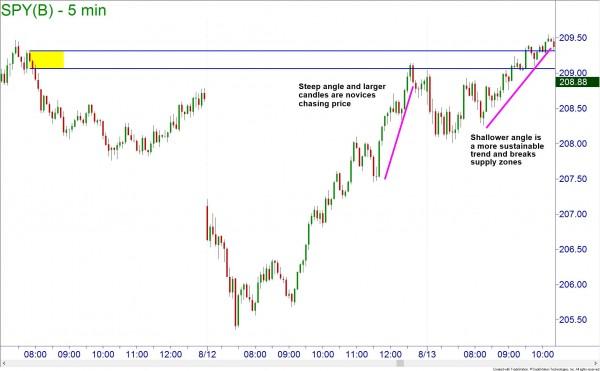
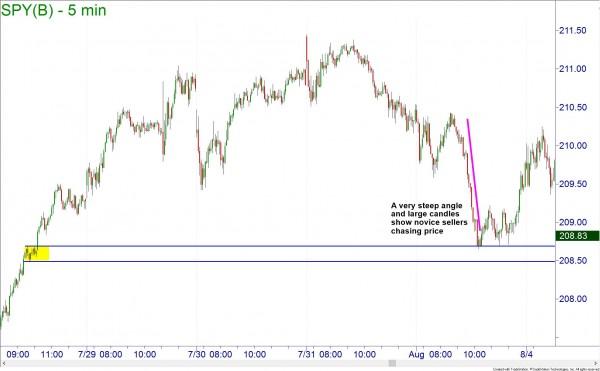
Arrival to demand zones are also important. If you arrive at the demand with large red candles signaling panic and fear, you are likely to have a bigger and better bounce. The large red candles signal that everyone who wanted to sell has now exited the stock. When buyers step in they must raise their bids quickly to attract a seller who may still be around.
This is a part of Online Trading Academy’s Odds Enhancers. In order to be successful in your trading and investing you need to use strategies and tools that are proven and profitable. To learn more about these Odds Enhancers and the Core Strategy be sure to visit your local Online Trading Academy Center and enroll for one of our trading courses. Until next time, trade safe and trade well!
Neither Freedom Management Partners nor any of its personnel are registered broker-dealers or investment advisers. I will mention that I consider certain securities or positions to be good candidates for the types of strategies we are discussing or illustrating. Because I consider the securities or positions appropriate to the discussion or for illustration purposes does not mean that I am telling you to trade the strategies or securities. Keep in mind that we are not providing you with recommendations or personalized advice about your trading activities. The information we are providing is not tailored to any individual. Any mention of a particular security is not a recommendation to buy, sell, or hold that or any other security or a suggestion that it is suitable for any specific person. Keep in mind that all trading involves a risk of loss, and this will always be the situation, regardless of whether we are discussing strategies that are intended to limit risk. Also, Freedom Management Partners’ personnel are not subject to trading restrictions. I and others at Freedom Management Partners could have a position in a security or initiate a position in a security at any time.
Editors’ Picks

EUR/USD breaks below 1.1800, two-week lows
EUR/USD’s selling pressure is gathering pace now, breaching below the key 1.1800 yardstick to hit new two-week troughs on Wednesday. The pair’s pullback comes on the back of marked gains in the US Dollar following US data releases and ahead of the publication of the FOMC Minutes.

GBP/USD reaches multi-day lows near 1.3500
GBP/USD reverses its initial upside momentum and is now adding to previous declines, approaching the 1.3500 region on Wednesday. Cable’s downtick comes on the back of decent gains in the Greenback and easing UK inflation figures, which seem to have reinforced the case for a BoE rate cut in March.

USD/JPY holds gains near 154.00 ahead of the Fed’s minutes
USD/JPY retraces Tuesday's losses and returns near weekly highs in the area of 154.00. The US Dollar trims losses in quiet markets with all eyes on the Fed's minutes. Weak Japanese GDP data resurfaced concerns about Japan's fiscal stability and halted JPY's recovery.
Editors’ Picks
EUR/USD breaks below 1.1800, two-week lows
EUR/USD’s selling pressure is gathering pace now, breaching below the key 1.1800 yardstick to hit new two-week troughs on Wednesday. The pair’s pullback comes on the back of marked gains in the US Dollar following US data releases and ahead of the publication of the FOMC Minutes.
GBP/USD reaches multi-day lows near 1.3500
GBP/USD reverses its initial upside momentum and is now adding to previous declines, approaching the 1.3500 region on Wednesday. Cable’s downtick comes on the back of decent gains in the Greenback and easing UK inflation figures, which seem to have reinforced the case for a BoE rate cut in March.

Gold battle to regain $5,000 continues
Gold is back on the front foot on Wednesday, shaking off part of the early week softness and challenging two-day highs near the $5,000 mark per troy ounce. The move comes ahead of the FOMC Minutes and is unfolding despite an intense rebound in the US Dollar.
Fed Minutes to shed light on January hold decision amid hawkish rate outlook
The Minutes of the Fed’s January 27-28 monetary policy meeting will be published today. Details of discussions on the decision to leave the policy rate unchanged will be scrutinized by investors.

Mixed UK inflation data no gamechanger for the Bank of England
Food inflation plunged in January, but service sector price pressure is proving stickier. We continue to expect Bank of England rate cuts in March and June. The latest UK inflation read is a mixed bag for the Bank of England, but we doubt it drastically changes the odds of a March rate cut.
RECOMMENDED LESSONS
Making money in forex is easy if you know how the bankers trade!

I’m often mystified in my educational forex articles why so many traders struggle to make consistent money out of forex trading. The answer has more to do with what they don’t know than what they do know. After working in investment banks for 20 years many of which were as a Chief trader its second knowledge how to extract cash out of the market.
5 Forex News Events You Need To Know

In the fast moving world of currency markets where huge moves can seemingly come from nowhere, it is extremely important for new traders to learn about the various economic indicators and forex news events and releases that shape the markets. Indeed, quickly getting a handle on which data to look out for, what it means, and how to trade it can see new traders quickly become far more profitable and sets up the road to long term success.
Top 10 Chart Patterns Every Trader Should Know

Chart patterns are one of the most effective trading tools for a trader. They are pure price-action, and form on the basis of underlying buying and selling pressure. Chart patterns have a proven track-record, and traders use them to identify continuation or reversal signals, to open positions and identify price targets.
7 Ways to Avoid Forex Scams

The forex industry is recently seeing more and more scams. Here are 7 ways to avoid losing your money in such scams: Forex scams are becoming frequent. Michael Greenberg reports on luxurious expenses, including a submarine bought from the money taken from forex traders. Here’s another report of a forex fraud. So, how can we avoid falling in such forex scams?
What Are the 10 Fatal Mistakes Traders Make
Trading is exciting. Trading is hard. Trading is extremely hard. Some say that it takes more than 10,000 hours to master. Others believe that trading is the way to quick riches. They might be both wrong. What is important to know that no matter how experienced you are, mistakes will be part of the trading process.
The challenge: Timing the market and trader psychology

Successful trading often comes down to timing – entering and exiting trades at the right moments. Yet timing the market is notoriously difficult, largely because human psychology can derail even the best plans. Two powerful emotions in particular – fear and greed – tend to drive trading decisions off course.