 Brandon Wendell, CMT
Brandon Wendell
In the Extended Learning Track program we have been watching the broad markets for influence on individual stocks. I have been demonstrating a method of watching the broad market indexes that reduces the need for multiple charts. I have decided to revisit an article I wrote a while ago that describes this method.
Those of you who have attended Online Trading Academy’s Professional Trader Course know that we always have a chart of the S&P 500 or NASDAQ to view in addition to our stock chart in the class. On average, 50-60% of a stock’s movement will be directly related to the movement and trend of the broad market. 30-40% of the stock’s movement will be influenced by the sector of that stock. That leaves only 10% of influence from the company itself.
I am sure you have noticed that the stocks moving with the market trend often move faster and farther than those trying to move against it. The other choice we must make is which market should we be following, the S&P 500, the NASDAQ, DJIA, or the Russell 2000? It comes down to which of those indexes is leading in the current trend. Most traders would suffer from information overload from trying to watch the charts of those four indexes as well as their stocks. I have found a solution for keeping an eye on the markets while focusing on your stock trade.
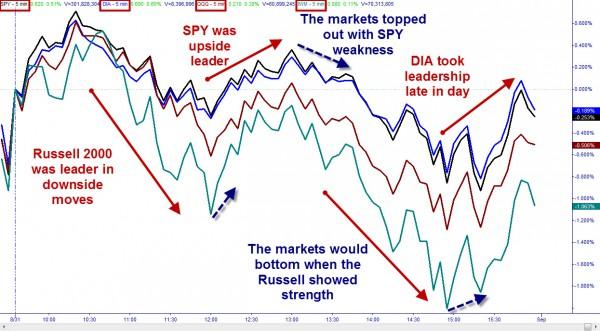
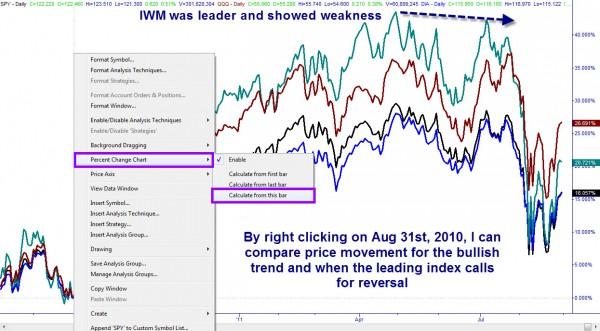
TradeStation software allows me to chart the four indexes in one chart. This is something I have used extensively in the XLT programs to identify market trend and potential confirmation at supply and demand levels. I use the “Percent Change” feature to compare all four indexes and easily identify the leader in the dominant trend. I like to use the ETF’s: SPY, QQQ, DIA & IWM to represent all of the indexes. You could easily substitute the indexes themselves or even the futures contracts. Since the futures are listed on different exchanges, you will have to adjust your chart to local time instead of “Exchange” time for them to overlay. You can see the finished chart below.
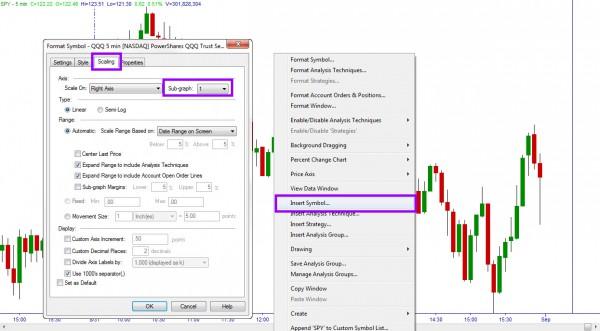
To create the chart, I start with a chart of the S&P 500. If you right click on the chart you can select “Insert Symbol” and then add the next ETF to your chart. You need to make sure you have the “Prompt for Format box checked when you add the symbol. You will need to go to the Scaling Tab and change the Sub-Graph to 1.
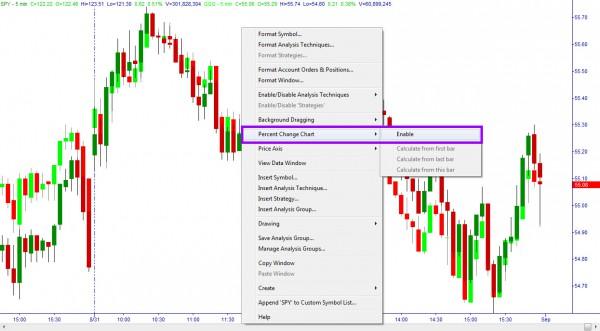
Once you have the second symbol on the chart, you will right click again and select “Percent Change Chart” and select “Enable.”
You can then add the additional ETF’s one at a time in the same manner. You can change the style and color of the lines when you add them if you keep the “Prompt for Format” box checked. Once all four are added your chart will look like this.
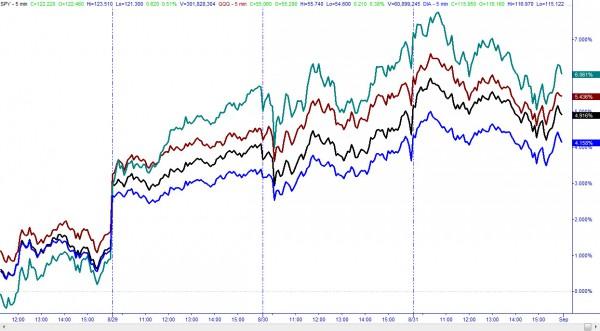
Finally, you must choose a starting point for the comparison. On intraday charts, I use the open. I right click on the chart at the line that represents the beginning of the day. Under the “Percent Change Chart” menu, I select “Calculate from This Bar.” That will start the price comparisons at zero from the open of the day. If I am using a daily chart or want to compare a longer move, I will start the chart from a major top or bottom and see when the trend is weakening from the leading index changing direction.
For more information on how we can use this tool, come join me in the Extended Learning Track of Online Trading Academy or even attend the Advanced Technical Analysis course. The skills you will pick up in these classes can greatly improve your trading.
Neither Freedom Management Partners nor any of its personnel are registered broker-dealers or investment advisers. I will mention that I consider certain securities or positions to be good candidates for the types of strategies we are discussing or illustrating. Because I consider the securities or positions appropriate to the discussion or for illustration purposes does not mean that I am telling you to trade the strategies or securities. Keep in mind that we are not providing you with recommendations or personalized advice about your trading activities. The information we are providing is not tailored to any individual. Any mention of a particular security is not a recommendation to buy, sell, or hold that or any other security or a suggestion that it is suitable for any specific person. Keep in mind that all trading involves a risk of loss, and this will always be the situation, regardless of whether we are discussing strategies that are intended to limit risk. Also, Freedom Management Partners’ personnel are not subject to trading restrictions. I and others at Freedom Management Partners could have a position in a security or initiate a position in a security at any time.
Editors’ Picks

EUR/USD challenges 1.1700, six-week lows
EUR/USD remains under heavy downside pressire in quite a dfrreadful start to the new trading week, putting the 1.1700 support to the test amid the marked rebound in the US Dollar. The flight-so-safety environment continues to support the Greenback following the escalating conflict in the Middle East.

GBP/USD hits new yearly lows near 1.3300
GBP/USD adds to the recent bearish tone, approaching to the key 1.3300 support to reach fresh YTD troughs against the backdrop of the robust performance of the US Dollar. Indeed, Cable’s decline comes amid the firm demand for the safe-haven space in the wake of the US and Israel attacks to Iran.

USD/JPY: Japanese Yen remains depressed vs. USD amid Middle East tensions; lacks follow-through
The USD/JPY pair catches fresh bids at the start of a new week and climbs back closer to last week's swing high, though it lacks follow-through and remains below the 157.00 mark through the Asian session. A coordinated US-Israel military strike on Iran marks a dramatic escalation of geopolitical tensions and unsettles global markets.
Editors’ Picks

Gold shifts its attention to $5,600 on fligh-to-safety mood
Gold climbs to levels last seen in late January past the $5,400 mark per troy ounce on Monday. The yellow metal’s strong uptick remains fuelled by incresing geopolitical tensions in the Middle East and the consequent demand for safer assets.

Oil surpasses the $72.00 mark, fresh multi-month highs
Crude oil prices kicked off the week with a sharply bullish gap, with WTI climbing to its highest level since June north of the $72.00 mark barrel, always amid mounting geopolitical risk following US and Israeli military strikes on Iran and the effective shutdown of the Strait of Hormuz.
EUR/USD challenges 1.1700, six-week lows
EUR/USD remains under heavy downside pressire in quite a dfrreadful start to the new trading week, putting the 1.1700 support to the test amid the marked rebound in the US Dollar. The flight-so-safety environment continues to support the Greenback following the escalating conflict in the Middle East.

Bitcoin on brink of breakdown amid US-Iran war
Bitcoin (BTC) remains under pressure near the key support level of $65,700. Trading at $66,400 at the time of writing on Monday, a breakdown below this critical level would suggest a deeper correction ahead.

The week ahead: Conflict in the Middle East jolts markets
Events in the Middle East are obviously dominating financial markets this morning. The Brent crude oil price is extending gains and is higher by more than 8%, stock futures are pointing lower and the gold price is higher by more than 2%.
RECOMMENDED LESSONS
Making money in forex is easy if you know how the bankers trade!

I’m often mystified in my educational forex articles why so many traders struggle to make consistent money out of forex trading. The answer has more to do with what they don’t know than what they do know. After working in investment banks for 20 years many of which were as a Chief trader its second knowledge how to extract cash out of the market.
5 Forex News Events You Need To Know

In the fast moving world of currency markets where huge moves can seemingly come from nowhere, it is extremely important for new traders to learn about the various economic indicators and forex news events and releases that shape the markets. Indeed, quickly getting a handle on which data to look out for, what it means, and how to trade it can see new traders quickly become far more profitable and sets up the road to long term success.
Top 10 Chart Patterns Every Trader Should Know

Chart patterns are one of the most effective trading tools for a trader. They are pure price-action, and form on the basis of underlying buying and selling pressure. Chart patterns have a proven track-record, and traders use them to identify continuation or reversal signals, to open positions and identify price targets.
7 Ways to Avoid Forex Scams

The forex industry is recently seeing more and more scams. Here are 7 ways to avoid losing your money in such scams: Forex scams are becoming frequent. Michael Greenberg reports on luxurious expenses, including a submarine bought from the money taken from forex traders. Here’s another report of a forex fraud. So, how can we avoid falling in such forex scams?
What Are the 10 Fatal Mistakes Traders Make
Trading is exciting. Trading is hard. Trading is extremely hard. Some say that it takes more than 10,000 hours to master. Others believe that trading is the way to quick riches. They might be both wrong. What is important to know that no matter how experienced you are, mistakes will be part of the trading process.
The challenge: Timing the market and trader psychology

Successful trading often comes down to timing – entering and exiting trades at the right moments. Yet timing the market is notoriously difficult, largely because human psychology can derail even the best plans. Two powerful emotions in particular – fear and greed – tend to drive trading decisions off course.