 Brandon Wendell, CMT
Brandon Wendell
Well, maybe not everything. Participating in the Boy Scouts is a rite of passage for many young men. I remember the meetings, the Pine Wood Derbies, Merit Badges, and the camping trips. As a member of the Scouts, I had lot of fun while learning life lessons which I carry with me to this day. Many of you are probably familiar with the Scout motto: Be Prepared.
Being prepared is something we all must do as traders. We do not know whether the markets will go up or down. Sure we can anticipate the most probable direction, but a trader will never be 100% sure. So, how can we protect ourselves against inverse market moves? Simple, be prepared!
Preparing for the markets involves identifying any possible dangers that may confront our positions. I see too many students who are new to the markets, focus too heavily on the possible profits the trade may offer them. Professionals and those who will last long term focus on the risk of the trade and look for all possibilities. The best way to do this is by having a plan prepared for your trade prior to entering it.
In the Online Trading Academy Professional Trader Course as well as the Extended Learning Track, we emphasize the need to have a complete trading plan as well as a plan for every trade you will take. The two plans are a way to remove the emotions from your trading and force you to objectively look at all possibilities in the market. We must create the trading plans before we have an open position so that we do not have a bias or emotion attached to the market.
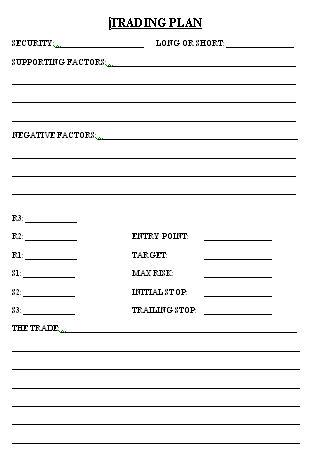
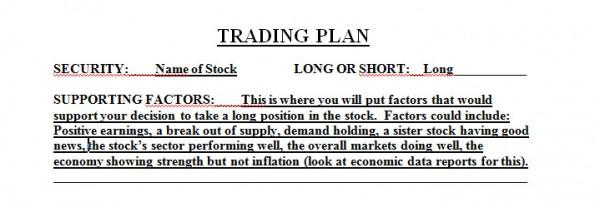
In the first part of the trading plan, the trader should look for reasons as to why this is a suitable trade to enter. Usually this is the easiest section for the trader to complete as we all want to trade and it can be easy for us to rationalize why we should enter. Be careful to make sure they are valid reasons such as supply or demand zones, the trend, and movement of related markets.
Now the hard part begins. The trader needs to start listing the negative factors that may work against the trade. This is where you have to find the dangers that could increase your risk of losing. We don’t want to think about being wrong and typically have a mental block that prevents us from seeing the danger or causes us to rationalize it. Look objectively at the markets and decide if there are dangers. List them to remind you to be aware and prepared for them!

Once you have the factors identified, it is time to write out the plan. Locate supply and demand levels, the desired entry point, target area, and where you will place your stop. The entry, exit and target will be determined by using the tools and tactics you listed in your overall trading business plan. You should then write out your trade. Be specific! Write out your entry and type of order to be used. Detail where and when you will place stops.
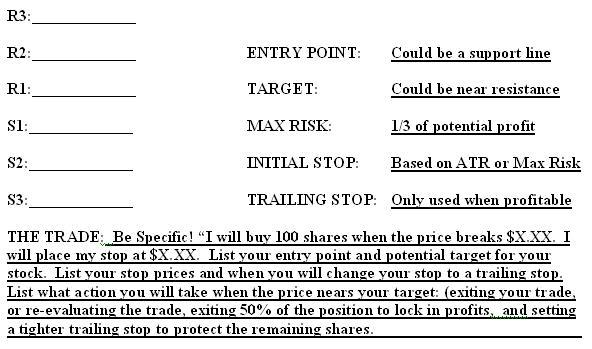
By completing this trade plan, you accomplish several things. You have accountability if you violate the plan and can build discipline. But you also build confidence when you follow your plan and you either make money or lose very little when things don’t work out as you had planned. By preparing the trade plan, you prepare for surprises and will not be shocked into large losses when the market makes a volatile turn.
Neither Freedom Management Partners nor any of its personnel are registered broker-dealers or investment advisers. I will mention that I consider certain securities or positions to be good candidates for the types of strategies we are discussing or illustrating. Because I consider the securities or positions appropriate to the discussion or for illustration purposes does not mean that I am telling you to trade the strategies or securities. Keep in mind that we are not providing you with recommendations or personalized advice about your trading activities. The information we are providing is not tailored to any individual. Any mention of a particular security is not a recommendation to buy, sell, or hold that or any other security or a suggestion that it is suitable for any specific person. Keep in mind that all trading involves a risk of loss, and this will always be the situation, regardless of whether we are discussing strategies that are intended to limit risk. Also, Freedom Management Partners’ personnel are not subject to trading restrictions. I and others at Freedom Management Partners could have a position in a security or initiate a position in a security at any time.
Editors’ Picks

EUR/USD seems fragile below 1.1700 as Middle East war boosts energy prices
The EUR/USD pair trades flat at around 1.1680 during the Asian trading session on Tuesday, but broadly seems vulnerable, being close to its five-week low. The major currency pair is under pressure as surging oil prices due to the United States-Israel war with Iran have increased the risks of higher inflation for the Old Continent.

GBP/USD hovers around 1.3400 with bearish pressure intact
GBP/USD edges higher after three days of losses, trading around 1.3400 during the Asian hours on Tuesday. The technical analysis of the daily chart indicates an ongoing bearish bias, as the pair trades within a descending channel pattern.

USD/JPY struggles below 157.50 amid intervention fears, risk aversion
USD/JPY stays defensive below the 157.50 and over a five-week high set on Monday as a dramatic escalation of geopolitical tensions in the Middle East continues to benefit the US Dollar's status as the global reserve currency. The Japanese Yen also benefits from a risk-off market scenario amid looming FX intervention fears, acting as a drag on the major.
Editors’ Picks
EUR/USD seems fragile below 1.1700 as Middle East war boosts energy prices
The EUR/USD pair trades flat at around 1.1680 during the Asian trading session on Tuesday, but broadly seems vulnerable, being close to its five-week low. The major currency pair is under pressure as surging oil prices due to the United States-Israel war with Iran have increased the risks of higher inflation for the Old Continent.

Gold weakens below $5,300 as sustained USD buying counter Middle East tensions
Gold attracts some intraday selling and falls around $100 from the daily top, around the $5,380 area. The US Dollar climbs to a fresh high since January 20 and turns out to be a key factor exerting downward pressure on the commodity. However, concerns about a broader regional conflict in the Middle East continue to weigh on investors' sentiment and underpin demand for the traditional safe-haven bullion.
GBP/USD hovers around 1.3400 with bearish pressure intact
GBP/USD edges higher after three days of losses, trading around 1.3400 during the Asian hours on Tuesday. The technical analysis of the daily chart indicates an ongoing bearish bias, as the pair trades within a descending channel pattern.

Stellar risks deeper losses as derivatives metrics turn negative
Stellar is trading red below $0.16 at the time of writing on Tuesday, after a slight recovery the previous day. Weakening derivatives data caps the recovery, while an unfavorable technical outlook projects a deeper correction for the XLM token in the upcoming days.

The market is not panicking it is repricing the probability distribution of Oil and time
At the end of the day, markets do not trade morality or geopolitics. They trade transmission channels. And the only channel that truly matters in this maelstrom runs through the price of energy and the time value of money.
RECOMMENDED LESSONS
Making money in forex is easy if you know how the bankers trade!

I’m often mystified in my educational forex articles why so many traders struggle to make consistent money out of forex trading. The answer has more to do with what they don’t know than what they do know. After working in investment banks for 20 years many of which were as a Chief trader its second knowledge how to extract cash out of the market.
5 Forex News Events You Need To Know

In the fast moving world of currency markets where huge moves can seemingly come from nowhere, it is extremely important for new traders to learn about the various economic indicators and forex news events and releases that shape the markets. Indeed, quickly getting a handle on which data to look out for, what it means, and how to trade it can see new traders quickly become far more profitable and sets up the road to long term success.
Top 10 Chart Patterns Every Trader Should Know

Chart patterns are one of the most effective trading tools for a trader. They are pure price-action, and form on the basis of underlying buying and selling pressure. Chart patterns have a proven track-record, and traders use them to identify continuation or reversal signals, to open positions and identify price targets.
7 Ways to Avoid Forex Scams

The forex industry is recently seeing more and more scams. Here are 7 ways to avoid losing your money in such scams: Forex scams are becoming frequent. Michael Greenberg reports on luxurious expenses, including a submarine bought from the money taken from forex traders. Here’s another report of a forex fraud. So, how can we avoid falling in such forex scams?
What Are the 10 Fatal Mistakes Traders Make
Trading is exciting. Trading is hard. Trading is extremely hard. Some say that it takes more than 10,000 hours to master. Others believe that trading is the way to quick riches. They might be both wrong. What is important to know that no matter how experienced you are, mistakes will be part of the trading process.
The challenge: Timing the market and trader psychology

Successful trading often comes down to timing – entering and exiting trades at the right moments. Yet timing the market is notoriously difficult, largely because human psychology can derail even the best plans. Two powerful emotions in particular – fear and greed – tend to drive trading decisions off course.