 Brandon Wendell, CMT
Brandon Wendell
While teaching a Professional Trader course in Minneapolis this week, I was demonstrating a technique where I can accurately predict the morning reversal of the S&P 500 Index due to arbitrage opportunities. In continuing the discussion with the class, I then realized that I had stumbled onto an odds enhancer for intraday trading under certain circumstances.
I will not give away the details of the initial trading opportunity that I teach since it wouldn’t be fair to my classroom and XLT students. But I will share the odds enhancer I found. For those who may not know, there are a group of institutional traders called program traders who have their computers set to recognize mispricing between the S&P 500 Index and the S&P 500 Futures. When the mispricing occurs, they buy the undervalued security (or the stocks making up the index) and sell the overvalued one. This is known as an arbitrage opportunity.
Futures trade with high leverage in comparison to the stocks making up the indexes. Buying 100 shares of the SPY (the ETF that tracks the S&P 500 index) would cost nearly $15,000 at the time of this writing. Even with 2:1 margin, a trader would need $7500 to maintain the position. To trade one contract of the ES, (the S&P 500 eMini future), a trader only needs $3850. Or much less if it is an intraday trade.
Since a trader can put down smaller margin and trade futures in lieu of stocks, they could earn interest on the money they are not using by buying stock. Well maybe when the US banks actually pay interest again. So the futures exchanges attach a fair value to the futures in order to make them priced similarly to the equivalent index. Additionally, a futures trader will not receive dividends as would the stock or ETF trader. That dividend value is subtracted from the interest to arrive at the fair value.
Futures Fair Value = Interest available on the future contract until expiration minus the dividends to be paid on the stocks until the expiration.
The fair value only changes once a day when the equity market closes. That is when a stock would go ex-div and pay out a dividend and also when there is one less day of interest until expiration. There are plenty of sites that show you the fair value number. I tend to check www.indexarb.com to get the data.
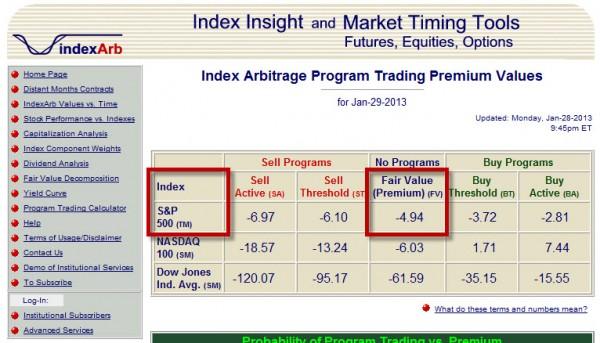
As you can see from the fair value, the S&P Futures should be trading 4.94 points below the S&P 500 Index for the entire day. The buy and sell thresholds tell the program traders when the two are mispriced and ready for an arbitrage opportunity. Should the difference between the two become less than 3.72, some of the program traders will buy the undervalued stocks in the S&P 500 and sell the S&P futures to bring the two back in line. If a larger move on the futures pushes the distance between them and the index to less than 2.81, then all of the programs traders should act and a sharp movement in the markets would result.
The opposite would occur should the difference between the S&P index and the futures become too great. If the price gap between the two grows greater than 6.10, then some program traders will buy the futures and sell most of the stocks making up the S&P 500 index. All of the program traders should move in and buy futures and short the stocks. This will result in a larger move in both the index and the futures.
In TradeStation, you can chart the difference between the S&P 500 index and the S&P 500 futures. This is called the premium and the symbol is $SPINX. If we look at the following chart of the premium along with the program trading buy and sell thresholds drawn on the chart, we can identify the times when these programs will move the markets.
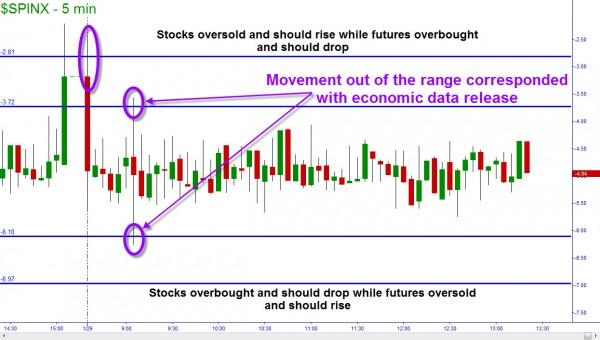
You can see that early in the morning at the equity market open, the premium was too high. This caused a selloff in the equity markets until the premium was near the -4.94 target. Later in the day the premium moved again on the release of the Consumer Confidence number. This gave a knowledgeable trader several opportunities.
On any given day, when you are watching your stock approaching a supply zone and are trying to decide whether you should sell or short the level, look at what the premium is doing. If it is approaching the lower levels or sell thresholds, then you should have more confidence that the level will hold. If you are looking at a demand zone on your stock and the premium is moving up to or beyond the buy threshold, you should have a higher confidence of the demand zone working.
I decided to take it one step further and placed a Bollinger Band set to 20 periods and an exponential moving average on the premium chart. I noticed that when the band was pierced, it often corresponded with an immediate change of trend direction in the SPY ETF.
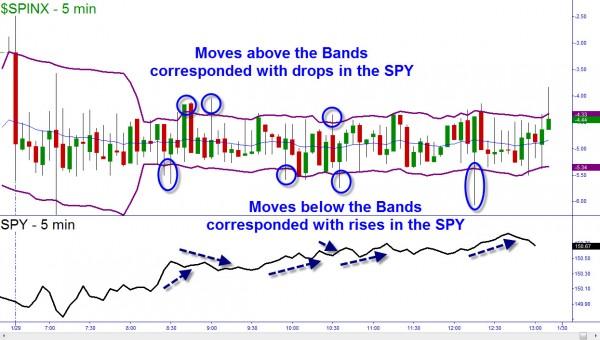
We must not forget that we need to center our trading decisions on supply, demand, and trend. So while the premium chart with Bollinger Bands is not the holy grail of technical analysis, it is something that a trader can use as a decision support tool.
Neither Freedom Management Partners nor any of its personnel are registered broker-dealers or investment advisers. I will mention that I consider certain securities or positions to be good candidates for the types of strategies we are discussing or illustrating. Because I consider the securities or positions appropriate to the discussion or for illustration purposes does not mean that I am telling you to trade the strategies or securities. Keep in mind that we are not providing you with recommendations or personalized advice about your trading activities. The information we are providing is not tailored to any individual. Any mention of a particular security is not a recommendation to buy, sell, or hold that or any other security or a suggestion that it is suitable for any specific person. Keep in mind that all trading involves a risk of loss, and this will always be the situation, regardless of whether we are discussing strategies that are intended to limit risk. Also, Freedom Management Partners’ personnel are not subject to trading restrictions. I and others at Freedom Management Partners could have a position in a security or initiate a position in a security at any time.
Editors’ Picks

EUR/USD climbs to daily highs near 1.1820
EUR/USD now picks up pace and advances to the area of daily peaks north of the 1.1800 barrier at the end of the week. The pair’s decent move higher comes against the backdrop of a generalised lack of direction in the FX galaxy and the mild offered stance in the US Dollar.

GBP/USD trims losses, retests 1.3460
After briefly challenging its key 200-day SMA near 1.3440, GBP/USD now manages to regain some balance and revisit the 1.3460 zone on Friday. Cable’s pullback comes as the selling pressure on the Greenback gathers traction, reigniting some recovery in the risk-linked space.

Japanese Yen gives back half of early gains against USD ahead of US PPI data
The Japanese Yen (JPY) surrenders half of its early gains against the US Dollar (USD) during the European trading session on Friday. The USD/JPY pair rebounds to near 155.90 as the JPY falls back, but is still 0.15% down.
Editors’ Picks

Oil at a critical breakpoint: Will geopolitics trigger the next major move?
The week ahead blends two powerful forces: moderating economic momentum and increasing geopolitical tension. While US and Eurozone data suggest steady but unspectacular growth, rising friction between the US and Iran is injecting a fresh risk premium into energy markets. Macro is softening but geopolitics may dominate price action.

Gold seen through the roof as US, Israel and Iran war enters day 3
Gold is set for a huge bullish opening gap in Asian trading on Monday, with a flight to safety rush likely to sponsor the upsurge after the US and Israel struck Iran with heavy bombings over the weekend. More geopolitical headlines surrounding the Middle East conflict and Oil price movement remain in focus.

AUD/USD dives 1% as US-Iran conflict spooks markets
AUD/USD has opened with a 1% bearish opening gap, heading toward 0.7000 in a dramatic start to a new week. Risk-aversion remains at full steam after the US and Israel attacked Iran in a coordinated move over the weekend and Tehran retaliated to the attack with force. The higher-yielding Australian Dollar is heavily sold off in Asia.

Iran escalation: Quick thoughts on markets
Markets are likely to open the week with risk-off, with declines led by airlines, cyclicals and trade-exposed names, while energy, defense and “strategic” sectors may be relatively steadier.
Crisis in the Middle East: The market reaction
A primer on how markets will open on Monday, and why geopolitical risk may not be easily absorbed by financial markets this time around. Geopolitics and events between Iran, the US and the wider Middle East will dominate financial markets on Monday. The situation has continued to escalate as we move through Sunday.
RECOMMENDED LESSONS
Making money in forex is easy if you know how the bankers trade!

I’m often mystified in my educational forex articles why so many traders struggle to make consistent money out of forex trading. The answer has more to do with what they don’t know than what they do know. After working in investment banks for 20 years many of which were as a Chief trader its second knowledge how to extract cash out of the market.
5 Forex News Events You Need To Know

In the fast moving world of currency markets where huge moves can seemingly come from nowhere, it is extremely important for new traders to learn about the various economic indicators and forex news events and releases that shape the markets. Indeed, quickly getting a handle on which data to look out for, what it means, and how to trade it can see new traders quickly become far more profitable and sets up the road to long term success.
Top 10 Chart Patterns Every Trader Should Know

Chart patterns are one of the most effective trading tools for a trader. They are pure price-action, and form on the basis of underlying buying and selling pressure. Chart patterns have a proven track-record, and traders use them to identify continuation or reversal signals, to open positions and identify price targets.
7 Ways to Avoid Forex Scams

The forex industry is recently seeing more and more scams. Here are 7 ways to avoid losing your money in such scams: Forex scams are becoming frequent. Michael Greenberg reports on luxurious expenses, including a submarine bought from the money taken from forex traders. Here’s another report of a forex fraud. So, how can we avoid falling in such forex scams?
What Are the 10 Fatal Mistakes Traders Make
Trading is exciting. Trading is hard. Trading is extremely hard. Some say that it takes more than 10,000 hours to master. Others believe that trading is the way to quick riches. They might be both wrong. What is important to know that no matter how experienced you are, mistakes will be part of the trading process.
The challenge: Timing the market and trader psychology

Successful trading often comes down to timing – entering and exiting trades at the right moments. Yet timing the market is notoriously difficult, largely because human psychology can derail even the best plans. Two powerful emotions in particular – fear and greed – tend to drive trading decisions off course.