

It still amazes me that after all these years of trading and being involved in the financial education business I never find it a challenge to write about the things concerning the markets and the challenges that traders face when attempting to negotiate them. Having just finished up a recent 3-day long Market Timing Class, it was fascinating to explore and talk through the many hurdles the students had before coming to class. Most of them decided that the only way to overcome their issues in the markets was to actually start doing something differently and get the necessary education to get their results moving in the direction they wanted them to be going. In this class, there seemed to be a big issue with understanding the correct profit targets and how to handle the trade once in full swing.
Obviously, for someone who knows very little of how the financial markets actually work, finding a decent entry point into the markets is not an easy task. One of the primary subjects we cover at our school is about teaching students how to effectively time the market’s turning points in advance, thus allowing them to buy and sell for maximum reward and minimum risk, just like the major banks and institutions do themselves. By understanding what a true picture of Demand and Supply looks like on a price chart we can track the delicate footsteps of the big market players and enter our trades when they do. Our students buy when the novices are selling and sell short when the amateur speculators are getting ready to buy again. Learn this skill and you have an edge in any market across any style of trading, not only the worldwide Forex markets but also in Equities, Options and Futures too. After this lesson is learned and the trade is beginning to work in our favor, the next question is how do we manage it most effectively?
It is completely overlooked and, ironically, one of the most vital aspects of the trade; but knowing what to do once the trade is in profit can be a huge difference maker in the final result of the trade and in the long-term will have a massive impact on the trader’s results over time. Let’s face it, we all love being in a wining position, don’t we? It is human nature, I think. Winning and making money feels good and is like the very best rollercoaster ride you could be on; you never really want it to end. However, the complete reverse of that feel-good feeling is when you watch a profitable trade turn back into a losing one. Nothing will suck the life out of you like that. Then, there are the times when you take the easy 3:1 profit and get out, only to come back to the chart and see the market now up 10:1, and wishing you were still on board. You are damned if you do, and damned if you don’t. The solution, my friends, is a simple one. Have your cake and eat it too by having more than one target. Let’s take a deeper look.
A few weeks ago I was teaching a live online session in the Forex XLT room, just around 8am UK time as the London and European markets were waking up and getting into the swing of things. Before the session started, I did my analysis and looked at my key levels where I believed the markets had the very best chance of turning, or where it looked like the big institutions were stepping in to do their own buying and selling. When I have this information together, I put the numbers on the Prep Screen for the students to review before we started the session itself. Here is a shot of the Prep Screen:
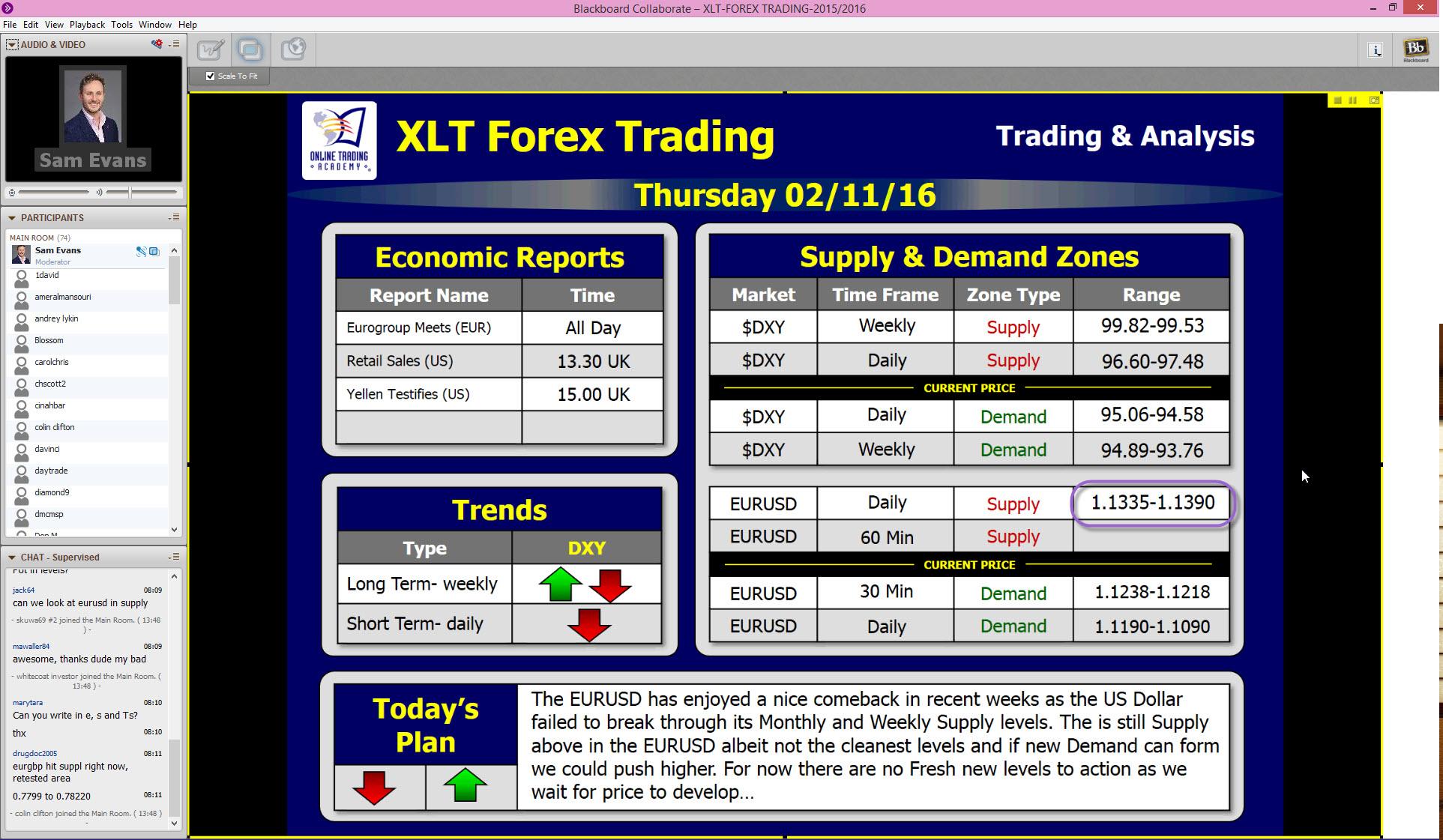
At the time, the EURUSD had been enjoying a decent rally for a while and many were feeling a continuation of this move was on the cards. The charts however, were telling a very different story. As you can see, we had a major Supply level between 1.1335 and 1.1390 where the banks had been selling Euros and they clearly had not gotten all of their orders filled at this level, leading me to believe this was a great opportunity to short the EURUSD. Luckily for us the currency pair had already rallied nicely into the area of supply allowing us to place an order to short the pair a little higher at 1.1358 with stops just above 1.1390 with the first target below at demand, offering us at least a 3:1 to the first area of profit. See the shot below as we placed the trade:
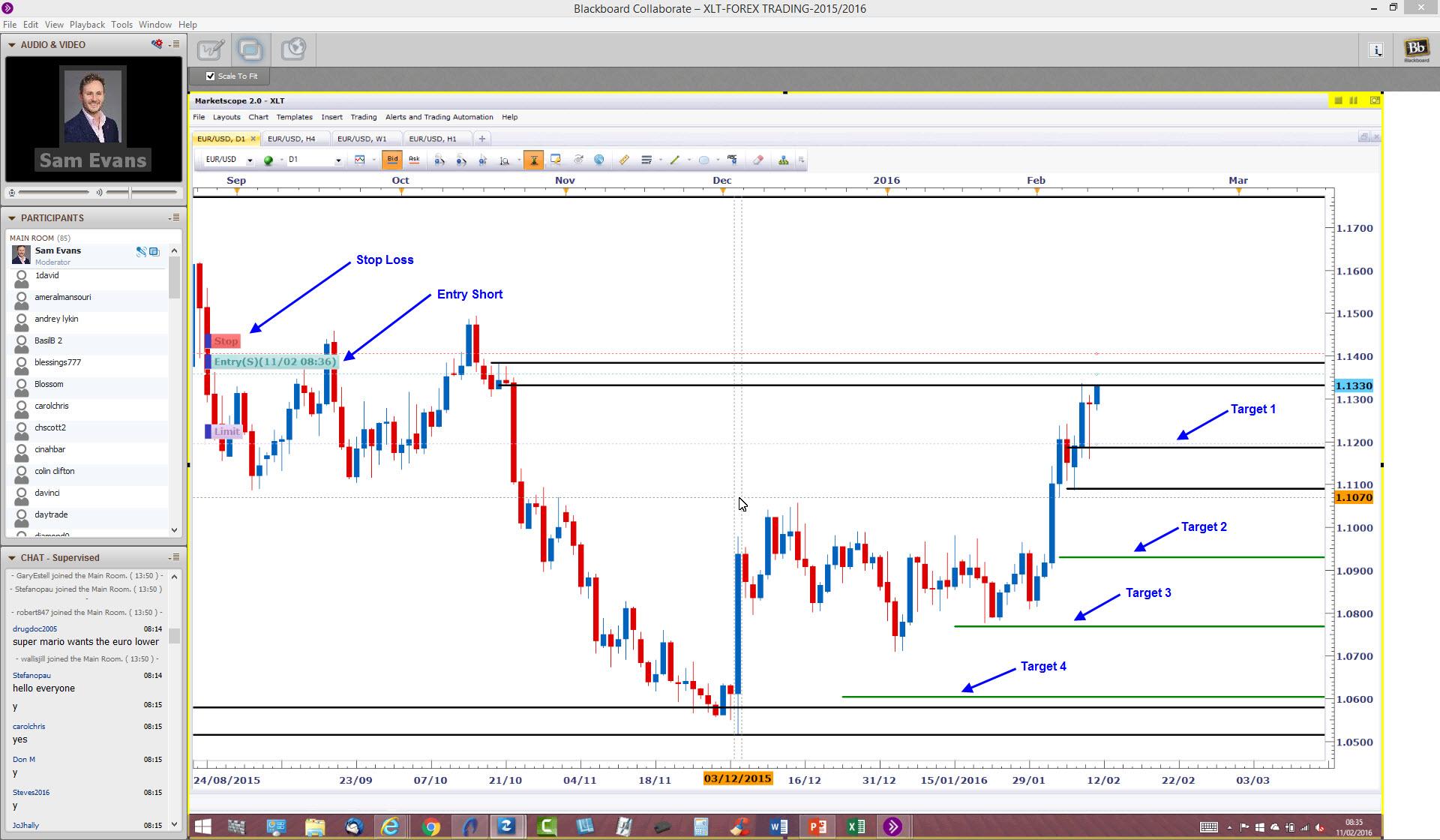
You will also notice above, the 3 extra green lines on the chart which I drew in for the students. These represent multiple profit taking areas should the pair continue to fall giving us a total of 4 targets in the trade. Now, the further out targets are way less likely to be hit, but the short position we took, according to our analysis, did have the potential to drop further if weakness crept into the EURUSD. I suggested on the XLT that we could take partial profits on target 1 if it got hit and then develop a more complex profit management strategy if the trade continued to develop. At the time of writing this article, the trade looked like this:
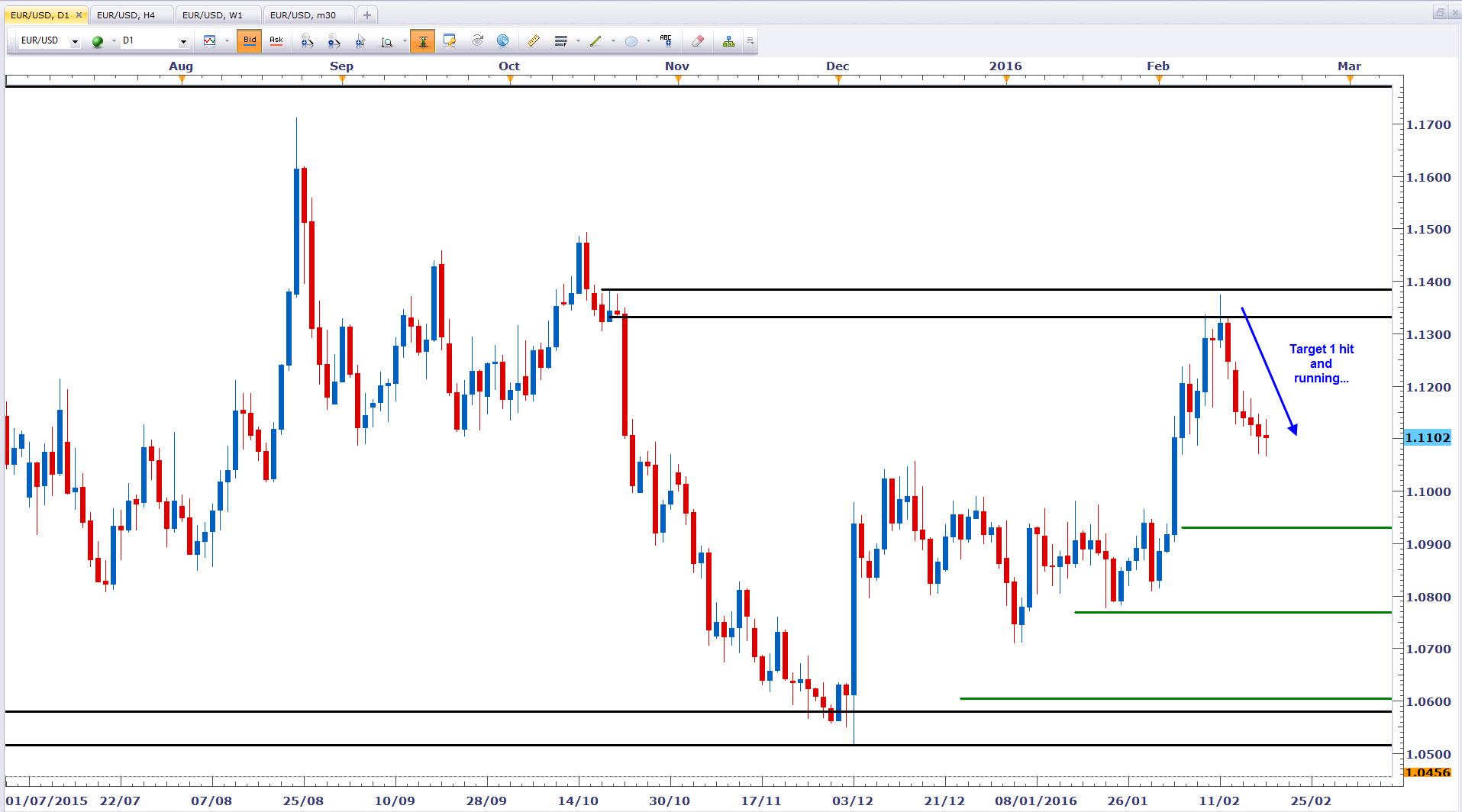
So with target 1 achieved, we now have options. We could take more profits lower down if it continues in our direction; we could close out the trade fully and take a profit now, or even add to the position if it goes more in our favor. There simply is no right answer except the one which works for you. Getting into the habit of placing multiple targets is a powerful tool to have in your trading kit but only if you have a plan that tells you what to do at each target ahead of time and before the trade is even triggered. In 2 weeks, part 2 of this article, we will take a more in-depth look into some of the ways to maximize a multiple target trade.
Until next time trade safe and be well.
The information provided is for informational purposes only. It does not constitute any form of advice or recommendation to buy or sell any securities or adopt any investment strategy mentioned. It is intended only to provide observations and views of the author(s) or hosts at the time of writing or presenting, both of which are subject to change at any time without prior notice. The information provided does not have regard to specific investment objectives, financial situation, or specific needs of any specific person who may read it. Investors should determine for themselves whether a particular service or product is suitable for their investment needs or should seek such professional advice for their particular situation. Please see our website for more information: https://bustamanteco.com/privacy-policy/
Editors’ Picks

EUR/USD remains depressed below mid-1.1800s; downside potential seems limited
The EUR/USD pair attracts some sellers for the second consecutive day on Tuesday and hovers below mid-1.1800s amid a relatively quiet trading action during the Asian session. The broader fundamental backdrop, however, warrants some caution for bearish traders before positioning for deeper losses.

GBP/USD trades with negative bias, eyes 1.3600 ahead of UK jobs data
The GBP/USD pair trades with a negative bias for the second straight day, though it lacks bearish conviction and holds above the 1.3600 mark through the Asian session on Tuesday. Traders now look forward to the release of the UK monthly jobs report, which will influence the British Pound and provide some impetus to the currency pair.

USD/JPY falls back toward 153.00 as Japanese Yen finds its feet
USD/JPY has turned south to test the 153.00 level after having faced resistance near the 153.75 zone in Asian trading on Tuesday. The divergent BoJ-Fed policy expectations offer some support to the Japanese Yen. That said, Japan's weak Q4 GDP print, released on Monday, tempered bets for an immediate BoJ rate hike. This, along with the underlying bullish sentiment, could limit the pair's downside.
Editors’ Picks

AUD/USD eases toward 0.7050 after RBA minutes
AUD/USD inches lower toward 0.7050 in Tuesday's Asian trading, reacting little to the RBA February Minutes, which reinforced a tightening bias. The hawkish outlook, however, fails to provide any impetus to the Australian Dollar as the timing of the next rate hike is unclear. In contrast, bets for more rate cuts by the Fed keep the US Dollar bulls on the defensive and act as a tailwind for the Aussie amid the underlying bullish sentiment.
USD/JPY falls back toward 153.00 as Japanese Yen finds its feet
USD/JPY has turned south to test the 153.00 level after having faced resistance near the 153.75 zone in Asian trading on Tuesday. The divergent BoJ-Fed policy expectations offer some support to the Japanese Yen. That said, Japan's weak Q4 GDP print, released on Monday, tempered bets for an immediate BoJ rate hike. This, along with the underlying bullish sentiment, could limit the pair's downside.

Gold declines as trading volumes remain subdued due to holidays in China
Gold price extends its losses for the second successive session, trading around $4,930 per troy ounce during the Asian hours on Tuesday. Gold price is trading nearly 0.7% lower at the time of writing as trading volumes stayed thin due to market holidays across China, Hong Kong, and other parts of Asia.

Top Crypto Gainers: Stable, MemeCore and Nexo rally test critical resistance levels
Stable, MemeCore, and Nexo are among the leading gainers in the crypto market over the last 24 hours, while Bitcoin remains below $70,000, suggesting renewed interest in altcoins among investors.

The week ahead: Key inflation readings and why the AI trade could be overdone
It is likely to be a quiet start to the week, with US markets closed on Monday for Presidents Day. European markets are higher across the board and gold is clinging to the $5,000 level after the tamer than expected CPI report in the US reduced haven flows to precious metals.
RECOMMENDED LESSONS
Making money in forex is easy if you know how the bankers trade!

I’m often mystified in my educational forex articles why so many traders struggle to make consistent money out of forex trading. The answer has more to do with what they don’t know than what they do know. After working in investment banks for 20 years many of which were as a Chief trader its second knowledge how to extract cash out of the market.
5 Forex News Events You Need To Know

In the fast moving world of currency markets where huge moves can seemingly come from nowhere, it is extremely important for new traders to learn about the various economic indicators and forex news events and releases that shape the markets. Indeed, quickly getting a handle on which data to look out for, what it means, and how to trade it can see new traders quickly become far more profitable and sets up the road to long term success.
Top 10 Chart Patterns Every Trader Should Know

Chart patterns are one of the most effective trading tools for a trader. They are pure price-action, and form on the basis of underlying buying and selling pressure. Chart patterns have a proven track-record, and traders use them to identify continuation or reversal signals, to open positions and identify price targets.
7 Ways to Avoid Forex Scams

The forex industry is recently seeing more and more scams. Here are 7 ways to avoid losing your money in such scams: Forex scams are becoming frequent. Michael Greenberg reports on luxurious expenses, including a submarine bought from the money taken from forex traders. Here’s another report of a forex fraud. So, how can we avoid falling in such forex scams?
What Are the 10 Fatal Mistakes Traders Make
Trading is exciting. Trading is hard. Trading is extremely hard. Some say that it takes more than 10,000 hours to master. Others believe that trading is the way to quick riches. They might be both wrong. What is important to know that no matter how experienced you are, mistakes will be part of the trading process.
The challenge: Timing the market and trader psychology

Successful trading often comes down to timing – entering and exiting trades at the right moments. Yet timing the market is notoriously difficult, largely because human psychology can derail even the best plans. Two powerful emotions in particular – fear and greed – tend to drive trading decisions off course.