Economic Calendar
Week ahead: Data blitz, Fed Minutes and RBNZ decision in the spotlight
US GDP and PCE inflation are main highlights, plus the Fed minutes. UK and Japan have busy calendars too with focus on CPI. Flash PMIs for February will also be doing the rounds. RBNZ meets, is unlikely to follow RBA’s hawkish path.
More infoReal time Economic Calendar
The real-time Economic Calendar covers financial events and indicators from all over the world. It's automatically updated when new data is released. The Real-time Economic Calendar only provides general information and it is not meant to be a trading guide. FXStreet commits to offer the most accurate contents but due to the large amount of data and the wide range of official sources, FXStreet cannot be held responsible for the eventual inaccuracies that might occur. The Real-time Economic Calendar may also be subject to change without any previous notice.
Calendar Guide
United States – Economic indicators
The US economic calendar is the most important one since the country is the world’s largest economy. The most important indicators mainly impact the price of the US Dollar (USD), but they also affect other markets and currencies.
The organizations that publish the most meaningful indicators – the ones that carry the greatest impact in the markets – are the US Bureau of Labor Statistics (BLS), the US Bureau of Economic Analysis (BEA), the US Census Bureau and the Energy Information Administration (EIA). Of special interest are the Federal Reserve (Fed) interest-rate decisions.
Canada – Economic indicators
Canada is one of the world's strongest economies, mainly due to its natural resources, technology, and industrial sectors. It is also a part of international trade agreements, such as the United States-Mexico-Canada Agreement (USMCA) or the Comprehensive and Progressive Agreement for Trans-Pacific Partnership (CPTPP).
Among the events with the greatest impact are announcements from the Bank of Canada (BoC), which is currently chaired by Tiff Macklem. Some of the most relevant indicators of Canada's Economic Calendar include:
United Kingdom – Economic indicators
The United Kingdom is the sixth-largest global economy, and its monetary policy is implemented by the Bank of England (BoE). whose Governor is Andrew Bailey. Its capital, London, is the second-largest financial center in the world, only behind New York.
The performance of the UK economy can impact many markets as well as currencies beyond the Pound Sterling (GBP). Some of the most relevant indicators of the United Kingdom Economic Calendar include:
Australia – Economic indicators
Australia's economy is one of the strongest in the world. The Land Down Under is rich in commodities and mainly sends its resources to China and other Asian countries.
The Reserve Bank of Australia (RBA) is responsible for implementing monetary policy, and its decisions are a key driver for the Australian Dollar (AUD). The current Governor of the RBA is Michele Bullock. Some of the most relevant indicators of the Australian Economic Calendar include:
What is the Economic Calendar?
FXStreet's real-time Economic Calendar covers economic events and indicators from all over the world with:
- 2 ,000+ events from more than 40 countries
- Data appears automatically once it is released
- Countdown
- Customizable local time
- Notifications
- Mobile-friendly
- Historical graphs
- Related news and reports
- Filters (by country, date, event category, volatility impact or keyword)
- Speeches from the main central bank speakers
- FXStreet’s own Speech Tracker
Why should I use it?
It's reliable. You can trust it
FXStreet Economic Calendar is the most complete, accurate and timely tool in the Forex market. There is a dedicated team of economists and journalists who update all the data 24 hours a day, five days a week.
Many brokers and market makers offer FXStreet’s calendar to their clients as a tool to trade. This is proof that it’s a trusted, respected, and widely used tool.
If you are a fundamental or a news trader, it's a must
To trade Forex through fundamental analysis, you have to check how economies over the world are doing based on their macroeconomics data (such as GDP, employment, consumption data, inflation…), watching closely the countries of the currencies you are trading the most.
Our economic calendar is your companion, a tab that is always opened on your computer.
If you do not care about macroeconomics when trading, it's still a useful tool
- Avoid bad surprises: you can check when high volatility data are expected to be released in order to better manage your trades.
How to read it?
Timing
All data are displayed in chronological order, divided by day. Released data are marked with a tick (✓) under the "time left" column. A light grey horizontal line shows you where we stand at the moment and below that line go all upcoming data. Time left before next release is indicated so you quickly grasp when this is coming. When a new data is released, the calendar page is automatically refreshed so you do not miss it. If you want, you can enable a sound notification for all releases.
Currencies
A flag icon indicates the country of the data release, and next to it, its currency. So you can quickly scan and see what currencies might be affected today or in some specific days.
Impact
Abbreviated as "Vol." in the economic calendar and represented with yellow/orange/red bars, volatility is an indicator of the expected impact of the data on currencies. If a bar is red and long, market watchers expect this data to have a high probability of moving the Forex market. If this bar is yellow and short, the probability is considered low. In orange, we are in the middle.
Actual, deviation, consensus and previous
For all economic calendar indicators, there is:
- Previous number: the data in its last release (frequency of data release is variable: it can be last month, last quarter, or simply a preliminary estimate).
- Actual number: When the data comes out, it is immediately displayed at the right of the volatility indicator.
- For most indicators, there is:
- Consensus number: What economists and market analysts expect before the release of the data.
- Deviation ratio: The indicator is based on an FXStreet exclusive calculation that measures the surprise caused by an event when the Actual data differs from the Consensus. Its number usually oscillates in an open scale between -7 and +7.
How to filter data?
You might want to focus on some type of data and ignore the rest: less noise means more efficiency. Click on the filter button at the top of the economic calendar. You can type a keyword or select countries, dates range, event categories or impact levels. Then hit the "Apply" button. If you always need to see the same data when you come to our calendar, you can save your settings for the next visit! We said efficiency, right?
How to get more info about the data?
Apart from the data itself, FXStreet provides additional information. To get a full picture, click on the row of the event to open a dropdown box with more related content:
- Editor's Notes (commentary and event previews from our editorial team, only included in the most important events)
- Description of the event (what it is, who releases it, what it means for currencies)
- Link to the official report (when the data has been released)
- Link to the Dashboard page (where you will be able to see and analyze the historical data of the event and several advanced calculations on how it has impacted several major currency pairs over the years)
- Related news surrounding the data release.
Trading economic event: experts advice
Big news events can – and often do – cause big swings with a single movement going several percent in one direction.
To know the events and releases better and learn different aspects that can influence or improve your trading, we collected some of the best educational articles, reports and videos about news trading.
Speech tracker
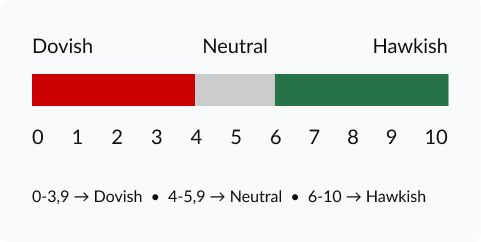
A score of 0.0-3.9 is dovish, 4.0-6.0 is neutral and 6.1-10 is hawkish.
- Dovish speeches are usually: USD bearish, Gold bullish, Stocks bullish.
- Neutral speeches generally have no impact on the USD or other assets.
- Hawkish speeches are usually: USD bullish, Gold bearish, Stocks bearish.
Financial markets are highly sensitive to expected changes in interest rates by the Federal Reserve (Fed). When decision-makers at the Fed signal the path of interest is lower, their speech is dovish. Indications of higher interest rates are hawkish.
Why is there no Sentiment/Score in this speech?
Sometimes, central bankers are scheduled to make public appearances but they do not talk about monetary policy, failing to make any impact on markets. When this happens, the result of the speech in our Economic Calendar will be N/A.
Who are the Fed speakers?
Markets are always adjusting to the Federal Open Market Committee (FOMC) future interest rate projections. There are 17 FOMC board members, but only 12 of them actually vote on the FOMC meetings, held eight times a year.
How does it work?
We have developed a custom AI model that analyzes all the relevant speeches by the FOMC members and rates them on a dove-hawk scale. This allows us to provide traders with real-time notifications on how each word of Fedspeak impacts the US Dollar.