Sterling: Has the Breaking Point been Reached?

Something has changed with sterling. It is not just last week's flash crash that seems now to be more of a mark down than fat-finger, liquidity or micro-market structure explanation that has been written about in the press. Surely claims that sterling's dramatic slide was due to comments by the otherwise inept French President, which did not go beyond the stern message sent by Germany's beleaguered Chancellor a few days earlier seem stretch.
At first, sterling's depreciation was understood as beneficial for the UK following the decision to leave the EU. The decline of sterling alongside the easing of monetary policy and the decline in long-term interest rates was a wholesome development. With a lag, it could serve as a cushion for the economy. Nearly every survey and press report have consistently warned that the UK's membership in the EU, and access to the single market, was an important factor on location, investment and employment decision by businesses.
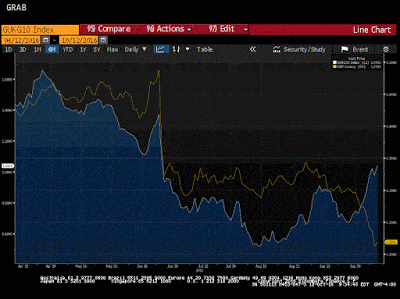
However, more recently, sterling's continued decline has not coincided with lower gilt yields. The benchmark 10-year Gilt yield has risen 22 bp over the past week. It is true that interest rates broadly have risen, but nothing like the UK has experienced. The US 10-year Treasury yield has risen eight basis point in the same period. The 10-year Germany Bund yield has risen seven basis points. After the UK, Canada has seen the second biggest increase in its 10-year yield, and it has risen 12 bp.
This is what this Great Graphic, composed on Bloomberg shows. Sterling, the yellow line, loosely but broadly tracked the 10-year Gilt yield (white line). Unfortunately, for the purpose of this illustration, the two-time series can only be meaningful displayed with two scales. The point is simply to confirm what we know, and that is that recently UK rates have risen while sterling has fallen. We think this is meaningful.
One important takeaway is that dramatic changes in foreign exchange prices can overwhelm total return calculations for international investors. John Authers at the Financial Times finds that when stripped out the currency component, UK Gilts have generated practically no return to investors this year, while US long-term Treasuries have returned 11%.
In the equity market, the FTSE 100, which is now recognized as a currency play given the heavy reliance of those companies on foreign earnings, has returned 13% for sterling-based investors but has lost unhedged dollar-based investors 6.4% this year. The return on the more domestic oriented FTSE 250 is worse. It has returned 3% to domestic investors and has taken 14.4% from dollar-based investors.
Many observers have focused on the salutary consequences of a decline in sterling. My unscientifically acquired impression is that this argument was especially appealing to the old currency war crowd that saw devaluations in Europe or elsewhere as a panacea or thought policymakers did. The UK needed to ease policy. A weaker sterling does this even if bluntly. Sterling's trade-weighted index, has fallen to new record lows. Since August 2015, the Bank of England's broad trade-weighted index has fallen by more than a fifth. More than 2/3 of that decline has been recorded since the referendum.
Sterling's decline will boost exports. That is what these observers have emphasized. It is true. UK farmers, for example, have seen strong demand from the Continent for grains. However, sustaining strength in exports through currency weakness is a different story. It did not work well for Japan, and there are now a number of studies that suggest the currency impact on trade flows may have diminished.
Another way that sterling's decline will reduce the UK's external deficit is through a lower demand for imports. Some of this may reflect import substitution. With a new 20%-plus cost advantage, in some sectors, domestic producers may pick up some market share. However, the imports may weaken also because of demand compression.
The dramatic drop in sterling will boost UK inflation. This will undermine real income and wages and weaken domestic demand. The UK reports CPI next week. Headline CPI bottomed last year after flirting with shallow negative readings (deflation). It finished last year at 0.2% and was at 0.5% at the end of Q1 16 and Q2 16. In July and August, it was at 0.6%. It may have risen to 0.8% in September.
It is true that the rise in energy prices are also at work here. UK core rate bottomed last July at 0.8% and had nearly doubled to 1.5% in March. It was at 1.3% in both July and August. Sterling fell 1.25% in September, the fifth consecutive monthly decline. Sterling has only risen in two months this year (March and April). It rose four months last year and three months in 2014.
There are different measures of inflation expectations. A common market-based measure is the 10-year breakevens. This is the difference between the yield of traditional and inflation-linked securities.
This second Great Graphic from Bloomberg shows the 10-year UK breakeven (white line) and sterling (yellow line). On this chart, we were able to normalize the two-time series and show both on the same scale.
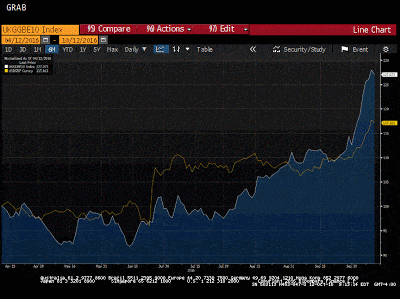
In hard numbers, the 10-year breakeven has risen from 2.30% immediately after the referendum to almost 2.70% at the end of September. It reached 3.05% yesterday. To be sure, the 10-year breakeven may be skewed by liquidity considerations, but it is a rough and ready measure that shows that sterling's decline boosting inflation expectations. If these expectations are indeed realized, many of the benefits through to accrue due to sterling weakness will be offset by higher prices.
This also has implications of fair-value for the pound. The OECD's model of purchasing power parity has sterling 19% undervalued today. Most of the time, OECD currencies do not move much beyond 20% +/- PPP. However, as we have seen with the yen, for example, sometime PPP moves toward foreign exchange prices not foreign exchange prices moving toward PPP. If the higher inflation expectations are born out, then PPP measures will likely fall.
Lastly, many economists and journalist write from the perspective of the asset manager or speculator. However, there is another market segment, and their activity is also important. In sterling's case, think about the debt manager. UK rates are higher so why borrow pounds? And to be sure, corporate issuance of sterling paper has surged. In first three months after the referendum, foreign corporates issued roughly GBP16.4 bln paper. This is nearly four times more than the previous three months. Part of this may be creating more product, which may qualify for BOE purchases under its new version of QE. There may also be advantages for some debt managers to borrow in currency they expect to depreciate.
Author
Marc Chandler
Marc to Market
Experience Marc Chandler's first job out of school was with a newswire and he covered currency futures and Eurodollar and Tbill futures.