Trading Is a Bit Like Gambling
|
Hello traders! As I mentioned in my last newsletter, I was fortunate enough to observe Justin Krebs teach our three day Market Timing Class a few weeks ago. During that class (and in every class I personally teach) the discussion of “market manipulation” came up. Market manipulation can be defined in numerous ways, but for this discussion we’ll just assume that some institutions have a distinctly unfair advantage in the marketplace. This can be through the high frequency trading computers that may have their servers co-located a few feet from the exchange servers, trading with inside information, or even the ability to nudge the market enough to “run stop loss orders.”
With these (and a few others), some new students and traders look to the market as too risky or manipulated, just not “fair.” With this knowledge, some students will refuse to participate in the markets by sitting in cash or merely buying the SPY ETF and calling it a day. While buying the SPY at the right times and managing that position the way we teach in our class can certainly give you an advantage, I believe that knowing and accepting the manipulation is a perfectly acceptable alternative.
When the issue of fairness in the markets is brought up in class, I generally bring up the subject of gambling in Las Vegas or even playing poker with friends. The vast majority of games in Vegas offer the individual gambler no advantage whatsoever; the house nearly always has the odds in their favor. Yet every year hundreds of thousands of people go to Vegas and gamble, all knowing the odds are against them! Is this foolish? If they are going to Vegas to earn a living, for the majority it is. This is much like trading. If you treated trading like most gamblers treated their trips to Vegas, your career would be a short one! What about the blackjack players who know how to count cards? (This is where numerical values are assigned to certain cards, and when a certain “score” is reached, the player can have a small statistical advantage over the house.) Over time, the proficient card counter can actually earn a living playing blackjack. This gambler/trader has accepted the rules of the game, but has learned to be patient and time their bets to make money. This is much like a profitable trader! We patiently wait for the proper set-ups to occur, and when they do, we take the trade! If the cards don’t play out, the blackjack player takes his loss and moves to the next hand. The profitable trader does the same thing; our stop gets hit for a small loss, and we wait for the next trade. Long term trading is nothing like the story of the man who went to Vegas and put all of his money on one spin of the roulette wheel. He had a less than 50:50 chance of making his money back! Professional traders limit their risk to a small percent of their account on a particular trade, often 1-3% of their account, much like professional gamblers.
Another issue of the “fairness” of trading comes about regarding the losses that other traders take. Specifically, if we believe that a drop into a demand zone is where new traders will look to sell, we look to buy. If we expect to make money on the trade, very often the person on the other side of the trade will lose money. Some new students believe that this is taking advantage of someone else, even taking their money. And then they feel sad for the new trader. Baloney! Does the house in Vegas feel sad when hundreds of new gamblers walk in their front door every day?
Hardly. If I sat at a poker table with 5 of the top professional poker players on the planet with $50,000 in my hand, would they tell me to walk away, that they would end up probably taking all of my money? Hardly. They would look at me just like the house looks at new gamblers-merely a source of income, nothing else.
We aren’t forcing anyone to take trades in the wrong places. Our job as traders is to make money by taking trades in the right places. Just as a professional gambler knows when to place bets, we know where to place trades.
Back to the manipulation conversation. While there is certainly an amount of that going on, the great thing about what we teach is that the “footprints” of the big money institutional orders are mostly immune to the small wiggles of the manipulators. If large banks/multi-national corporations are moving the market for days, weeks, even months at a time, they are unconcerned about a small handful of pips moving in the opposite direction. By learning to spot these footprints, we can ride the waves that these institutions make in the market.
In the following AUDUSD daily chart, a gap up followed by a sharp move higher is probably an indication of where a large pile of institution orders is sitting. At the blue arrow, an easy long position could have been entered. Should we feel sorry for the novice who sold short down there, after a 250 pip pullback, into a demand zone? Hardly! In fact, you should feel like a philanthropist. If someone wants to sell there, you are merely helping them do what they want by providing a buy order for them to trade against. Philanthropy is a good thing, right?
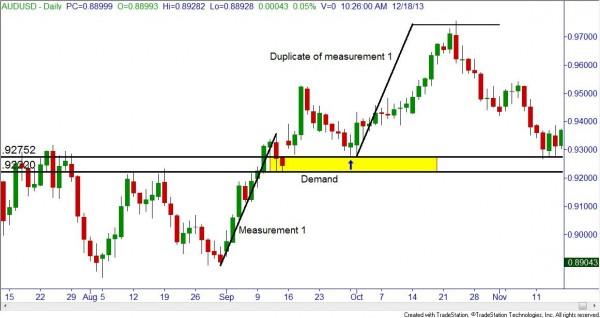
By the way, I did a nifty little measurement trick on this chart. I measured from the low to the high of one move in the market, and duplicated it to measure a possible target for another move. No, this is not a proper Elliott Wave pattern, but it is just an example of how the market loves symmetrical moves. Kind of neat how that works out sometimes. Want to see more of these? Come to class!
So what is the point? Yes, the market is stacked against you. Yes, you can refuse to participate and earn your .0001% at your bank by staying in cash. Or, you can trade like the house/institution and learn to make a few pips in this terrific market!
Information on these pages contains forward-looking statements that involve risks and uncertainties. Markets and instruments profiled on this page are for informational purposes only and should not in any way come across as a recommendation to buy or sell in these assets. You should do your own thorough research before making any investment decisions. FXStreet does not in any way guarantee that this information is free from mistakes, errors, or material misstatements. It also does not guarantee that this information is of a timely nature. Investing in Open Markets involves a great deal of risk, including the loss of all or a portion of your investment, as well as emotional distress. All risks, losses and costs associated with investing, including total loss of principal, are your responsibility. The views and opinions expressed in this article are those of the authors and do not necessarily reflect the official policy or position of FXStreet nor its advertisers.