The Power of Leverage
|In the financial markets, successful speculation boils down to a few factors that, although not easy to attain, are quite simple. Those factors are low risk, high probability, taken with a reasonable degree of leverage. The fact is, most people that first engage the markets, that is, those that don’t have any idea how the financial markets actually work, look at these critical factors of successful speculation in the entirely wrong sequence.
First, the lure of easy money leads them to buy “cheap” assets, such as penny stocks, or far out-of-the-money options which are highly leveraged because they require very little money to purchase and if the trades work, they will produce big payouts. The odds of these trades working out however are very remote, and hence, we can say that they have a low probability. They also —as I mentioned earlier, usually have a small sum of money which has the trader willing to risk all of it. This in turn makes this trade high risk. If you think about it, isn’t this scenario similar to the gambler that goes to Las Vegas knowing full well he’s likely going to lose, and usually does, but it’s almost always more than he initially planned for.
So to sum it up, this novice trader uses maximum leverage in the trades that have the lowest probability, and the highest risk. Mathematically speaking,this flies in the face of what a trader should be doing to be consistently profitable. The math works much better by taking the lowest risk, with the highest probability while using moderate leverage.
In the general public, using leverage in trading usually gets a bad rap. That’s because almost everyone has heard about, or personally experienced large losses at the hands of a leveraged asset such as options, futures, or forex. Many of the large brokerage firms go as far as requiring their clients to have several years of trading experience before they will allow them to use margin.
This is due to the risk associated with leverage; however, it’s more the risk to the firm they want to protect against rather than the risk of loss to their clients. This may not come as a big surprise, but on Wall Street, everyone looks out for their own interests even at the expense of others.
Leverage, when used judicially is a beautiful thing. Real estate is a great example of good leverage when used smartly. It’s rare to see a first time home buyer purchase a house without the assistance of financing. This use of leverage has helped many people buy homes that would otherwise have been excluded. More importantly, if purchased in the right market, the equity generated through the appreciation of the property enables the home owner to move up to a bigger home or another investment property. The media has deemed this “the American dream,” and it is made possible only by using leverage in a sensible manner.
The Futures market is very similar, in that a trader has the benefit of ten-to-one leverage on most all contracts that trade on the major exchanges. This means that just like in real estate, when we buy a futures contract we “control” a sizable amount of the underlying cash asset (this could be an Index, currency or physical commodity) for a small deposit referred to as a performance bond. This bond acts as collateral for controlling the asset.
The key when using leverage is to find the lowest risk opportunities so that if we are wrong we lose very little. The chart below illustrates one of these low risk opportunities that presented itself in the Russell 2000 E-mini contract recently. The setup was simply to buy at demand with a limit order at the top of the demand zone, and placing a stop a few ticks below the lower line of that same zone. We also used the opposing supply zone for a target.
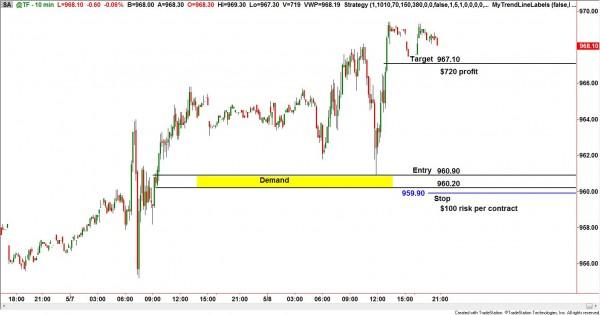
In this trade example, $1320 is the intraday margin that controls approximately $96,000 worth of the Russell 2000 index. For traders wishing to hold overnight the margin is a bit higher ( about $5000) . The key for using this type of leverage is that the risk on this trade was only one hundred Dollars per contract. In addition, the profit margin was at least five-to- one.
As we can see from this example, low-risk, plus high probability, coupled with using prudent leverage, adds up to a winning combination. However if you do these three factors in the wrong sequence, that is using leverage with high risk, and low probability, well… that usually spells disaster, and nobody wants that.
Until next time, I hope everyone has a great week.
Information on these pages contains forward-looking statements that involve risks and uncertainties. Markets and instruments profiled on this page are for informational purposes only and should not in any way come across as a recommendation to buy or sell in these assets. You should do your own thorough research before making any investment decisions. FXStreet does not in any way guarantee that this information is free from mistakes, errors, or material misstatements. It also does not guarantee that this information is of a timely nature. Investing in Open Markets involves a great deal of risk, including the loss of all or a portion of your investment, as well as emotional distress. All risks, losses and costs associated with investing, including total loss of principal, are your responsibility. The views and opinions expressed in this article are those of the authors and do not necessarily reflect the official policy or position of FXStreet nor its advertisers.