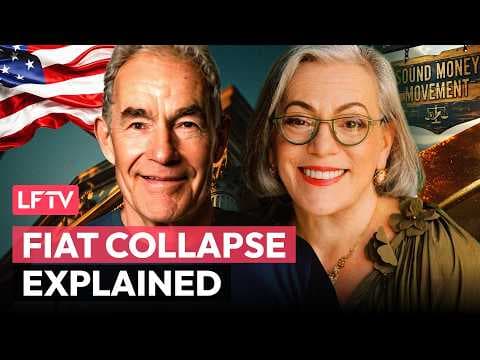
Preparing for the shift: Gold, Silver and Sound Money in a digital era [Video]
![Preparing for the shift: Gold, Silver and Sound Money in a digital era [Video]](https://editorial.fxsstatic.com/images/i/gold-march-05_XtraLarge.jpg)

The world is undergoing a profound monetary transformation. In conversation with Andrew Maguire, Lynette Zhang of ITM Trading emphasised that the collapse of the debt-based fiat system is accelerating, and with it comes the urgent need to embrace sound money principles. Physical gold and silver remain unmatched in preserving purchasing power, offering protection against both inflation and the systemic erosion of wealth. These metals are not only stores of value but instruments of personal freedom and monetary sovereignty.
Lynette contrasts the enduring value of pre-1965 silver quarters with modern, debased coinage to illustrate how currency debasement conceals the degradation of wealth. Unlike digital assets, whose applications are limited and production energy-intensive, gold and silver are essential across every sector of the global economy. Their intrinsic properties cannot be synthetically replicated, ensuring universal demand and irreplaceable utility. Holding physical metals thus protects against the illusion of wealth created by inflated equity valuations or hyperinflationary currencies, safeguarding real purchasing power when fiat fails.
Self-sufficiency and community resilience
A cornerstone of Lynette’s philosophy is self-sufficiency. Her “mantra” encompasses food, water, energy, security, barterability, wealth preservation, community, and shelter - foundations for thriving through systemic change. Since 2008, she has championed urban farming and local food networks, recognising that reliance on centralised systems undermines resilience. By fostering skill-sharing, community gardens, and local marketplaces, individuals build networks capable of withstanding economic turbulence. These actions reconnect human interdependence with wealth creation, establishing stability beyond the reach of centralised monetary control.
The risks of digital money
The conversation highlights the digital shift in money. Lynette traces the erosion of sound money back to 1914, when Federal Reserve notes replaced corporate debt, gradually distancing citizens from tangible gold. Today, stablecoins and centralised digital currencies risk repeating this deception, concentrating power and surveillance over ordinary people. Corporations issuing treasury-backed digital currencies could accelerate inflation while using AI-driven data to enforce behavioural control. The only protection lies in physical assets and decentralised systems that cannot be seized digitally, as evidenced by frozen accounts during recent protests in Canada.
Globally, the rise of gold-backed currencies such as China’s yuan stablecoin presents a direct challenge to the dollar system. With over 110,000 tonnes of gold held by China, Russia, India, and Saudi Arabia, physical metals now underpin true sovereignty. Hyperinflation remains a likely reset mechanism, yet gold and silver provide a reliable hedge, allowing holders to preserve purchasing power and seize opportunity as fiat collapses. Spot prices, manipulated through paper contracts, obscure this reality, emphasising the necessity of holding tangible metals over speculative instruments.
Digital control and the loss of privacy
The transition to digital money carries profound risks beyond inflation. Lynette Zhang warns that stablecoins and centralised digital currencies enable unprecedented surveillance, tracking personal behaviour and spending. As financial systems become fully digitised, governments and corporations can enforce control instantly, restricting access, freezing accounts, or manipulating purchasing power without transparency. This erosion of privacy undermines individual autonomy, creating dependence on centralised authorities. Physical gold and silver, alongside resilient local communities, offer a safeguard - tangible assets that cannot be monitored, manipulated, or taken, preserving both freedom and financial sovereignty in an increasingly intrusive digital landscape.
Preserving wealth for the long term
Lynette stresses that gold and silver are not for trading but for long-term preservation of wealth. Her layered strategy, honed since 1987, starts with physical metals - including coins with historical protections - supplemented by liquid assets, income-producing property, and legacy planning. This disciplined approach contrasts sharply with the modern economy, which trades labour for debt, siphoning real value through inflation and taxation. True security comes from tangible assets and resilient communities, not digital or centralised instruments that monitor, restrict, and control behaviour.
Beyond individual preparation, Lynette advocates global grassroots action. Distributing silver “dime cards” in Asia and engaging in local education demonstrates that even partial conversion of fiat into tangible metals can catalyse a broader movement toward sound money. She frames this not merely as wealth preservation but as a moral duty: to protect future generations and promote fairness, sovereignty, and stability. As communities reconnect through cooperation, knowledge-sharing, and mutual support, they form the human foundation necessary to withstand systemic upheaval.
A path to monetary sovereignty
Ultimately, the episode reveals a stark truth: the transition from fiat to digital control is underway, threatening both autonomy and prosperity. Physical gold and silver, coupled with self-sufficient, interconnected communities, represent the antidote. By embracing tangible assets, decentralised networks, and prudent planning, individuals reclaim power from failing financial systems, safeguarding their wealth and ensuring resilience for themselves and future generations. This is not speculation - it is the restoration of fairness, security, and freedom in an increasingly unstable world.
Author
Samuel Briggs
Kinesis Money
Samuel holds a deep understanding of the precious metals markets, and as an in-house journalist for 1:1 gold and silver-backed monetary system, Kinesis, he is chiefly responsible for updating the community with insights and analys